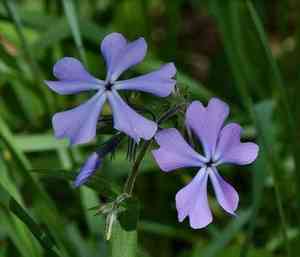
Wild blue phlox (Phlox divaricata)
Also known as: Wild sweet william
The wild blue phlox (Phlox divaricata), also known as woodland phlox or Louisiana phlox, is native to eastern North America. This plant features flowers on hairy, sticky stems and often thrives along stream banks in its natural habitat. The name "phlox" originates from the Greek word for "flame," chosen for the species due to its strikingly vivid flower colors.
In This Article
Attributes of Wild blue phlox
Lifespan
Perennial
Plant Type
Herb
Plant Height
15 cm to 30 cm
Spread
50 cm
Leaf Color
Green
Flower Size
2.5 cm to 8 cm
Flower Color
White Blue Purple Lavender
Images of Wild blue phlox
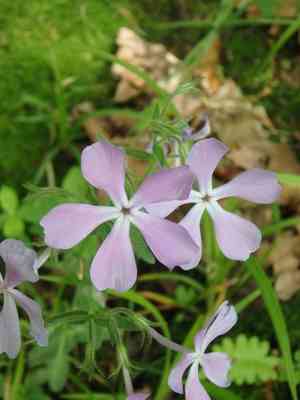
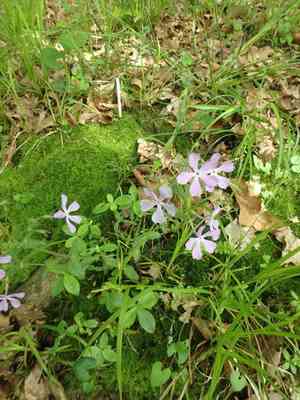
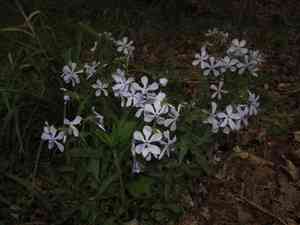
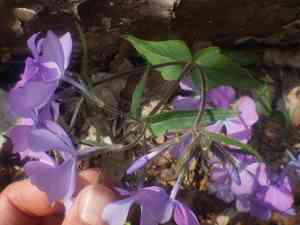
Quickly Identify Wild blue phlox
1
Lush green leaves, 2 inches (5 cm) long, with fine hairs and sticky texture.
2
Vibrant blue tubular flowers, 1.5 inches (3.8 cm) wide, with recessed stamens.
3
Ovoid fruit capsules, 0.2 inches (5 mm) long, containing small black seeds.
4
Slender stem, 0.1-0.2 inches (2.5-5 mm) thick, hairy and sticky with sparse branching.
5
Cluster-forming herbaceous perennial, 6-12 inches (15-30 cm) tall, growing on forest floors.
Scientific Classification of Wild blue phlox
Phylum
Vascular plants
Class
Dicotyledons
Order
Ericales
Family
Phlox
Genus
Phloxes
Species
Wild blue phlox
Planting and Growing of Wild blue phlox
Care Difficulty
Easy
Watering Schedule
Every 2 days
Sunlight Requirements
Partial sun
Sunshine Duration
6-10 hours
Ideal Temperature
65-75℉
Soil Type
Potting Mix, Peat Mix
Soil pH
6.5-7.5
Fertilizer Type
Balanced
Pruning Season
Spring, Summer
Pruning Area
Branches, Leaves
Pruning Frequency
2 times a year
Repotting Season
Spring
Pot Type
Plastic, Ceramic
 How to Water Wild blue phlox?
For Phlox divaricata, the key is to maintain consistently moist soil without waterlogging. Approximately 500 ml per watering is ideal, ensuring the soil feels damp to the touch without being overly saturated. Water until the top few inches are uniformly moist, indicating sufficient hydration without drenching the roots.
More About Watering Techniques→
What are the symptoms of an underwatered Wild blue phlox?
›
What should I do if my Wild blue phlox is not getting enough water?
›
What are the symptoms of an overwatered Wild blue phlox?
›
How to save an overwatered Wild blue phlox?
›
 What Are the Sunlight Requirements for Wild blue phlox?
Phlox divaricata thrives best in partial sun or full shade conditions. Ideal light encourages vibrant blossoms and robust foliage, creating a healthy and visually appealing plant.
More About Sunlight Requirements Techniques→
How much sunlight is ideal?
›
Solutions for obtaining ideal sunlight?
›
Benefits of achieving ideal sunlight?
›
 What Is the Ideal Temperature Range for Wild blue phlox?
The ideal temperature range for Phlox divaricata is between 65°F and 75°F. This range helps ensure optimal growth and blooming. Temperatures within this range allow the plant to maintain healthy metabolic processes and develop strong, vibrant flowers.
 What Soil is Best for Wild blue phlox?
Phlox divaricata thrives in well-drained soil, which prevents waterlogging and root rot. This ensures that the plant's roots receive adequate oxygen, promoting healthy growth and flower production. The soil should retain enough moisture to keep the plant hydrated without becoming waterlogged. This balance supports sustained flowering and prevents the wilting of the plant during dry spells. A soil rich in organic matter provides essential nutrients, enhancing the health of Phlox divaricata. Organic matter improves soil structure, promotes beneficial microorganisms, and increases nutrient availability.
More About Soil→
 How to Fertilize Wild blue phlox?
For Phlox divaricata, use a balanced, water-soluble fertilizer diluted to half strength. Avoid over-fertilizing, as this can lead to leggy growth and reduced flowering. A teaspoon in a gallon of water will suffice for liquid applications.
More About Fertilizing Techniques→
 How to Prune Wild blue phlox?
Monitor the growth pattern of Phlox divaricata; if it becomes too leggy, a mid-season trim in early summer can help maintain a compact shape. Be cautious not to prune more than one-third of the plant at any one time, as overpruning can stress the plant and negatively affect its growth. Remove all cuttings and debris from the base of the plant to prevent pest infestations and ensure good air circulation around the plant.
More About Pruning Techniques→
 How to Propagate Wild blue phlox plant?
1
Collect seeds from matured phlox flowers in late summer. Let them dry and store them in a cool, dry place until you are ready to plant in early spring.
2
Select healthy stems and cut 4 to 6-inch sections. Remove the lower leaves and place the cut ends in a rooting hormone before planting in well-draining soil or a container.
3
In early spring or late autumn, carefully dig up the plant. Separate clumps using a clean knife or spade and replant the divisions into appropriate garden spaces or pots.
 How to Repot Wild blue phlox plant?
1
Phlox divaricata shows it needs repotting when its roots start circling the container and it appears cramped and unhappy. If growth seems stunted and despite proper care it's not thriving, these are key indicators that repotting is necessary to refresh the soil and give roots more room.
2
Select a pot that is about two inches larger in diameter than the current one. The extra space allows roots to expand without stress. A pot with drainage holes at the bottom is essential to prevent waterlogged conditions, which can lead to root rot. A clay or terracotta pot is a good choice, as it is breathable and prevents overwatering.
3
Phlox divaricata thrives best in well-draining, rich soil. A good potting mix with organic matter enhances nutrient availability and drainage, preventing sogginess. It should support healthy root growth by allowing air circulation. Adding some perlite or sand structures the soil better, balancing water retention and drainage.
Learn More About Wild blue phlox Diseases
Anthracnose
Bacterial Leaf Spot
Bacterial Soft Rot
Bacterial Wilt
Black Spot
Chemical Injury
Crown Gall
Damping-off
Downy Mildew
Drought Stress
Fusarium Wilt
Gray Mold
Leaf Spot
Mosaic
Nutrient Deficiency
Nutrient Toxicity
Powdery Mildew
Root Rot
Root-knot Nematode
Rusts
Sooty Mold
Spider Mites
Temperature Stress
Thrips Damage
White Mold



