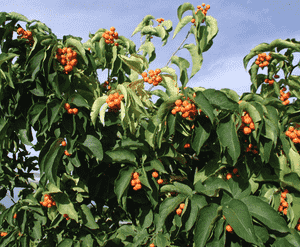
American bittersweet(Celastrus scandens)

American bittersweet (Celastrus scandens)

Also known as: False bittersweet, Bittersweet

Celastrus scandens, also known as American bittersweet, is a deciduous twining vine that thrives in rich woodlands, woodland edges, and disturbed areas. It often climbs trees or sprawls over bushes. In the fall, it produces distinctive red berries encased in orange capsules. Though it has ornamental appeal, the plant's berries and vines are considered toxic to humans.

Attributes of American bittersweet

Lifespan
Perennial
Plant Type
Vine
Plant Height
9 m
Spread
90 cm to 1.8 m
Leaf Color
Green Yellow
Flower Size
2.5 cm
Flower Color
Green Yellow White

ForwardPlant - Identify plants with a snap

Identify and diagnose plants, get toxicity alerts, and explore safety guides for all types of fungi.

Try for Free

Images of American bittersweet

American bittersweet(Celastrus scandens)

Quickly Identify American bittersweet

1
Vigorous twining vine with oval leaves up to 5 inches (12.7 cm) long.
2
Showy fruit: spherical berries with yellow husks revealing bright red seeds.
3
Distinctive orange fruit capsule, 1/2 inch (1.27 cm) diameter, containing red seeds.
4
Alternate, oblong elliptic leaves with serrated margins, 2-4 inches (5-10 cm) long.
5
Green stem transitions to brown or gray, twining habit, up to 0.4 inches (1 cm) in diameter.

Scientific Classification of American bittersweet

Phylum
Vascular plants
Class
Dicotyledons
Order
Celastrales
Family
Bittersweet
Genus
Staff vines
Species
American bittersweet

Planting and Growing of American bittersweet

Care Difficulty
Easy
Watering Schedule
Every 2 days
Sunlight Requirements
Full sun
Sunshine Duration
8-12 hours
Ideal Temperature
60-75℉
Soil Type
Potting Mix, Peat Mix
Soil pH
6.5-7.5
Fertilizer Type
Balanced
Pruning Season
Spring, Summer
Pruning Area
Branches, Leaves
Pruning Frequency
2 times a year
Repotting Season
Spring
Pot Type
Plastic, Ceramic

water icon How to Water American bittersweet?

Celastrus scandens, also known as bittersweet, thrives best when its soil is consistently moist but not waterlogged. Ideally, you should water the plant with approximately 500 milliliters, soaking the soil thoroughly until you notice water starting to drain from the bottom. This ensures that the roots have enough moisture to draw from, encouraging healthy growth.
What are the symptoms of an underwatered American bittersweet?
What should I do if my American bittersweet is not getting enough water?
What are the symptoms of an overwatered American bittersweet?
How to save an overwatered American bittersweet?

sunlight icon What Are the Sunlight Requirements for American bittersweet?

Sunlight Requirements: Full sun, Partial sun
Duration of light: 5-8 hours daily
Enjoying full sun to partial sun ensures optimal growth for Celastrus scandens. Proper light exposure enhances photosynthetic efficiency, yielding healthier foliage and increased fruit production, essential for the plant's overall vitality.
What is the ideal sunlight exposure?
How to ensure sufficient sunlight for Celastrus scandens?
What are the benefits of proper sunlight for this plant?
More About Sunlight Requirements Techniques

temperature icon What Is the Ideal Temperature Range for American bittersweet?

Ideal Temperature: 60 ~ 75℉
The ideal temperature range for Celastrus scandens is between 60°F and 75°F. This range provides optimal conditions for growth and development, ensuring that the plant does not experience stress from either cold or heat, which can affect its physiological processes.

soil icon What Soil is Best for American bittersweet?

Soil type: Sandy loam, Loam
Soil PH: 6.5 ~ 7.5
For Celastrus scandens, well-drained soil is crucial because it prevents waterlogging, which can lead to root rot. This kind of soil ensures air circulation around the roots, promoting healthy growth and enhancing the vine's ability to climb efficiently. While this plant isn't too fussy about soil richness, a moderately fertile soil enhances its growth and fruiting capabilities. It ensures the plant gets sufficient nutrients without the risk of nutrient burn, supporting robust vine structures and abundant berries. Maintaining consistently moist soil benefits Celastrus scandens. It needs moisture for nutrient uptake and to support its extensive growth. However, the soil should never be soggy, as this could cause damage to the roots.

fertilize icon How to Fertilize American bittersweet?

Fertilizer type: Balanced
For Celastrus scandens, it's important to apply just enough fertilizer to boost growth without overwhelming the plant. Liquid fertilizers should be applied at a rate of approximately half the recommended dose on the package, mixed with water, to avoid root burn and nutrient shock.

prune icon How to Prune American bittersweet?

Pruning Time: Spring, Summer
Start by removing any dead, damaged, or diseased wood. Cut back overgrown shoots to maintain your desired shape and size, encouraging a denser branching structure. To promote flowering, focus on cutting back the stems that flowered in the previous season. This unlocks the plant's energy, allowing it to produce fresh blooms. Use sharp, clean pruning shears to avoid damaging stems. Bypass pruners are ideal for making clean cuts, reducing the risk of infection in the plant tissue. More About Pruning Techniques

propagate icon How to Propagate American bittersweet plant?

Propagate Time: Spring, Early spring, Summer
1
Celastrus scandens seeds require cold stratification. Place the seeds in moist sand in the refrigerator for 3 months to break dormancy before sowing.
2
For cuttings, select healthy vine segments 4-6 inches long. Remove leaves from the bottom half and dip in rooting hormone before planting in well-draining soil.
3
In early spring, dig up existing plants and gently separate the root ball. Each division should contain several shoots and part of the root system, ready to be replanted.
More About Propagating Techniques

repot icon How to Repot American bittersweet plant?

Repotting frequency: Every 2-3 years
1
Repot Celastrus scandens when you notice roots emerging from the drainage holes, the plant becoming root-bound or experiencing slow growth. These signs suggest that it's time to give the plant more room to thrive and replenish soil nutrients.
2
Select a pot slightly larger than the current one with good drainage holes. A larger pot allows the roots to expand and provides space for new soil, promoting healthy growth and reducing the risk of waterlogging.
3
Choose a well-draining potting mix to prevent root rot and ensure adequate airflow to the roots. A mix containing ingredients like sand, perlite, or bark is ideal for balancing moisture retention with drainage, fostering robust plant growth.

ForwardPlant - Identify plants with a snap

Find the best spots for them to optimize their health, simply using your phone.

Try for Free

Toxicity of American bittersweet

Is American bittersweet toxic to humans?

The American bittersweet is recognized as a toxic plant that can lead to mild to moderate illness if ingested. The fruit of this plant, especially the seeds, is identified as the most hazardous, although every other part may also possess toxic properties. The harmful components of the plant are known to contain cardenolides and toxic alkaloids—dangerous chemical substances that can result in mild to severe gastrointestinal distress in humans after consumption. Common symptoms of toxicity may include vomiting, diarrhea, nausea, abdominal cramping, excessive sweating, fainting, and seizures.

Is American bittersweet toxic to cat?

The American bittersweet presents a mild to moderate level of toxicity for cats. Common signs of poisoning include vomiting and diarrhea after consuming even a small quantity. Should a cat ingest a significant amount, the toxins found in its fruits, leaves, and possibly all portions of the plant may lead to muscle weakness and seizures.

Is American bittersweet toxic to dog?

American bittersweet poses a moderate level of toxicity to dogs. While severe reactions to this plant may necessitate prompt medical intervention, it is typically the case that very little of the plant is consumed, leading to only mild reactions. Every part of the plant contains toxins, with the berries having the most significant concentration. Signs of poisoning from american bittersweet can include vomiting and diarrhea. In more severe instances, symptoms may escalate to include pronounced fatigue, tremors, or even seizures.

Identify toxic plants for your safety

Learn which plants are harmful to you and your pets, and make informed choices for a safer home!

Try for Free
WARNING
The judgment on toxicity and danger is for reference only. We DO NOT GUARANTEE any accuracy of such judgment. Therefore, you SHALL NOT rely on such judgment. It is IMPORTANT TO SEEK PROFESSIONAL ADVICE in advance when necessary.
More About Toxic Techniques

