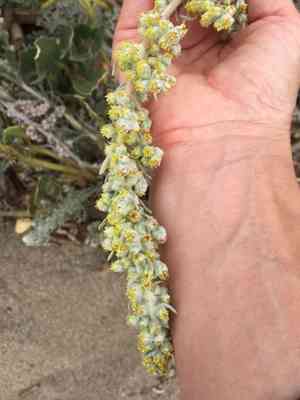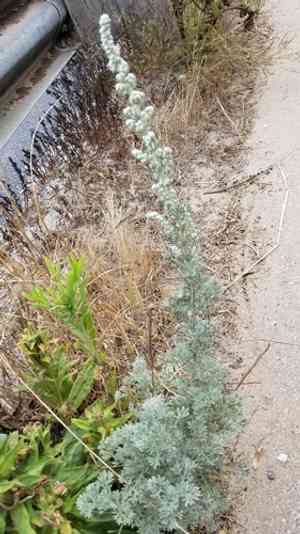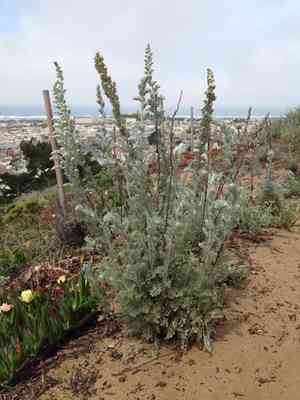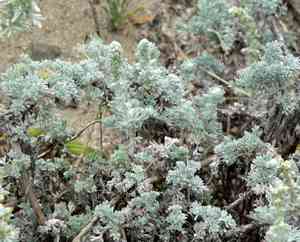
Beach wormwood(Artemisia pycnocephala)

Beach wormwood (Artemisia pycnocephala)

Also known as: Coastal Sagebrush, Coastal sagewort

Beach wormwood (Artemisia pycnocephala) is a hardy evergreen perennial known for its aromatic properties that attract various pollinators such as butterflies and bees. Key features include:

- **Height:** Generally grows between 1-3 feet.
- **Foliage:** Silvery-gray, dense, and feathery leaves.
- **Flowers:** Small, round yellow blossoms appearing in fuzzy clusters, blooming primarily in spring and summer.
- **Wildlife:** Provides nesting material for birds.

**Optimal Growing Conditions:**

- **Sunlight:** Prefers full sun exposure.
- **Soil:** Thrives in well-drained, sandy soils.
- **Water:** Drought-tolerant, needing minimal watering once established.
- **Climate:** Well-suited for coastal environments, resistant to salt spray and wind.
- **Maintenance:** Low-maintenance; occasional pruning helps maintain shape and remove dead parts.

Beach wormwood is an excellent choice for coastal gardens and erosion control due to its resilience and minimal water requirements.

Attributes of Beach wormwood

Lifespan
Perennial
Plant Type
Shrub
Plant Height
50 cm
Spread
1 m
Leaf Color
Silvery-gray
Flower Size
0.2-0.3 centimeters
Flower Color
Yellow

ForwardPlant - Identify plants with a snap

Identify and diagnose plants, get toxicity alerts, and explore safety guides for all types of fungi.

Try for Free

Images of Beach wormwood

Beach wormwood(Artemisia pycnocephala)

Quickly Identify Beach wormwood

1
Identifiable by its silvery-gray foliage and dense clusters of small flower heads. The leaves are deeply divided and covered with fine, silky hairs.

Scientific Classification of Beach wormwood

Phylum
Vascular plants
Class
Dicotyledons
Order
Asterales
Family
Daisy
Genus
Mugworts
Species
Beach wormwood

Planting and Growing of Beach wormwood

Care Difficulty
Easy
Watering Schedule
Every 2 days
Sunlight Requirements
Full sun
Sunshine Duration
6-10 hours
Ideal Temperature
60-75℉
Soil Type
Potting Mix, Peat Mix
Soil pH
6.5-7.5
Fertilizer Type
Balanced
Pruning Season
Spring, Summer
Pruning Area
Branches, Leaves
Pruning Frequency
2 times a year
Repotting Season
Spring
Pot Type
Plastic, Ceramic

water icon How to Water Beach wormwood?

Artemisia pycnocephala, commonly known as sandhill sage, thrives in well-drained soil. It is best to water this plant deeply but infrequently, ensuring the water reaches about 200 ml per session. The goal is to mimic its natural habitat where water is scarce and absorbed slowly. The soil should ideally dry out completely between watering sessions.
What are the symptoms of an underwatered Beach wormwood?
What should I do if my Beach wormwood is not getting enough water?
What are the symptoms of an overwatered Beach wormwood?
How to save an overwatered Beach wormwood?

sunlight icon What Are the Sunlight Requirements for Beach wormwood?

Sunlight Requirements: Full sun, Partial sun
Duration of light: 6 to 8 hours
Known for thriving in full sun and partial sun settings, the ideal lighting promotes robust plant development, enhances aromatic oil production, and deters harmful pests through improved vitality and health.
What is the ideal light condition for Artemisia pycnocephala?
How can one achieve the ideal lighting conditions for Artemisia pycnocephala?
What benefits does Artemisia pycnocephala gain from ideal lighting conditions?
More About Sunlight Requirements Techniques

temperature icon What Is the Ideal Temperature Range for Beach wormwood?

Ideal Temperature: 60 ~ 75℉
The ideal temperature range for Artemisia pycnocephala is between 60°F and 75°F. This range ensures optimal growth conditions, allowing the plant to maintain its health and vigor. Within this temperature range, the plant's physiological processes, such as photosynthesis and respiration, occur efficiently, promoting robust growth and development.

soil icon What Soil is Best for Beach wormwood?

Soil type: Sandy soil, Sandy loam
Soil PH: 6.5 ~ 7.5
Artemisia pycnocephala thrives in nutrient-poor conditions. This means that the plant does not require rich, fertile soil to grow well, which is beneficial because it reduces the need for frequent fertilization. Well-draining soil is crucial for Artemisia pycnocephala as it prevents waterlogging, which can lead to root rot. Sandy and sandy loam soils naturally provide excellent drainage. Loose, friable soil allows for better root expansion and air circulation. This helps the plant’s roots grow more effectively, leading to a healthier and more robust Artemisia pycnocephala.

fertilize icon How to Fertilize Beach wormwood?

Fertilizer type: Balanced
For Artemisia pycnocephala, a light hand is crucial when it comes to fertilization. Liquid fertilizers should be applied in a diluted solution, about quarter strength, while slow-release granules should be scattered sparingly around the base. A superficial touch will suffice, as excessive nutrients can harm this resilient plant that thrives in less fertile soil.

prune icon How to Prune Beach wormwood?

Pruning Time: Spring, Summer
Be cautious not to remove more than one-third of the plant at a time. Over-pruning can stress Artemisia pycnocephala, slowing its growth and reducing its resilience to pests and diseases. Ensure you prune during early Spring or late Summer. Pruning at these times leverages the plant's natural growth cycles, fostering better regrowth and health. After pruning, keep an eye on your plant for signs of pest infestations. Fresh cuts can be attractive to pests; prompt action can prevent an infestation. More About Pruning Techniques

propagate icon How to Propagate Beach wormwood plant?

Propagate Time: Spring,Late spring,Early spring
1
Choose a healthy parent plant with no signs of disease or pest damage. Opt for non-flowering shoots for cuttings, as they generally root more easily and focus energy on root development instead of supporting blooms.
2
When taking cuttings, ensure each piece is about 4-6 inches long, with several healthy leaves. Remove the leaves from the lower section to prevent decay in the soil, and treat the cut end with rooting hormone to encourage quicker root development.
3
Fill pots or trays with a mix of well-draining soil, such as a combination of perlite and peat moss. Insert the cuttings into the soil, ensuring the nodes where the leaves were removed are buried to promote root growth.
More About Propagating Techniques

repot icon How to Repot Beach wormwood plant?

Repotting frequency: Every 2-3 years
1
Look for signs such as roots circling inside the pot, reduced growth rate, or soil drying out quickly. These indicate that Artemisia pycnocephala needs a new space to thrive. Ideally, time your repotting early in spring or during autumn for best results.
2
Select a pot just one size larger than the current one, offering enough space for root expansion without causing stress. Ensure the pot has adequate drainage holes to prevent water stagnation, promoting healthier root systems and minimizing rot risks.
3
Opt for a well-draining sandy soil mix that mimics its natural environment. This ensures proper drainage and the retention of essential nutrients, supporting the plant's health and encouraging robust growth in its new container.

ForwardPlant - Identify plants with a snap

Find the best spots for them to optimize their health, simply using your phone.

Try for Free