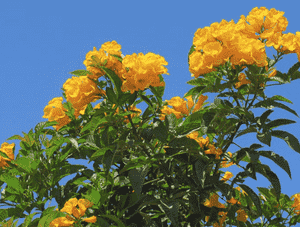
Bush allamanda (Allamanda schottii)
Also known as: Shrub allamanda
Bush allamanda (Allamanda schottii) flourishes in sunny locations and is well-suited to warm, humid environments. This evergreen shrub is known for its abundant trumpet-shaped yellow flowers that bloom from summer until frost. For continuous blooming, it's advisable to deadhead spent flowers, as this prevents seed formation and promotes new growth.
In This Article
Attributes of Bush allamanda
Lifespan
Perennial
Plant Type
Shrub
Plant Height
91 cm to 1.2 m
Spread
1.8 m to 2.5 m
Leaf Color
Green
Flower Size
5 cm to 10 cm
Flower Color
Yellow White Gold
Images of Bush allamanda
Quickly Identify Bush allamanda
1
Look for evergreen shrubs with oval, leathery leaves and bright yellow trumpet-shaped flowers. The plant typically produces flowers almost year-round in tropical climates.
Scientific Classification of Bush allamanda
Phylum
Vascular plants
Class
Dicotyledons
Order
Gentians, dogbanes, madders, and allies
Family
Dogbane
Genus
Allamanda
Species
Bush allamanda
Planting and Growing of Bush allamanda
Care Difficulty
Easy
Watering Schedule
Every 2 days
Sunlight Requirements
Full sun
Sunshine Duration
4-8 hours
Ideal Temperature
70-86℉
Soil Type
Potting Mix, Peat Mix
Soil pH
6.5-7.5
Fertilizer Type
Balanced
Pruning Season
Spring, Summer
Pruning Area
Branches, Leaves
Pruning Frequency
2 times a year
Repotting Season
Spring
Pot Type
Plastic, Ceramic
 How to Water Bush allamanda?
For Allamanda schottii, water until the soil is evenly moist but not saturated. Ensure that the water drains well, as stagnant water can lead to root rot. A good rule of thumb is to water thoroughly until you see excess water starting to seep out of the drainage holes in the pot, indicating that the entire root ball has been moistened.
What are the symptoms of an underwatered Bush allamanda?
›
What should I do if my Bush allamanda is not getting enough water?
›
What are the symptoms of an overwatered Bush allamanda?
›
How to save an overwatered Bush allamanda?
›
 What Are the Sunlight Requirements for Bush allamanda?
Allamanda schottii prefers full sun, ideally receiving 6-8 hours of direct sunlight daily. This range supports blooming and keeps the foliage vibrant and healthy, enhancing the plant’s ornamental value.
More About Sunlight Requirements Techniques→
How much sun does Allamanda schottii need?
›
What are solutions to provide ideal lighting?
›
What are the benefits of ideal lighting?
›
 What Is the Ideal Temperature Range for Bush allamanda?
Allamanda schottii thrives best in temperatures ranging from 70°F to 86°F. This range ensures optimal growth, vibrant flowers, and healthy leaf development. When the temperature is ideal, photosynthesis processes are most effective, and the plant can efficiently use nutrients and grow robustly.
 What Soil is Best for Bush allamanda?
Allamanda schottii thrives in well-drained soils which prevent waterlogging. This is crucial because standing water can harm the roots and stunt plant growth. Well-drained soils ensure that roots receive sufficient oxygen, leading to a healthy and flourishing plant. The plant requires soils rich in essential nutrients. A nutrient-rich soil environment supports robust growth, vibrant leaves, and plentiful flowering. Organic matter such as compost or aged manure can be mixed to enhance soil fertility and supply vital nutrients. While Allamanda schottii prefers dry conditions, maintaining moderate soil moisture is essential. Consistent moisture, without being soggy, supports overall plant health, ensuring the plant remains resilient during dry spells.
 How to Fertilize Bush allamanda?
For Allamanda schottii, the amount of fertilizer required varies depending on the age of the plant and its growth stage. In general, a balanced liquid fertilizer, diluted to half-strength, should be applied monthly during the growing season. For slow-release fertilizers, a sparing application of about 30 grams per square meter, every four months, ensures the plant receives nutrients steadily.
 How to Prune Bush allamanda?
Begin your pruning by removing any dead or diseased branches to promote overall plant health. Use sharp pruning shears to make clean cuts, ideally at a 45-degree angle. Focus on trimming back any excessively long branches to your desired shape, encouraging a fuller plant structure. Ensure that cuts are made just above a leaf node to stimulate new growth in the desired direction. Allamanda schottii can be shaped into a bushy shrub with regular trims. While pruning, visualize the final form you want the plant to take and remove branches that disrupt this silhouette. Maintaining an even shape not only improves the aesthetic appeal but also allows better sunlight penetration, which is essential for healthy growth and flowering.
More About Pruning Techniques→
 How to Propagate Bush allamanda plant?
1
Choose a healthy, semi-hardwood stem about 4-6 inches long with several leaves. Avoid stems with flowers or buds as they are less likely to root successfully.
2
Using sharp pruning shears, cut the chosen stem below a node. Remove the lower leaves to prevent them from rotting in the planting medium.
3
Dip the prepared cutting in rooting hormone to boost root development. Then plant it in a pot filled with a well-draining soil mix, ensuring at least one node is below the soil surface.
 How to Repot Bush allamanda plant?
1
Allamanda schottii should be repotted when its roots start winding around the bottom of the pot, indicating root-bound growth. Additional signs include slow growth and reduced water absorption. Typically, repotting is ideal when the plant is actively growing.
2
Select a pot that is 2-3 inches larger in diameter than the current one. It should have drainage holes to prevent waterlogging, which can lead to root rot. The slightly larger size allows sufficient space for root expansion and optimal growth.
3
Choose a well-draining potting mix with components like peat, perlite, and bark. This combination ensures proper air circulation and moisture retention, allowing roots to thrive without the risk of standing water.
Learn More About Bush allamanda Diseases
Anthracnose
Bacterial Leaf Spot
Bacterial Soft Rot
Bacterial Wilt
Black Spot
Chemical Injury
Crown Gall
Cyst Nematode
Damping-off
Downy Mildew
Drought Stress
Fusarium Wilt
Gray Mold
Leaf Curl
Leaf Spot
Mosaic
Nutrient Deficiency
Nutrient Toxicity
Powdery Mildew
Root Rot
Root-knot Nematode
Rusts
Sooty Mold
Spider Mites
Temperature Stress
Thrips Damage
White Mold



