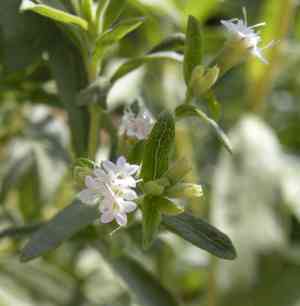
Candyleaf (Stevia rebaudiana)
Also known as: Sweetleaf
Stevia, also known as Candyleaf or Sweet Leaf, belongs to the sunflower family. In tropical regions, it grows as a perennial, while in cooler climates, it is cultivated as an annual. Its sweet leaves are used to produce extracts, sugar substitutes, and are also added to teas and desserts.
In This Article
Attributes of Candyleaf
Lifespan
Perennial, Annual
Plant Type
Herb
Plant Height
30 cm to 61 cm
Spread
60 cm
Leaf Color
Green
Flower Size
5 cm to 10 cm
Flower Color
White
Images of Candyleaf
Quickly Identify Candyleaf
1
Oppositely arranged oblong leaves with serrated edges and sweet taste (25-30 times sweeter than sucrose).
2
Small white flowers with light purple accents, tubular shape, and clustered arrangement (2-6 florets per cluster).
3
Petite, bristly, one-seeded fruit with hardy protective shell and subtle coloration blending with foliage.
4
Slender, floopy green stems measuring 0.12-0.2 inches (3-5 mm) in thickness, displaying a zig-zag growth pattern.
5
Non-noteworthy, free-flowering flowers lacking scent, enhancing modest appearance with clustered, inconspicuous nature.
Scientific Classification of Candyleaf
Phylum
Vascular plants
Class
Dicotyledons
Order
Asterales
Family
Daisy
Genus
Candyleaf
Species
Candyleaf
Planting and Growing of Candyleaf
Care Difficulty
Easy
Watering Schedule
Every 2 days
Sunlight Requirements
Full sun
Sunshine Duration
6-10 hours
Ideal Temperature
70-85℉
Soil Type
Potting Mix, Peat Mix
Soil pH
6.5-7.5
Fertilizer Type
Balanced
Pruning Season
Spring, Summer
Pruning Area
Branches, Leaves
Pruning Frequency
2 times a year
Repotting Season
Spring
Pot Type
Plastic, Ceramic
 How to Water Candyleaf?
Stevia rebaudiana prefers its soil to be kept consistently moist but not waterlogged. The goal is to water until the soil is saturated but not pooling, typically around 250 ml per watering session, depending on the pot size and drainage capabilities.
What are the symptoms of an underwatered Candyleaf?
›
What should I do if my Candyleaf is not getting enough water?
›
What are the symptoms of an overwatered Candyleaf?
›
How to save an overwatered Candyleaf?
›
 What Are the Sunlight Requirements for Candyleaf?
Stevia excels in full to partial sun exposure. Ideal lighting facilitates vigorous growth, enhances leaf sweetness, and optimizes the plant's photosynthetic efficiency.
More About Sunlight Requirements Techniques→
What is Stevia's ideal light source?
›
How to achieve ideal lighting indoors?
›
Benefits of optimal sun exposure for Stevia?
›
 What Is the Ideal Temperature Range for Candyleaf?
Stevia rebaudiana thrives in environments with consistent warmth and minimal temperature fluctuations. The ideal temperature range for optimal growth is between 70°F and 85°F, as this range simulates its native subtropical climate where nutrient uptake and photosynthesis are most efficient.
 What Soil is Best for Candyleaf?
Stevia rebaudiana thrives in well-drained soil because excessive water can cause root rot, limiting nutrient uptake. This drainage system allows roots to access oxygen, ensuring the plant's vigorous growth. Maintaining consistent moisture is crucial for Stevia rebaudiana, as dry periods can stunt its growth. Adequate moisture supports the plant's ability to absorb nutrients, resulting in sweeter leaves. Stevia rebaudiana flourishes in nutrient-rich soil. These nutrients fuel its growth and promote the development of robust, healthy leaves, ultimately increasing the plant's yield and quality.
 How to Fertilize Candyleaf?
For Stevia rebaudiana, a balanced fertilizer is key. Using a water-soluble 10-10-10 NPK fertilizer, apply about 1 tablespoon per gallon of water for liquid feedings. For slow-release granules, use approximately 1 to 2 tablespoons per plant spread evenly around the base.
 How to Prune Candyleaf?
Start by identifying leggy or overgrown stems that lack leaf density. These typically appear spindly and extend much beyond the rest of the plant. Cutting these back encourages bushier growth. Make cuts just above a node where leaves join the stem. This is where new shoots will emerge. Ensuring cuts are at a node will promote a more compact and dense plant structure. Regular trimming helps keep the plant at an optimal size for easier management. Prune to shape the plant, ensuring that it fits well in your garden or pot and receives adequate sunlight throughout.
More About Pruning Techniques→
 How to Propagate Candyleaf plant?
1
Soak Stevia rebaudiana seeds in warm water for 24 hours before planting. This helps to break seed dormancy and increases the germination rate by allowing moisture to penetrate the seed coat.
2
Select healthy, non-flowering stem segments from a mature plant. Trim about 4-6 inches of stem just below a node using a sterilized pruner. Remove lower leaves to expose nodes that will root.
3
Plant seeds or cuttings in a sterile, well-draining medium. For seeds, place them on the surface and cover lightly. For cuttings, insert into the medium ensuring at least two nodes are covered.
 How to Repot Candyleaf plant?
1
Stevia rebaudiana typically shows signs of needing repotting when its roots begin to circle the pot or break through drainage holes. Additionally, if the water you pour in takes a long time to soak into the soil or runs off quickly, it may indicate compacted soil needing replacement. Optimal repotting takes place in spring or early summer when the plant is naturally growing.
2
Choose a pot that is about 2 inches larger in diameter than the current one. Ensure it has several drainage holes to prevent root rot. A slightly larger pot allows for root growth while ensuring the plant doesn't become waterlogged, promoting healthier and more vigorous growth patterns.
3
Opt for a well-draining potting mix that contains a balance of peat, perlite, and coarse sand. This mix provides the ideal environment for Stevia's roots, ensuring that they remain healthy and aerated. A well-draining soil prevents excess moisture retention, reducing the risk of root rot and keeping the plant thriving.
Learn More About Candyleaf Diseases
Anthracnose
Bacterial Leaf Spot
Bacterial Soft Rot
Bacterial Wilt
Chemical Injury
Crown Gall
Cyst Nematode
Damping-off
Downy Mildew
Drought Stress
Fusarium Wilt
Gray Mold
Leaf Spot
Mosaic
Nutrient Deficiency
Nutrient Toxicity
Powdery Mildew
Root Rot
Root-knot Nematode
Rusts
Sooty Mold
Spider Mites
Temperature Stress
Thrips Damage
White Mold



