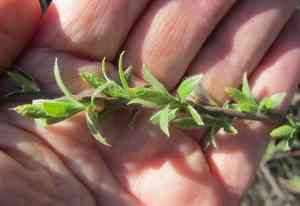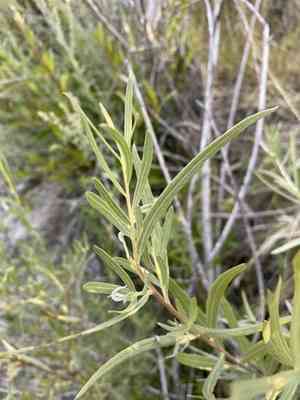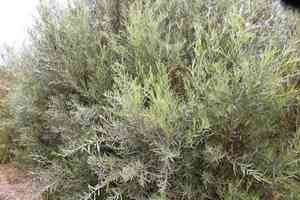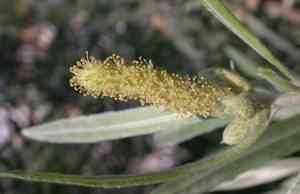
Narrowleaf willow(Salix exigua)

Narrowleaf willow (Salix exigua)

Also known as: Sandbar willow, Hinds' willow

The Narrowleaf willow (Salix exigua) is a deciduous shrub native to North America. Known for its slender, lance-shaped leaves, it serves several purposes:

1. **Erosion Prevention**: Its robust root network is effective in stabilizing soil, especially along waterways.
2. **Wildlife Support**: Provides essential habitat for various species, including birds and insects.
3. **Reclamation**: Utilized in ecological restoration projects due to its resilience.

**Characteristics**:
- **Leaves**: Narrow and elongated.
- **Height**: Grows between 3 to 20 feet.
- **Growth Pattern**: Forms dense, bushy thickets.
- **Environmental Tolerance**: Thrives in wet, sandy, or gravelly soils, and can withstand periodic flooding.

Attributes of Narrowleaf willow

Lifespan
Perennial
Plant Type
Shrub
Plant Height
3.5 m to 11 m
Spread
6 m
Leaf Color
Green Gray Silver
Flower Size
2.5 cm
Flower Color
Yellow Green

ForwardPlant - Identify plants with a snap

Identify and diagnose plants, get toxicity alerts, and explore safety guides for all types of fungi.

Try for Free

Images of Narrowleaf willow

Narrowleaf willow(Salix exigua)

Quickly Identify Narrowleaf willow

1
Salix exigua can be identified by its long, narrow leaves which are typically gray-green and have a fine, silky pubescence on the underside. The stems are slender and flexible, and the plant often forms dense thickets.

Scientific Classification of Narrowleaf willow

Phylum
Vascular plants
Class
Dicotyledons
Order
Malpighiales
Family
Willow
Genus
Willows
Species
Narrowleaf willow

Planting and Growing of Narrowleaf willow

Care Difficulty
Easy
Watering Schedule
Every 8 days
Sunlight Requirements
Full sun
Sunshine Duration
6-10 hours
Ideal Temperature
60-75℉
Soil Type
Potting Mix, Peat Mix
Soil pH
6.5-7.5
Fertilizer Type
Balanced
Pruning Season
Spring, Summer
Pruning Area
Branches, Leaves
Pruning Frequency
2 times a year
Repotting Season
Spring
Pot Type
Plastic, Ceramic

water icon How to Water Narrowleaf willow?

For Salix exigua, also known as narrowleaf willow, watering should follow the principle of keeping the soil consistently moist but not waterlogged. Ideally, use about 500 milliliters per session. Ensure that water is penetrating deep enough to reach the roots, typically speaking around six inches into the soil, but not so much that it causes pooling or drainage issues.
What are the symptoms of an underwatered Narrowleaf willow? ›
What should I do if my Narrowleaf willow is not getting enough water? ›
What are the symptoms of an overwatered Narrowleaf willow? ›
How to save an overwatered Narrowleaf willow? ›

sunlight icon What Are the Sunlight Requirements for Narrowleaf willow?

Sunlight Requirements: Full sun, Partial sun
Duration of light: 6 to 8 hours daily
Salix exigua grows optimally in environments offering full to partial sun. The ideal light range promotes photosynthesis, which is crucial for vibrant leaf color, increased growth rate, and overall health of the plant, making it more robust against environmental stressors.
Optimal Sunlight for Growth ›
Balancing Growth and Heat ›
Diverse Planting Strategies ›
More About Sunlight Requirements Techniques→

temperature icon What Is the Ideal Temperature Range for Narrowleaf willow?

Ideal Temperature: 60 ~ 75℉
The ideal temperature range for Salix exigua, a willow species commonly found in riparian zones of North America, is between 60°F and 75°F. This range ensures optimal growth and physiological functions, allowing the plant to maintain its delicate balance of energy and nutrient uptake. In these conditions, Salix exigua can effectively produce and sustain foliage while supporting its structural integrity.

soil icon What Soil is Best for Narrowleaf willow?

Soil type: Sandy soil, Loam, Sandy loam
Soil PH: 6.5 ~ 7.5
Salix exigua thrives beautifully in well-drained soil. This type of soil prevents waterlogging, thereby reducing root rot risk and enhancing the overall plant health by allowing air flow around the roots. The plant loves moisture, but not saturated conditions. Soil that can retain some moisture without becoming soggy is ideal, helping the willow remain hydrated and lush without the danger of drowning. A nutrient-loaded soil promotes healthy growth and vibrant foliage for Salix exigua. The presence of organic matter aids in nutrient provision, ensuring robust development and greater resilience against pests and diseases.

fertilize icon How to Fertilize Narrowleaf willow?

Fertilizer type: Balanced
Salix exigua prefers a balanced approach when it comes to nutrients. Apply liquid fertilizer at half strength to avoid nutrient burn, ensuring the soil remains healthy and supports optimal growth. A 10-10-10 NPK liquid fertilizer works well, with approximately 500 ml per application for a small tree, mixed with water.

prune icon How to Prune Narrowleaf willow?

Pruning Time: Spring, Summer, Autumn, Winter
Identify dead, damaged, or diseased branches and cut them back to the main stem. 2. Shape the plant by removing overly long branches to maintain its form. 3. Cut at an angle just above a bud or lateral branch, which encourages new growth. For older or overgrown plants, cut back to the ground level in late winter to promote vigorous new growth in spring. Do this every 3-5 years to maintain plant vitality. More About Pruning Techniques→

propagate icon How to Propagate Narrowleaf willow plant?

Propagate Time: Early spring, Spring
1
In early spring, select healthy stems from a mature Salix exigua plant. Use sterilized pruning shears to take 6-8 inch cuttings, ensuring each has at least one leaf node from which roots will emerge.
2
Remove the leaves from the lower half of the cutting to reduce water loss through transpiration. Dip the cut end into a rooting hormone to encourage the rooting process and enhance success rates.
3
Insert the cutting 2-3 inches deep into a pot filled with a well-draining medium, such as a peat and perlite mix. Firm the soil gently around the base to secure the cutting in place.
More About Propagating Techniques→

repot icon How to Repot Narrowleaf willow plant?

Repotting frequency: Every 2-3 years
1
Salix exigua should be repotted when its roots start to encircle the pot or begin to grow out of the drainage holes. Additionally, if the plant growth seems stunted or the soil appears compacted and no longer retains moisture effectively, it's time for a change.
2
Select a pot that is a couple of inches wider in diameter than the current one. Ensure the pot has sufficient drainage holes at the bottom to prevent waterlogging, which can lead to root rot. Using a pot made of breathable material like terracotta can help with moisture regulation.
3
Opt for a well-draining, loamy soil mix that retains moisture but allows excess water to escape easily. Incorporating organic matter can enhance soil fertility, promoting healthier growth and reducing the need for frequent fertilization.

ForwardPlant - Identify plants with a snap

Find the best spots for them to optimize their health, simply using your phone.

Try for Free