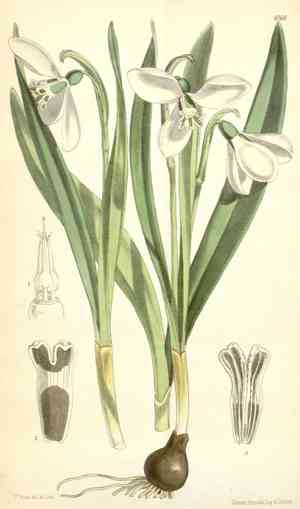
Greater snowdrop (Galanthus elwesii)
Also known as: Elwess snowdrop, Giant turkish snowdrop
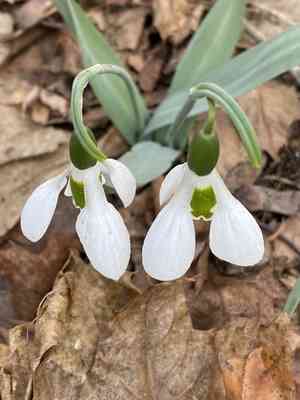
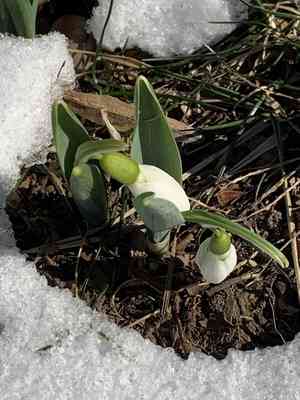
Greater snowdrops (Galanthus elwesii) feature delicate, white, teardrop-shaped flowers. Inside the bulbs, you'll find nutrient-storing scales and green inner segments. These blooms emit a subtle, honey-like fragrance.
In This Article
Attributes of Greater snowdrop
Lifespan
Perennial
Plant Type
Herb
Plant Height
20 cm to 25 cm
Spread
8 cm to 15 cm
Leaf Color
Green Gray Silver
Flower Size
1 cm to 2 cm
Flower Color
White
Images of Greater snowdrop
Quickly Identify Greater snowdrop
1
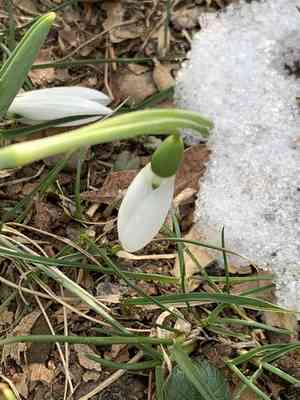
Solitary white flowers on 4-6 inches (10-15 cm) tall stems rising through snow.
2
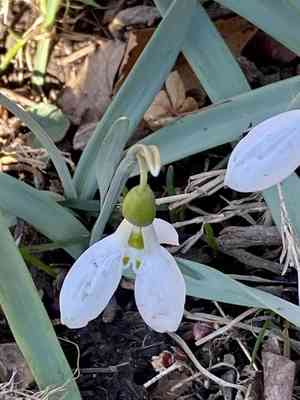
Bell-shaped flowers with distinctive white tepals and green-marked inner segments.
3
Tripartite fruit capsules with dry, paper-like texture and small black seeds.
4
Linear greyish-green leaves up to 4 inches (10 cm) long and 1 1/4 inches (3 cm) wide.
5
Smooth, green stems emerging from bulbous base, 4-8 inches (10-20 cm) high.
Scientific Classification of Greater snowdrop
Phylum
Vascular plants
Class
Monocotyledons
Order
Asparagales
Family
Amaryllis
Genus
Snowdrops
Species
Greater snowdrop
Planting and Growing of Greater snowdrop
Care Difficulty
Easy
Watering Schedule
Every 2 days
Sunlight Requirements
Partial sun
Sunshine Duration
4-6 hours
Ideal Temperature
50-68℉
Soil Type
Potting Mix, Peat Mix
Soil pH
6.5-7.5
Fertilizer Type
Balanced
Pruning Season
Spring, Summer
Pruning Area
Branches, Leaves
Pruning Frequency
Once a year
Repotting Season
Spring
Pot Type
Plastic, Ceramic
 How to Water Greater snowdrop?
Galanthus elwesii, also known as the Elwes' snowdrop, prefers consistently moist but not waterlogged soil. Water thoroughly to ensure soil is evenly moist, usually around 200 milliliters per session, depending on the size of the pot and drainage capacity.
What are the symptoms of an underwatered Greater snowdrop?
›
What should I do if my Greater snowdrop is not getting enough water?
›
What are the symptoms of an overwatered Greater snowdrop?
›
How to save an overwatered Greater snowdrop?
›
 What Are the Sunlight Requirements for Greater snowdrop?
Partial sun gives Galanthus elwesii the perfect balance of light to support photosynthesis and growth while avoiding the stress of too much direct sun, resulting in healthy blooms.
Where should I place Galanthus elwesii?
›
How can I ensure optimal lighting?
›
What are the benefits of ideal lighting?
›
 What Is the Ideal Temperature Range for Greater snowdrop?
Maintaining Galanthus elwesii within the ideal temperature range of 50°F to 68°F is crucial for optimal growth and blooming. Temperatures within this range help ensure that the plant's physiological processes operate efficiently, allowing it to utilize nutrients effectively and maintain a robust structure.
 What Soil is Best for Greater snowdrop?
Galanthus elwesii thrives in well-draining soils which prevent waterlogging. This ensures that the bulb does not rot and receives adequate oxygen, promoting robust growth and flowering. A nutrient-rich substrate enhances the growth of Galanthus elwesii. Nutrients like phosphorus support root development and vibrant blooms, making the plant lush and healthy. While the soil should be well-draining, consistent moisture is crucial during the growing season. Sufficient moisture ensures the plant develops strong foliage and beautiful blossoms.
 How to Fertilize Greater snowdrop?
For Galanthus elwesii, apply a balanced liquid fertilizer at half the recommended strength. Use around 1 teaspoon per gallon of water, ensuring not to over-fertilize as this delicate plant is sensitive to excessive nutrients.
 How to Prune Greater snowdrop?
Begin pruning Galanthus elwesii after it has completed its blooming cycle in spring. Use sharp, sterile scissors to trim back any spent, yellowing leaves to the base. This process diverts the plant's energy into the bulb for next year's growth instead of maintaining unnecessary foliage.
More About Pruning Techniques→
 How to Propagate Greater snowdrop plant?
1
To propagate by seeds, collect them once the seed pods have ripened on the plant. Carefully open the pods and place the seeds in a dry bag until ready for sowing.
2
During early spring or late autumn, carefully dig around the clumps of bulbs. Gently separate the bulbs, ensuring each piece has its roots, and replant at the same depth they were growing.
3
Sow seeds in a well-draining seed mix, press lightly into the surface, and cover with a thin layer of grit. Water gently and place the trays in a cool area, maintaining consistent moisture.
 How to Repot Greater snowdrop plant?
1
Galanthus elwesii, commonly known as the giant snowdrop, signals its need for repotting when growth appears stunted or the bulbs are overcrowding their pot. Early signs include reduced flowering and bulbs popping out of the soil, indicating space shortage. Repotting should ideally happen after flowering in spring to minimize stress on the plant and encourage healthy growth.
2
When selecting a pot for Galanthus elwesii, ensure it is slightly larger than the current one, with sufficient drainage holes. A pot that is too big might retain excess moisture, leading to bulb rot. Terra cotta pots are ideal as they allow for air circulation around the roots, thus preventing soggy soil conditions and promoting a more natural growth environment.
3
Choose a well-draining sandy loam mix for repotting Galanthus elwesii. This type of soil facilitates adequate drainage, reducing the risk of waterlogging which can harm the bulbs. Adding perlite or grit can further improve drainage, ensuring that the bulbs remain healthy and can absorb nutrients effectively without the risk of rot.
Toxicity
Ingestion
WARNING
The judgment on toxicity and danger is for reference only. We DO NOT GUARANTEE any accuracy of such judgment. Therefore, you SHALL NOT rely on such judgment. It is IMPORTANT TO SEEK PROFESSIONAL ADVICE in advance when necessary.
Learn More About Greater snowdrop Diseases
Bacterial Leaf Spot
Bacterial Soft Rot
Crown Gall
Cyst Nematode
Damping-off
Downy Mildew
Fusarium Wilt
Gray Mold
Leaf Spot
Mosaic
Nutrient Deficiency
Nutrient Toxicity
Powdery Mildew
Root Rot
Root-knot Nematode
Rusts
Sooty Mold
Spider Mites
Thrips Damage
White Mold
Chemical Injury
Drought Stress
Temperature Stress



