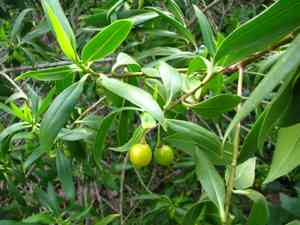
Wild olive (Bontia daphnoides)
Also known as: Saltwort, Bontia
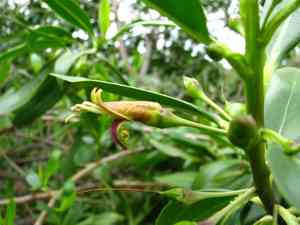
Bontia daphnoides is a shrub or small tree that can reach up to 6 meters in height with a trunk diameter of about 15 cm. The leaves are alternately arranged, measuring 5 to 10 cm in length and 1.5 to 2 cm in width, and have an elliptic shape with a prominent mid-vein on the underside. The flowers are solitary and grow in the leaf axils on stalks of 1.5 to 2 cm in length. They are present most of the year. The fruits are nearly spherical with a small beak, starting off pale yellow and turning brown as they mature.
In This Article
Attributes of Wild olive
Lifespan
Perennial
Plant Type
Tree, Shrub
Plant Height
Up to 2 meters
Spread
About 1 to 1.5 meters
Leaf Color
Dark green
Flower Size
Approximately 2 to 3 centimeters
Flower Color
White to pale pink with a touch of purple
Images of Wild olive
Quickly Identify Wild olive
1
To identify Bontia daphnoides, look for a small, evergreen shrub with glossy, lance-shaped leaves. The leaves are usually dark green and leathery. The flowers are tubular and white to pale pink with a touch of purple. The plant often grows in sandy and rocky soils near the coast.
Scientific Classification of Wild olive
Phylum
Vascular plants
Class
Dicotyledons
Order
Lamiales
Family
Figwort
Genus
Bontia
Species
Wild olive
Planting and Growing of Wild olive
Care Difficulty
Easy
Watering Schedule
Every 3 days
Sunlight Requirements
Full sun
Sunshine Duration
4-8 hours
Ideal Temperature
70-85℉
Soil Type
Potting Mix, Peat Mix
Soil pH
6.5-7.5
Fertilizer Type
Balanced
Pruning Season
Spring, Summer
Pruning Area
Branches, Leaves
Pruning Frequency
2 times a year
Repotting Season
Spring
Pot Type
Plastic, Ceramic
 How to Water Wild olive?
Bontia daphnoides prefers a moderate amount of water. This means watering the plant until the soil is evenly moist but not soggy. Allow the top inch of soil to dry out between waterings to ensure the roots are not sitting in water.
What are the symptoms of an underwatered Wild olive?
›
What should I do if my Wild olive is not getting enough water?
›
What are the symptoms of an overwatered Wild olive?
›
How to save an overwatered Wild olive?
›
 What Are the Sunlight Requirements for Wild olive?
Bontia daphnoides thrives best in full to partial sun, ensuring robust growth and prolific flowering. Proper light facilitates essential processes like photosynthesis, vital for its physiological health.
What is the ideal lighting environment for Bontia daphnoides?
›
How can I achieve ideal lighting for this plant?
›
What benefits will this plant experience with ideal light conditions?
›
 What Is the Ideal Temperature Range for Wild olive?
Bontia daphnoides thrives best in warm conditions, where temperatures range between 70°F and 85°F. This range optimizes the plant's growth and supports healthy foliage. Maintaining a consistent temperature within this ideal range prevents stress and promotes vigorous growth.
 What Soil is Best for Wild olive?
Bontia daphnoides thrives in well-draining soils that prevent water stagnation. Such conditions help avoid root rot and ensure that the roots get the right balance of moisture and air. While drainage is important, the soil should also retain enough moisture to prevent the plant from drying out. It provides a consistent water supply to sustain healthy growth. A nutrient-rich soil supports lush foliage and vibrant blooms. Adding organic matter can improve nutrient availability, benefiting overall plant health.
 How to Fertilize Wild olive?
For Bontia daphnoides, the fertilization amount should be carefully managed. Use a balanced liquid fertilizer at half strength, about 1/4 teaspoon per gallon, to avoid over-fertilization that could harm the plant's roots.
 How to Prune Wild olive?
Begin by removing any dead, diseased, or damaged branches. This ensures that the plant's energy is not wasted on non-viable parts and reduces the risk of infection spreading. Trim back any branches that are growing out of the desired shape of the plant. Focus on maintaining a balanced shape and removing any crossing branches that might rub against each other. Thinning the crown by selectively removing branches can improve airflow through the plant, which helps reduce the risk of fungal diseases by allowing moisture to evaporate more quickly.
More About Pruning Techniques→
 How to Propagate Wild olive plant?
1
Harvest seeds when the plant's fruit or seed pods mature. Ensure seeds are collected before dispersal occurs to maximize yield.
2
Choose a healthy stem and cut just below a node. Ensure the stem is about 4-6 inches long and has at least two leaves. Remove the bottom leaves for better root growth.
3
Place seeds in trays filled with a well-draining substrate. For cuttings, dip the cut end in a rooting hormone and plant it in a mixture of soil and sand.
 How to Repot Wild olive plant?
1
You should consider repotting your Bontia daphnoides when you observe roots appearing through the drainage holes, or if the growth becomes stunted. Spring and autumn are ideal as the plant experiences minimal stress. This timing ensures optimal root establishment and recovery.
2
Select a pot that is one size larger than the current one. Ensure it has ample drainage holes to prevent waterlogging. The larger size provides enough space for root expansion, while drainage holes assist in avoiding root rot, maintaining a healthy plant system.
3
Opt for a well-draining loamy soil mix. This type of soil retains moisture without becoming waterlogged, which is critical for preventing root decay. It allows adequate aeration for the roots, promoting healthy growth and nutrient absorption.
Learn More About Wild olive Diseases
Anthracnose
Bacterial Leaf Spot
Bacterial Soft Rot
Bacterial Wilt
Black Spot
Chemical Injury
Crown Gall
Cyst Nematode
Damping-off
Downy Mildew
Drought Stress
Fusarium Wilt
Gray Mold
Leaf Curl
Leaf Spot
Mosaic
Nutrient Deficiency
Nutrient Toxicity
Powdery Mildew
Root Rot
Root-knot Nematode
Rusts
Sooty Mold
Spider Mites
Temperature Stress
Thrips Damage
White Mold



