How to Propagate White prickly poppy?
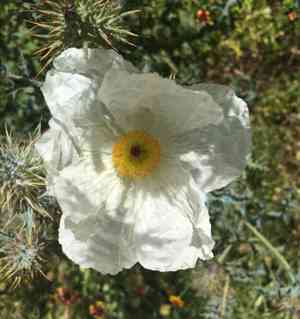
The white prickly poppy flourishes when reproduced via seed dispersal. Best outcomes are generally achieved by scattering seeds directly onto porous earth, ensuring steady hydration without saturation. Cultivators should lightly press the seeds onto the soil's surface, avoiding deep burial, as this significantly boosts germination rates due to the species' need for light to sprout. Consistent attention after planting will encourage robust growth and maturation.
Optimal Period for Propagating White Prickly Poppy?
Propagation Method
Seeding
Propagation Period
Spring
Equipment Used for White Prickly Poppy Propagation?
Seeds
Seeds are the primary propagation material needed for white prickly poppy. Given that sowing is the preferred technique, seeds must be viable and collected at the correct time to ensure successful sprouting.
Seed trays
Seed trays are employed to initiate seeds under regulated environments, making them crucial for the initial stage of white prickly poppy propagation. These trays aid in uniform seed distribution and maintaining necessary moisture and temperature levels.
Quality potting mix
A well-draining, nutrient-rich potting medium is essential for the germination of white prickly poppy. It offers the required support and nutrients for the plant's early developmental phases.
Watering can with a fine rose
This implement enables gentle irrigation, ensuring that white prickly poppy seeds are not dislodged or buried too deeply by water pressure. The fine rose attachment helps distribute water evenly, maintaining ideal moisture levels without causing soil erosion in the seed trays.
Labels and markers
Utilizing labels and markers to identify seed trays is crucial for recognizing white prickly poppy after planting, especially when propagating multiple species concurrently. This assists in monitoring growth and providing appropriate care specific to each plant.
Growth lights (if indoor propagation)
Grow lights are advantageous if white prickly poppy is being propagated indoors. They guarantee seedlings receive sufficient light, which is vital for photosynthesis and overall development, particularly in conditions with limited natural sunlight.
Method for Propagating White Prickly Poppy?
Propagation Type
Simple
Post-Propagation Care for Your White Prickly Poppy?
Post-Propagation Care for Your White Prickly Poppy?
Following propagation, continue to observe white prickly poppy for robust development. It flourishes in full sun and requires minimal watering once established, making it relatively low-maintenance. Be wary of overwatering as it can lead to root rot. Periodically check for pests, though white prickly poppy is generally quite resilient. As white prickly poppy matures, it may necessitate occasional thinning to prevent overcrowding, which promotes improved air circulation and overall plant health.
Common Errors to Avoid When Propagating White Prickly Poppy
Overwatering
Excessive watering of white prickly poppy can result in root rot, as this species generally prefers arid conditions. Too much moisture can hinder root development and weaken the plant.
Excessive soil compaction
Compacting the soil around white prickly poppy too much can restrict root growth and reduce aeration, leading to poorer plant health and stunted development.
Neglecting sunlight requirements
White prickly poppy thrives in abundant sunlight. Insufficient light can lead to leggy plants with weak stems and diminished flowering capacity.
Using non-draining containers
Propagating white prickly poppy in containers lacking proper drainage promotes water retention, which can worsen root diseases detrimental to the plant's well-being.
Advice for Propagating White Prickly Poppy
Using well-draining soil
Employ a well-draining soil mixture for white prickly poppy to ensure surplus water can escape, mimicking its natural, dry habitat conditions and fostering healthier root growth.
Moderate watering
Maintain a balanced watering schedule for white prickly poppy, allowing the soil to dry out between waterings to prevent root diseases and encourage strong root development.
Full sunlight exposure
Ensure that white prickly poppy is situated in an area that receives ample sun for optimal growth and blooming. This replicates the native habitat conditions that white prickly poppy is best suited for.
Use of airy containers
Selecting containers with good air circulation and drainage holes for white prickly poppy will help imitate natural soil conditions, reducing the risk of moisture-related problems.



