Wright's viburnum(Viburnum wrightii)

Wright's viburnum (Viburnum wrightii)

Also known as: Hobblebush

The tree can grow up to 4 meters tall, featuring dark brown bark on the trunk and green young branches that often have a purple-brown hue. These branches can be either hairless or covered with long, simple hairs. The leaves are positioned opposite each other, and their petioles range from 1 to 2 cm in length, usually reddish and covered with long, downy hairs or sometimes short bundles. The petioles also have grooves on the top and typically lack stipules.

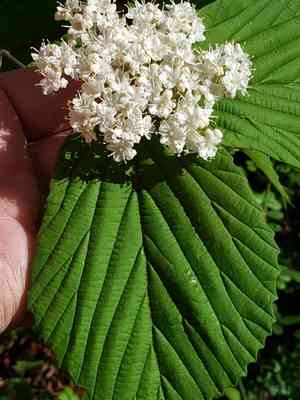
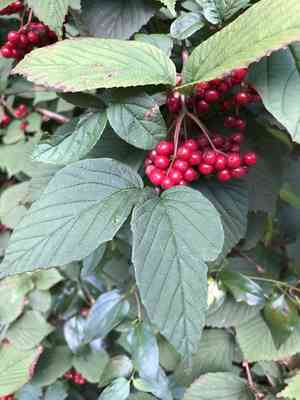
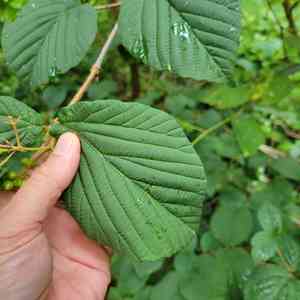
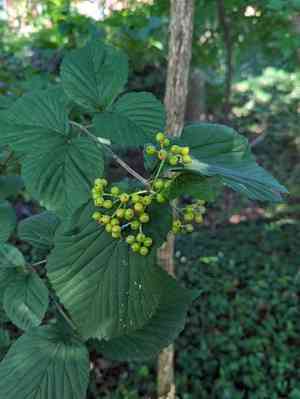
The leaf blades measure between 6 to 14 cm in length and 4 to 9 cm in width, ranging in shape from oval to broad oval. The tips of the leaves narrow sharply and end in a point, while the base is either wide wedge-shaped, rounded, or dull. The edges of the leaves have shallow, square-shaped teeth. At the ends of short branches, there are flowering inflorescences about 6 to 10 cm in diameter, which are densely packed with many white flowers. The tree produces spherical or ovoid drupes that are 5 to 7 mm long and turn a shiny dark red when ripe. Each drupe contains an oval seed, 4.5 to 7 mm long and 1.8 to 2.5 mm thick, with shallow grooves on both the dorsal and ventral sides.

Attributes of Wright's viburnum

Lifespan
Perennial
Plant Type
Shrub
Plant Height
1.8 m to 3 m
Spread
1.2 m to 1.8 m
Leaf Color
Green turning to reddish-purple in the fall
Flower Size
5 cm to 10 cm
Flower Color
White

ForwardPlant - Identify plants with a snap

Identify and diagnose plants, get toxicity alerts, and explore safety guides for all types of fungi.

Try for Free

Images of Wright's viburnum

Wright's viburnum(Viburnum wrightii)

Quickly Identify Wright's viburnum

1
Flat-topped clusters of bright white flowers in spring
2
Dark metallic green leaves with long hairs and dark spots
3
Smooth gray-brown stem with opposite branching pattern
4
Vivid red berries persisting into winter
5
Clusters of small white fragrant flowers in late spring

Scientific Classification of Wright's viburnum

Phylum
Vascular plants
Class
Dicotyledons
Order
Dipsacales
Family
Moschatel
Genus
Viburnum
Species
Wright's viburnum

Planting and Growing of Wright's viburnum

Care Difficulty
Easy
Watering Schedule
Every 3 days
Sunlight Requirements
Partial sun
Sunshine Duration
4-6 hours
Ideal Temperature
60-75℉
Soil Type
Potting Mix, Peat Mix
Soil pH
6.5-7.5
Fertilizer Type
Balanced
Pruning Season
Spring, Summer
Pruning Area
Branches, Leaves
Pruning Frequency
2 times a year
Repotting Season
Spring
Pot Type
Ceramic, Plastic

water icon How to Water Wright's viburnum?

Viburnum wrightii prefers consistently moist soil but not waterlogged. Water deeply until the soil is moist to a depth of 6 inches, approximately 500ml, allowing for proper root hydration without oversaturating the soil.
What are the symptoms of an underwatered Wright's viburnum? ›
What should I do if my Wright's viburnum is not getting enough water? ›
What are the symptoms of an overwatered Wright's viburnum? ›
How to save an overwatered Wright's viburnum? ›

sunlight icon What Are the Sunlight Requirements for Wright's viburnum?

Sunlight Requirements: Partial sun
Duration of light: 4 to 6 hours
Viburnum wrightii benefits from partial sun exposure, ideally between 4 to 6 hours of sunlight daily. This amount of light supports its growth and flowering process, maintaining a healthy, lush appearance.
How much light does Viburnum wrightii need? ›
What are the solutions to achieve ideal lighting? ›
What are the benefits of ideal lighting for Viburnum wrightii? ›

temperature icon What Is the Ideal Temperature Range for Wright's viburnum?

Ideal Temperature: 60 ~ 75℉
The ideal temperature range for growing Viburnum wrightii is between 60°F and 75°F. This range provides the optimal environment for the plant to thrive, promoting healthy growth, flowering, and disease resistance. Maintaining these temperatures helps ensure that the plant’s metabolic processes operate efficiently, thereby facilitating robust development.

soil icon What Soil is Best for Wright's viburnum?

Soil type: Loam, Sandy loam
Soil PH: 6.5 ~ 7.5
Viburnum wrightii thrives in well-drained soil as it helps prevent waterlogging, which can lead to root rot. It’s crucial for ensuring that the plant’s roots have access to both moisture and oxygen. The plant benefits from soil rich in nutrients, which promotes robust growth and vibrant foliage. Nutrient-dense soils support its flowering potential and overall health. Though drainage is important, the soil should also retain some moisture to keep roots hydrated. This balance allows the plant to sustain its foliage during warmer months.

fertilize icon How to Fertilize Wright's viburnum?

Fertilizer type: Balanced
The Viburnum wrightii typically requires a balanced application of fertilizers, with a focus on the N-P-K ratio. For liquid fertilizers, a solution of 20-20-20 is often suitable, diluted as per the manufacturer's instructions. For slow-release fertilizers, apply granules as per the plant's size and soil condition, usually around one cup for every foot of the plant's height annually.

prune icon How to Prune Wright's viburnum?

Pruning Time: Spring, Autumn
Begin by inspecting the Viburnum wrightii for any dead, damaged, or diseased branches. Carefully remove these branches to improve the plant's overall appearance and health, cutting them back to healthy tissue. After removing unwanted branches, focus on shaping the plant. Prune back long or wayward branches to maintain the desired shape and size. A well-shaped Viburnum wrightii is more visually appealing and promotes even growth. Thin out areas with dense branch growth to allow sunlight and air to penetrate the foliage. This not only boosts the plant's health but also minimizes the risk of fungal infections and improves overall blooming. More About Pruning Techniques→

propagate icon How to Propagate Wright's viburnum plant?

Propagate Time: Spring,Late spring,Early summer
1
Gather seeds from mature Viburnum wrightii fruits. Clean and dry them before sowing to prevent fungal infections.
2
Select a healthy stem and cut a 6-8 inch piece. Strip the lower leaves and apply rooting hormone before planting in moist soil.
3
Bend a low-growing, flexible stem to the ground. Cover a portion with soil, leaving the tip exposed, and allow it to root naturally over time.

repot icon How to Repot Wright's viburnum plant?

Repotting frequency: Every 2-3 years
1
Monitor the Viburnum wrightii for signs such as roots circling the bottom of the pot or stunted growth, indicating it's time to repot. Spring or autumn is ideal, avoiding temperature extremes.
2
Select a pot slightly larger than the current one, ensuring it has drainage holes. This supports healthy root growth and prevents waterlogging, which could lead to root rot.
3
Opt for a well-draining, loamy soil mix rich in organic matter. This ensures proper aeration and drainage, crucial for the plant's health, preventing waterlogging and promoting robust growth.

ForwardPlant - Identify plants with a snap

Find the best spots for them to optimize their health, simply using your phone.

Try for Free