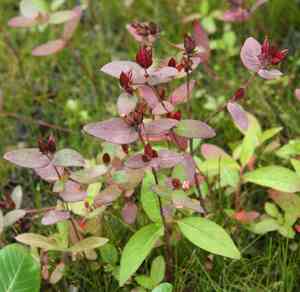
Fraser's marsh St. John's wort (Triadenum fraseri)
Also known as: St. John's-wort, Fraser's marsh St. John's wort
Fraser's marsh St. John's wort (Triadenum fraseri) thrives in various wetland environments across the United States and southern Canada. This plant can be found in habitats such as marshes, bogs, fens, wet meadows, and along the shores of ponds and streams. The plant features stems that can reach 60 cm in height, with leaves that may exhibit bluish, purplish, or pinkish hues. Unlike the commonly known St. John's wort used in herbal supplements, this specific species is not suitable for the same purposes.
In This Article
Attributes of Fraser's marsh St. John's wort
Lifespan
Perennial
Plant Type
Herb
Plant Height
30 cm to 61 cm
Spread
Approximately 20-30 cm (8-12 inches)
Leaf Color
Green Blue
Flower Size
About 1-2 cm (0.4-0.8 inches)
Flower Color
Pink Red Brown
Images of Fraser's marsh St. John's wort
Quickly Identify Fraser's marsh St. John's wort
1
Triadenum fraseri can be identified by its slender, erect stems that are typically reddish-brown in color. The leaves are opposite, lanceolate, and have a bluish-green hue. The flowers are star-shaped with five pink petals and yellow stamens.
Scientific Classification of Fraser's marsh St. John's wort
Phylum
Vascular plants
Class
Dicotyledons
Order
Malpighiales
Family
St. John's wort
Genus
Marsh St. John's wort
Species
Fraser's marsh St. John's wort
Planting and Growing of Fraser's marsh St. John's wort
Care Difficulty
Easy
Watering Schedule
Every 3 days
Sunlight Requirements
Partial sun
Sunshine Duration
4-8 hours
Ideal Temperature
60-75℉
Soil Type
Potting Mix, Peat Mix
Soil pH
5.5-7
Fertilizer Type
Balanced
Pruning Season
Spring, Summer
Pruning Area
Branches, Leaves
Pruning Frequency
2 times a year
Repotting Season
Spring
Pot Type
Plastic, Ceramic
 How to Water Fraser's marsh St. John's wort?
For Triadenum fraseri, water until the soil is consistently moist but not waterlogged. Aim for about 300 milliliters each time, ensuring the soil remains damp to mimic its natural wetland habitat.
What are the symptoms of an underwatered Fraser's marsh St. John's wort?
›
What should I do if my Fraser's marsh St. John's wort is not getting enough water?
›
What are the symptoms of an overwatered Fraser's marsh St. John's wort?
›
How to save an overwatered Fraser's marsh St. John's wort?
›
 What Are the Sunlight Requirements for Fraser's marsh St. John's wort?
Triadenum fraseri thrives in partial sun to filtered sunlight. Ideal lighting enhances robust foliage, stimulates flowering, and maintains a dense structural form.
What type of sunlight does this plant prefer?
›
How to ensure ideal lighting for Triadenum fraseri?
›
Benefits of providing ideal light conditions
›
 What Is the Ideal Temperature Range for Fraser's marsh St. John's wort?
The ideal temperature range for Triadenum fraseri is between 60°F and 75°F. This range provides the optimal conditions for growth, ensuring that the plant's physiological processes occur smoothly. Within this range, the plant can effectively manage its water and nutrient uptake, leading to healthy development.
 What Soil is Best for Fraser's marsh St. John's wort?
Triadenum fraseri thrives in soils that can retain moisture, similar to its native wetland habitats. Retaining moisture ensures optimal hydration and encourages strong growth and flowering. The plant benefits from soils rich in organic matter, providing a wealth of nutrients crucial for vigorous growth. Such nutrients enable the plant to sustain its vibrant foliage and robust structure. Despite its need for moisture, Triadenum fraseri requires soil with good drainage to avoid waterlogging. This prevents root rot, promoting healthier root systems and plant stability.
 How to Fertilize Fraser's marsh St. John's wort?
For Triadenum fraseri, it is essential to apply a balanced fertilizer rich in essential nutrients but without overloading. A light hand is preferable, with approximately 1/4 teaspoon per gallon when using liquid fertilizer and about 0.5 oz per square foot for slow-release granules.
 How to Prune Fraser's marsh St. John's wort?
Start by identifying and removing any dead or diseased branches, which helps direct the plant's energy to healthier parts and prevents disease spread. After removing unhealthy growth, focus on shaping the plant. Cut back excessive growth while maintaining a balanced, aesthetically pleasing structure that allows light penetration. Make your cuts just above a node or leaf joint, as this encourages the development of new growth. Be sure to angle cuts slightly to prevent water from collecting on the cut surface.
More About Pruning Techniques→
 How to Propagate Fraser's marsh St. John's wort plant?
1
Start by filling seed trays with a sterile seed-starting mix. Sow the seeds evenly and cover them lightly with soil. Keep the tray in a warm, bright location and ensure consistent moisture until germination occurs.
2
Choose healthy, non-flowering stems and cut them to about 4-6 inches long. Remove the lower leaves and plant the cuttings in a pot filled with well-draining soil. Keep them in a humid environment until roots develop.
3
Dig up a mature plant carefully and divide the root ball into sections using a sharp knife. Ensure each section has enough roots and shoots. Replant the divisions immediately in the desired location.
 How to Repot Fraser's marsh St. John's wort plant?
1
Look for signals such as roots protruding from drainage holes, soil that dries out too fast, or stunted growth. These signs indicate it's time for Triadenum fraseri to be moved to new accommodations. Spring or autumn, when plant activity is moderate, are ideal seasons for repotting.
2
Opt for a pot that is one size larger than the current one, with good drainage holes. This allows space for root growth and prevents waterlogging, which Triadenum fraseri is sensitive to. A slightly snug fit helps in structural support, minimizing transplant shock.
3
Choose a rich, well-draining soil that can retain moisture but not remain soggy. This mix supports the plant's root system by providing essential nutrients and preventing root rot, enabling robust growth and vibrant foliage.
Learn More About Fraser's marsh St. John's wort Diseases
Anthracnose
Bacterial Leaf Spot
Bacterial Soft Rot
Bacterial Wilt
Chemical Injury
Crown Gall
Cyst Nematode
Damping-off
Downy Mildew
Drought Stress
Fusarium Wilt
Gray Mold
Leaf Curl
Leaf Spot
Mosaic
Nutrient Deficiency
Nutrient Toxicity
Powdery Mildew
Root Rot
Root-knot Nematode
Rusts
Sooty Mold
Spider Mites
Temperature Stress
Thrips Damage
White Mold



