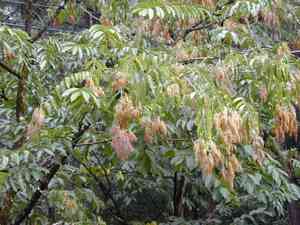
East indian almond (Terminalia myriocarpa)
Also known as: Terminalia, East Indian Almond, Myrobalan
The East Indian almond tree, native to tropical regions, is commonly utilized for its durable wood, which finds applications in construction, furniture, doors, and window frames. The wood is moderately heavy and even serves well as charcoal. Additionally, the tree produces an abundance of seeds, aligning with its species name *Terminalia catappa*, where "catappa" is derived from regional names that highlight its prolific fruiting nature.
In This Article
Attributes of East indian almond
Lifespan
Perennial
Plant Type
Tree
Plant Height
Up to 30-45 meters
Spread
15-25 meters
Leaf Color
Dark green
Flower Size
Small, less than 0.5 cm
Flower Color
Greenish-white
Images of East indian almond

Quickly Identify East indian almond
1
Look for a tall tree with a buttressed trunk, wide canopy, and long, lanceolate leaves. The bark is greyish and flakes off in irregular patches. The flowers are small, greenish-white, and appear in dense spikes.
Scientific Classification of East indian almond
Phylum
Vascular plants
Class
Dicotyledons
Order
Myrtales
Family
White mangrove
Genus
Terminalia
Species
East indian almond
Planting and Growing of East indian almond
Care Difficulty
Easy
Watering Schedule
Every 3 days
Sunlight Requirements
Partial sun
Sunshine Duration
6-12 hours
Ideal Temperature
65-77℉
Soil Type
Potting Mix, Peat Mix
Soil pH
6.5-7.5
Fertilizer Type
Balanced
Pruning Season
Spring, Summer
Pruning Area
Branches, Leaves
Pruning Frequency
Once a year
Repotting Season
Spring
Pot Type
Plastic, Ceramic
 How to Water East indian almond?
Terminalia myriocarpa thrives when its soil is kept consistently moist but not waterlogged. Water approximately 500ml each time, ensuring that the moisture reaches the plant's deeper roots. Check that the top 2-3 inches of soil have dried before the next watering.
What are the symptoms of an underwatered East indian almond?
›
What should I do if my East indian almond is not getting enough water?
›
What are the symptoms of an overwatered East indian almond?
›
How to save an overwatered East indian almond?
›
 What Are the Sunlight Requirements for East indian almond?
Terminalia myriocarpa benefits from partial sun exposure, which supports its healthy growth, allowing it to maintain adequate photosynthesis and overall plant vigor.
Optimal Sun Exposure
›
Sufficient Light Solution
›
Effects of Ideal Lighting
›
 What Is the Ideal Temperature Range for East indian almond?
The ideal temperature range for Terminalia myriocarpa is between 65°F and 77°F. Within this range, the plant can perform optimal growth and physiological processes. These temperatures are favorable because they resemble their native habitat's climate conditions and ensure efficient photosynthesis and nutrient absorption. Staying within this range minimizes stress factors like dehydration or slowed growth, thus maintaining healthy development.
 What Soil is Best for East indian almond?
Terminalia myriocarpa thrives in well-drained soil to prevent waterlogging, which can stunt growth and cause root diseases. Good drainage ensures roots receive adequate oxygen, promoting vigorous growth and healthier foliage. It requires soil enriched with organic matter or nutrients. Adding compost or well-rotted manure can enhance soil fertility, providing essential nutrients for robust development and lush canopy. While preferring well-drained soil, moisture retention is equally important to sustain growth during drier periods. Mulching can help retain soil moisture, reducing the need for frequent watering.
 How to Fertilize East indian almond?
For Terminalia myriocarpa, it is essential to provide a balanced amount of fertilizer to promote healthy growth. Utilize a liquid fertilizer diluted to half the recommended strength to avoid over-fertilization. Typically, apply around 1 liter of this diluted solution per plant to ensure an adequate supply of nutrients without overwhelming the root system.
 How to Prune East indian almond?
Begin by inspecting the tree for any dead, diseased, or damaged branches. These should be removed first to prevent the spread of disease. Look for branches that cross or rub against each other, as these can cause wounds that invite infection. When making a cut, ensure it's at a slight angle to encourage healing and water runoff. Cut just outside the branch collar where the branch meets the trunk, which helps the tree recover quickly. Avoid leaving stubs or cutting too close to the trunk, as this can damage plant tissue. For shaping, consider the natural form of Terminalia myriocarpa. Aim to maintain its elegant, tiered canopy by selectively thinning out crowded areas. This enhances its aesthetics while allowing sunlight to penetrate the interior, promoting healthy, balanced growth within.
More About Pruning Techniques→
 How to Propagate East indian almond plant?
1
Gather seeds from mature Terminalia myriocarpa fruit. Ensure the seeds are fully ripe and free from any fungal infection. Clean them and allow them to dry slightly before sowing.
2
Select healthy branches of the Terminalia myriocarpa for cuttings. Cut sections that are about 10-15 cm in length, ensuring each has multiple nodes and is free of disease or damage.
3
For seed propagation, sow the seeds in a nutrient-rich potting mix. For cuttings, place them in the soil with nodes buried, then cover with a plastic dome to maintain humidity.
 How to Repot East indian almond plant?
1
Terminalia myriocarpa should be repotted when you notice its roots poking through the drainage holes or the plant seems to outgrow its current pot. Early spring or summer is ideal because the plant is actively growing and can recover faster from root disturbance.
2
Select a pot that is about 2 inches larger in diameter than the current one, with good drainage holes. A slightly larger pot provides room for root expansion and helps prevent the risk of overwatering by allowing excess water to escape easily.
3
Choose a loamy soil mix with excellent drainage capacity. Adding some perlite or coarse sand can enhance aeration. A well-drained mix prevents root rot and allows the roots to breathe efficiently, ensuring healthy growth.



