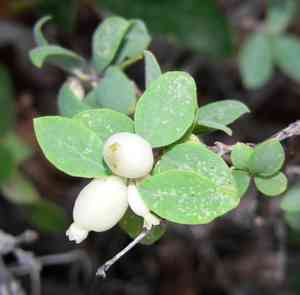
Mountain snowberry (Symphoricarpos oreophilus)
Also known as: Snowberry, Mountain Snowberry
This plant can grow to a height ranging from 30 cm to 1.5 meters, depending on its environment. It produces a white drupe fruit that houses two nutlets, each containing a seed. The plant primarily propagates through its rhizome, with new growth emerging vegetatively from this underground stem. Additionally, it can reproduce through layering and by producing seeds for sexual reproduction.
In This Article
Attributes of Mountain snowberry
Lifespan
Perennial
Plant Type
Herb
Plant Height
61 cm to 1.2 m
Spread
2 to 4 feet (0.6 to 1.2 meters)
Leaf Color
Green
Flower Size
0.2 inches (0.5 cm)
Flower Color
White to pale pink
Images of Mountain snowberry
Quickly Identify Mountain snowberry
1
To identify Symphoricarpos oreophilus, look for a shrub typically between 1 and 2 meters tall. It has oval, opposite leaves and small, bell-shaped white to pale pink flowers. The most distinctive feature is its clusters of white berries that appear in late summer and persist into the winter.
Scientific Classification of Mountain snowberry
Phylum
Vascular plants
Class
Dicotyledons
Order
Dipsacales
Family
Honeysuckle
Genus
Snowberry
Species
Mountain snowberry
Planting and Growing of Mountain snowberry
Care Difficulty
Easy
Watering Schedule
Every 2 days
Sunlight Requirements
Full sun
Sunshine Duration
6-10 hours
Ideal Temperature
60-75℉
Soil Type
Potting Mix, Peat Mix
Soil pH
6.5-7.5
Fertilizer Type
Balanced
Pruning Season
Spring, Summer
Pruning Area
Branches, Leaves
Pruning Frequency
2 times a year
Repotting Season
Spring
Pot Type
Plastic, Ceramic
 How to Water Mountain snowberry?
When watering Symphoricarpos oreophilus, aim for a deep soak that allows 500 milliliters of water to penetrate down to the root zone. The soil should feel moist to your touch but not soggy, ensuring the roots have the right amount of hydration without drowning.
What are the symptoms of an underwatered Mountain snowberry?
›
What should I do if my Mountain snowberry is not getting enough water?
›
What are the symptoms of an overwatered Mountain snowberry?
›
How to save an overwatered Mountain snowberry?
›
 What Are the Sunlight Requirements for Mountain snowberry?
Symphoricarpos oreophilus thrives in full sun to partial sun conditions. Ideal light promotes lush foliage and abundant flowering, enhancing both aesthetic and ecological benefits of the plant in its environment.
How much light is ideal for Symphoricarpos oreophilus?
›
How can you provide the ideal light conditions?
›
What benefits can ideal light conditions bring?
›
 What Is the Ideal Temperature Range for Mountain snowberry?
For Symphoricarpos oreophilus, the ideal temperature range is between 60°F and 75°F. These temperate conditions mimic its natural habitat, ensuring optimal growth and vitality. Proper temperature allows this plant to thrive, producing lush foliage and abundant, vibrant flowers.
 What Soil is Best for Mountain snowberry?
Symphoricarpos oreophilus thrives in well-drained loamy soil as it provides an ideal balance of nutrients and moisture retention. This composition ensures that the roots can breathe while accessing the necessary minerals crucial for healthy growth and robust foliage. The plant prefers soil with moderate moisture levels, preventing both waterlogging and drought stress. Constant but not excessive moisture supports the plant's natural cycles and improves its resilience against changing weather conditions. A nutrient-rich environment is essential for Symphoricarpos oreophilus, as it requires a variety of minerals to maintain its vibrant appearance and to produce flowers. Well-fed soil promotes better blooming, enhances disease resistance, and extends the lifespan of the plant.
 How to Fertilize Mountain snowberry?
For Symphoricarpos oreophilus, it's crucial to avoid over-fertilization. Use a modest amount such as 1/2 teaspoon of liquid fertilizer per 1 gallon of water or a slow-release fertilizer at a rate of 1 tablespoon per square foot of soil. Adapting the amount based on the plant's growth stage and soil quality is essential.
 How to Prune Mountain snowberry?
To maintain a neat and attractive shape for Symphoricarpos oreophilus, remove any dead or crossing branches. This should be done to allow sunlight to penetrate the shrub, promoting healthy growth and a fuller appearance. Use sharp, clean tools to make precise cuts just above a bud or leaf node for best results. Pruning this plant annually enables stronger and healthier branches to form, as old and weak wood is removed. Trim back about one-third of the oldest wood each season after flowering to stimulate vigorous new growth that ensures the shrub's longevity and vitality.
More About Pruning Techniques→
 How to Propagate Mountain snowberry plant?
1
Collect seeds in autumn when the fruit matures. Clean and store them until spring. Sow them in a well-drained mix.
2
Use healthy, non-flowering wood cuttings in spring. Make a clean cut using pruning shears and dip in rooting hormone.
3
In early summer, dig up mature plants and divide the root clumps carefully. Replant the divisions in prepared soil.
 How to Repot Mountain snowberry plant?
1
Look for the signs that your Symphoricarpos oreophilus needs repotting: roots growing out of the drainage holes, the plant seems top-heavy, or when growth has noticeably slowed. Spring and early autumn are ideal times as the plant is not in an active growth phase and can adjust to new conditions more comfortably.
2
Select a pot that is slightly larger than the current one, with ample drainage holes. This ensures room for growth while preventing waterlogging, which can harm the plant’s roots. Terracotta pots are great for their porosity; they allow the soil to breathe and excess moisture to escape.
3
Opt for a well-draining soil mix, perhaps a combination of potting soil, sand, and perlite. This mixture allows for proper moisture retention without becoming waterlogged, which can lead to root rot. The airy composition supports strong roots and healthy growth.
Learn More About Mountain snowberry Diseases
Anthracnose
Bacterial Leaf Spot
Crown Gall
Cyst Nematode
Damping-off
Downy Mildew
Drought Stress
Fusarium Wilt
Gray Mold
Leaf Curl
Leaf Spot
Mosaic
Nutrient Deficiency
Nutrient Toxicity
Powdery Mildew
Root Rot
Root-knot Nematode
Rusts
Sooty Mold
Spider Mites
Temperature Stress
Thrips Damage
White Mold



