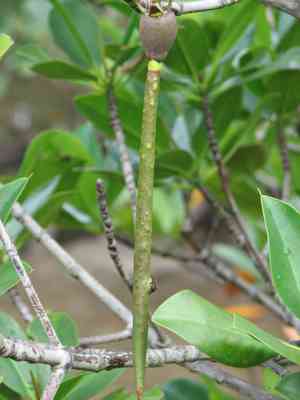
Asiatic mangrove(Rhizophora mucronata)

Asiatic mangrove (Rhizophora mucronata)

Also known as: Red mangrove, Stilt mangrove

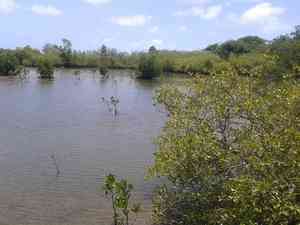
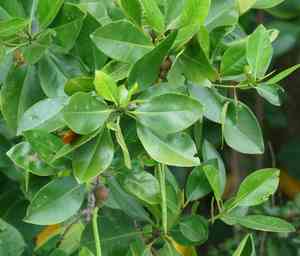
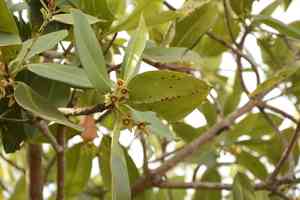
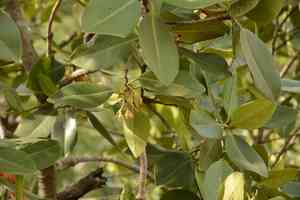
Rhizophora mucronata, also known as the red mangrove, generally grows up to 20 to 25 meters (66 to 82 feet) tall along riverbanks. On the seaward fringes, they typically reach heights of 10 to 15 meters (33 to 49 feet). These trees are tallest near the water and shorter further inland. They feature numerous aerial stilt roots that support the trunk. The elliptical leaves are about 12 centimeters (4.7 inches) long and 6 centimeters (2.4 inches) wide, often with elongated tips that can break off. Corky warts are present on the pale undersides of the leaves. Flowers form in clusters along the twigs, with each flower having a hard cream-colored calyx, four sepals, and four white, hairy petals. The seeds are viviparous, starting to develop while still attached to the tree, with roots that can elongate to over a meter (yard) before detaching to root in the mud below.

Attributes of Asiatic mangrove

Lifespan
Perennial
Plant Type
Tree
Plant Height
10 m to 25 m
Spread
6 m
Leaf Color
Green
Flower Size
0.5 mm to 1.5 mm
Flower Color
Yellow

ForwardPlant - Identify plants with a snap

Identify and diagnose plants, get toxicity alerts, and explore safety guides for all types of fungi.

Try for Free

Images of Asiatic mangrove

Asiatic mangrove(Rhizophora mucronata)

Quickly Identify Asiatic mangrove

1
Identifying Rhizophora mucronata involves looking for its characteristic aerial roots, often called prop roots, as well as its large, leathery leaves that are dark green on the upper surface and lighter underneath.

Scientific Classification of Asiatic mangrove

Phylum
Vascular plants
Class
Dicotyledons
Order
Malpighiales
Family
Red mangrove
Genus
True mangroves
Species
Asiatic mangrove

Planting and Growing of Asiatic mangrove

Care Difficulty
Hard
Watering Schedule
Every 3 days
Sunlight Requirements
Full sun
Sunshine Duration
4-8 hours
Ideal Temperature
77-86℉
Soil Type
Potting Mix, Peat Mix
Soil pH
6.5-7.5
Fertilizer Type
Balanced
Pruning Season
Spring, Summer
Pruning Area
Branches, Leaves
Pruning Frequency
2 times a year
Repotting Season
Spring
Pot Type
Plastic, Ceramic

water icon How to Water Asiatic mangrove?

For Rhizophora mucronata, ensuring the right amount of water is crucial due to its native tidal mangrove habitats. Aim to thoroughly saturate the soil with approximately 1000ml each time, ensuring sufficient moisture without over-saturating, which mimics the tidal inundation they naturally experience.
What are the symptoms of an underwatered Asiatic mangrove?
What should I do if my Asiatic mangrove is not getting enough water?
What are the symptoms of an overwatered Asiatic mangrove?
How to save an overwatered Asiatic mangrove?

sunlight icon What Are the Sunlight Requirements for Asiatic mangrove?

Sunlight Requirements: Full sun, Partial sun
Duration of light: 6 to 8 hours
Rhizophora mucronata typically thrives in full to partial sun. This range enables it to maintain vigorous growth and high energy reserves, contributing to robust development and resilience against environmental stresses.
How much sunlight does Rhizophora mucronata ideally need?
What are some solutions to achieve ideal lighting?
What benefits does ideal lighting provide?

temperature icon What Is the Ideal Temperature Range for Asiatic mangrove?

Ideal Temperature: 77 ~ 86℉
The ideal temperature range for Rhizophora mucronata is between 77°F and 86°F. In this temperature range, the plant can effectively carry out photosynthesis, metabolize nutrients, and grow at its optimal rate. This mangrove species is adapted to warm tropical climates, which allows it to thrive in coastal and estuarine environments where these temperatures are commonly found.

soil icon What Soil is Best for Asiatic mangrove?

Soil type: Sandy soil, Loam, Clay soil
Soil PH: 6.5 ~ 7.5
Rhizophora mucronata thrives in nutrient-rich soils. This requirement ensures that the plant has access to necessary minerals and elements, promoting robust growth, vibrant leaves, and a healthy root system. Mangrove habitats naturally provide such environments, making this an essential criterion. The ability of the soil to retain water is crucial for this mangrove species. Sandy or loam soils offer excellent drainage but should also be capable of holding sufficient moisture to prevent nutrient leaching while supporting healthy root hydration. Good aeration and porosity support root expansion and respiration, which is vital for Rhizophora mucronata. Soils that are too compact can limit these processes and stunt plant growth.

fertilize icon How to Fertilize Asiatic mangrove?

Fertilizer type: Balanced
Rhizophora mucronata, known as the red mangrove, requires specific fertilization to thrive in saline coastal conditions. It benefits from moderate amounts of fertilizer, ensuring that its nutrient needs are met while considering its salt tolerance. Typically, the application of 1-2 teaspoons of a balanced fertilizer per young plant monthly during the growing season is sufficient. Mature plants might require less frequent fertilization as they establish deeper roots, extracting nutrients more effectively from their environment.

prune icon How to Prune Asiatic mangrove?

Pruning Time: Spring, Summer, Autumn
Begin pruning Rhizophora mucronata by identifying any dead or diseased branches. Use clean, sharp pruning tools to make precise cuts. Target branches that cross or rub against each other, which helps improve air circulation and light penetration. Focus cuts to just above a node to encourage new growth. Always prune conservatively, as mangroves play a critical role in coastal ecosystems. More About Pruning Techniques

propagate icon How to Propagate Asiatic mangrove plant?

Propagate Time: Early summer,Late summer
1
Harvest seeds from Rhizophora mucronata when they are mature, typically in late summer. Ensure seeds are not damaged during collection for higher germination rates.
2
Place the seeds in germination trays filled with a mix of sand and peat moss. Water them lightly and place them in a location receiving indirect sunlight. Maintain a warm and humid environment to prompt germination.
3
After seeds germinate and seedlings develop, they should be transplanted to a suitable coastal area. Plant them in muddy substrates, ensuring the roots are well-covered and the seedlings are stable.

repot icon How to Repot Asiatic mangrove plant?

Repotting frequency: Every 2-3 years
1
Signs that Rhizophora mucronata is ready for repotting include noticeable root-bound conditions, where roots emerge from drainage holes, or a significant slowdown in growth. Spring or early summer is the ideal time when the plant is in a growing phase, which helps it recover from the stress of repotting more efficiently.
2
Choose a pot that is one size larger than the current one, with adequate drainage holes. A slightly larger pot prevents waterlogging and allows the roots to expand, promoting a healthier, more robust growth. Additionally, using a breathable material like terra cotta can help manage moisture levels better.
3
Opt for a well-draining, loamy soil that is slightly acidic. This type of soil provides the correct balance of moisture retention and aeration, mimicking the mangrove's natural habitat. It encourages nutrient uptake and supports strong root development, crucial for the plant's health.

ForwardPlant - Identify plants with a snap

Find the best spots for them to optimize their health, simply using your phone.

Try for Free

Toxicity

Ingestion

Identify toxic plants for your safety

Learn which plants are harmful to you and your pets, and make informed choices for a safer home!

Try for Free
WARNING
The judgment on toxicity and danger is for reference only. We DO NOT GUARANTEE any accuracy of such judgment. Therefore, you SHALL NOT rely on such judgment. It is IMPORTANT TO SEEK PROFESSIONAL ADVICE in advance when necessary.