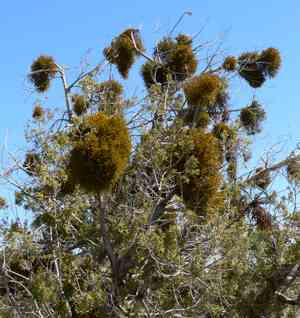
Juniper mistletoe (Phoradendron juniperinum)
Also known as: Juniper Mistletoe
Juniper mistletoe (Phoradendron juniperinum) belongs to the sandalwood family and parasitizes juniper trees. Despite its parasitic nature, it is not closely related to true mistletoe. Birds consume its small berries and later deposit the seeds on tree branches, where they take root. The branches of juniper mistletoe have been utilized to produce a textile dye.
In This Article
Attributes of Juniper mistletoe
Lifespan
Perennial
Plant Type
Shrub
Plant Height
61 cm to 91 cm
Spread
60 cm to 1.2 m
Leaf Color
Greenish-yellow
Flower Size
3 mm to 5 mm
Flower Color
Yellow Green
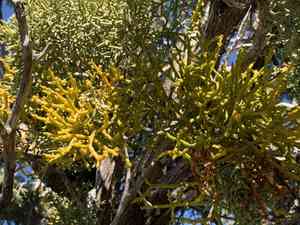
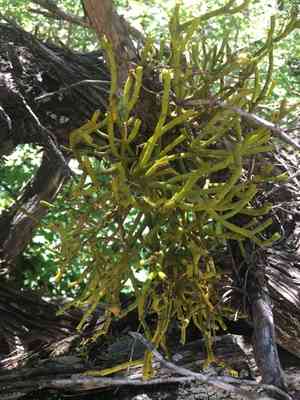
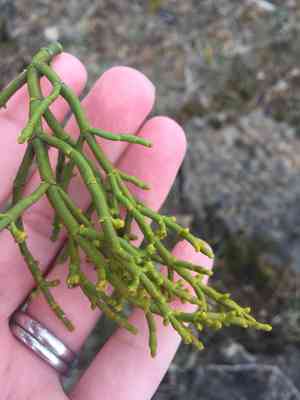
Images of Juniper mistletoe

Quickly Identify Juniper mistletoe
1
Identify Phoradendron juniperinum by looking for its leathery, scale-like leaves and white to yellowish berries. It is commonly found attached to juniper trees.
Scientific Classification of Juniper mistletoe
Phylum
Vascular plants
Class
Dicotyledons
Order
Santalales
Family
Sandalwood
Genus
Mistletoe
Species
Juniper mistletoe
Planting and Growing of Juniper mistletoe
Care Difficulty
Hard
Watering Schedule
Every 2 days
Sunlight Requirements
Partial sun
Sunshine Duration
6-12 hours
Ideal Temperature
55-75℉
Soil Type
Potting Mix, Peat Mix
Soil pH
5.5-7.5
Fertilizer Type
Balanced
Pruning Season
Spring, Summer
Pruning Area
Branches, Leaves
Pruning Frequency
2 times a year
Repotting Season
Spring
Pot Type
Terracotta, Plastic
 How to Water Juniper mistletoe?
Phoradendron juniperinum prefers moderate watering. When watering, ensure the soil is moist but not saturated. The key is to water thoroughly but allow the medium to dry between waterings to mimic its natural arid environment.
What are the symptoms of an underwatered Juniper mistletoe?
›
What should I do if my Juniper mistletoe is not getting enough water?
›
What are the symptoms of an overwatered Juniper mistletoe?
›
How to save an overwatered Juniper mistletoe?
›
 What Are the Sunlight Requirements for Juniper mistletoe?
Phoradendron juniperinum thrives best in partial sun conditions. Receiving 3 to 6 hours of gentle sunlight daily ensures robust growth, vibrant foliage, and maintains overall plant vigor.
More About Sunlight Requirements Techniques→
Solution for Ideal Lighting
›
How to Operate for Ideal Light
›
Benefits of Ideal Lighting
›
 What Is the Ideal Temperature Range for Juniper mistletoe?
Phoradendron juniperinum thrives best in mild temperatures ranging between 55°F and 75°F. This range provides the optimal conditions for the plant to photosynthesize effectively and maintain its water balance, ensuring robust growth and healthy foliage.
 What Soil is Best for Juniper mistletoe?
Phoradendron juniperinum thrives in well-draining soil as it prevents root rot by not retaining excess moisture. This is vital for the plant’s health, allowing it to grow robustly without the risk of the roots being suffocated by waterlogged conditions. A moderate amount of organic matter in the soil can benefit Phoradendron juniperinum as it provides necessary nutrients while maintaining a balanced structure. This promotes healthy growth and assists in maintaining an optimal soil pH level. This plant prefers soil with a pH ranging from neutral to slightly acidic, between 5.5 to 7.5. Such a pH range helps in optimum nutrient absorption, ensuring the plant's foliage grows lush and vibrant.
 How to Fertilize Juniper mistletoe?
When fertilizing Phoradendron juniperinum, ensure to use a balanced, water-soluble fertilizer. Dilute the fertilizer to half the recommended concentration to avoid over-fertilization. Apply approximately 100-150 ml of diluted liquid fertilizer per application to avoid overwhelming this semi-parasitic plant.
 How to Prune Juniper mistletoe?
Begin by removing any dead or diseased branches at their base. Next, cut back any overgrown or crossing branches to enhance structure. Finally, prune to shape the plant aesthetically, ensuring a balanced look. First, examine the plant for weak or damaged growth. Plan your cuts ahead of time to avoid unnecessary damage and ensure healthy, sustained growth.
More About Pruning Techniques→
 How to Propagate Juniper mistletoe plant?
1
Harvest seeds from ripe Phoradendron juniperinum berries. Clean them to remove pulp and residual plant material, which could inhibit germination or harbor pathogens.
2
Prepare a well-draining potting mix. Incorporate sand or perlite to improve aeration and drainage, as Phoradendron juniperinum prefers a substrate that doesn't retain excessive moisture.
3
Sow seeds on the surface of the potting mix, pressing them gently to ensure contact without burying. Cover with a thin layer of soil or vermiculite, keeping it moist but not soggy.
 How to Repot Juniper mistletoe plant?
1
Phoradendron juniperinum typically shows signs of needing a new pot when the roots begin to circle the bottom or poke out through the drainage holes. Additionally, if the plant seems to require frequent watering or there is a noticeable lack in growth, it might be time to consider repotting.
2
Opt for a pot that is only slightly larger than the current one, ideally with good drainage holes. A slight increase in size allows the plant to grow without being overwhelmed by excessive soil, which can retain water and lead to root rot.
3
A well-draining soil mix is critical, incorporating elements such as perlite or sand to prevent waterlogging. This helps ensure that Phoradendron juniperinum's roots receive the right balance of moisture and air, encouraging healthy growth.
Toxicity
Ingestion
WARNING
The judgment on toxicity and danger is for reference only. We DO NOT GUARANTEE any accuracy of such judgment. Therefore, you SHALL NOT rely on such judgment. It is IMPORTANT TO SEEK PROFESSIONAL ADVICE in advance when necessary.



