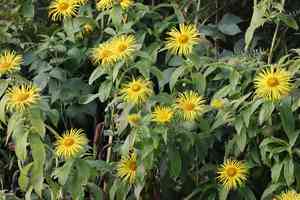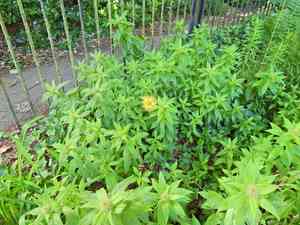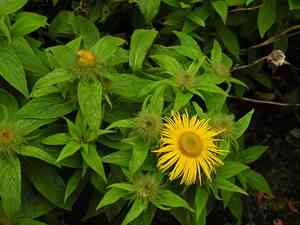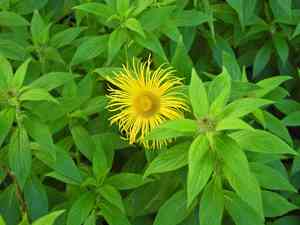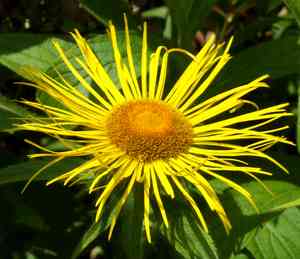
Hooker's inula(Inula hookeri)

Hooker's inula (Inula hookeri)

Also known as: Clump perennial

Hooker's inula (Inula hookeri) makes a wonderful addition to a wildlife garden or meadow due to its numerous benefits:

1. **Pollinator Magnet**: The vibrant yellow flowers are highly attractive to butterflies and bees, providing essential nectar.
2. **Bird-Friendly**: Birds are drawn to its seedheads, making it a great choice for supporting local bird populations.
3. **Versatile Use**: Beyond meadows, it works well in beds, borders, and cottage gardens, adding versatility.
4. **Visual Appeal**: Its unique, spindly petals and fuzzy centers offer aesthetic charm throughout the growing season.

Incorporating Hooker's inula enhances biodiversity while adding beauty to your garden.

Attributes of Hooker's inula

Lifespan
Perennial
Plant Type
Herb
Plant Height
60 cm to 1 m
Spread
45 cm
Leaf Color
Green
Flower Size
6 cm to 8 cm
Flower Color
Yellow

ForwardPlant - Identify plants with a snap

Identify and diagnose plants, get toxicity alerts, and explore safety guides for all types of fungi.

Try for Free

Images of Hooker's inula

Hooker's inula(Inula hookeri)

Quickly Identify Hooker's inula

1
Identify Inula hookeri by its large, vibrant yellow flowers with long, thin petals. It has broad, lance-shaped green leaves and a robust, upright stem.

Scientific Classification of Hooker's inula

Phylum
Vascular plants
Class
Dicotyledons
Order
Asterales
Family
Daisy
Genus
Inula
Species
Hooker's inula

Planting and Growing of Hooker's inula

Care Difficulty
Easy
Watering Schedule
Every 4 days
Sunlight Requirements
Full sun
Sunshine Duration
6-8 hours
Ideal Temperature
60-75℉
Soil Type
Potting Mix, Peat Mix
Soil pH
6.5-7.5
Fertilizer Type
Balanced
Pruning Season
Spring, Summer
Pruning Area
Branches, Leaves
Pruning Frequency
2 times a year
Repotting Season
Spring
Pot Type
Plastic, Ceramic

water icon How to Water Hooker's inula?

Inula hookeri, also known as Hooker's fleabane, requires a consistent watering approach to thrive. The key is to ensure the soil is kept moderately moist but not waterlogged. Watering with approximately 500 milliliters is generally adequate to thoroughly moisten the soil without causing excess water to pool, allowing the roots to breathe and absorb nutrients effectively.
What are the symptoms of an underwatered Hooker's inula?
What should I do if my Hooker's inula is not getting enough water?
What are the symptoms of an overwatered Hooker's inula?
How to save an overwatered Hooker's inula?

sunlight icon What Are the Sunlight Requirements for Hooker's inula?

Sunlight Requirements: Full sun, Partial sun
Duration of light: 6 to 8 hours
This plant enjoys full to partial sunlight, which promotes optimal growth and flowering. Inula hookeri benefits from balanced sun exposure, ensuring robust foliage and a profusion of vibrant blooms.
What is ideal lighting?
How to achieve optimal lighting?
Benefits of ideal lighting?
More About Sunlight Requirements Techniques

temperature icon What Is the Ideal Temperature Range for Hooker's inula?

Ideal Temperature: 60 ~ 75℉
For optimal growth, Inula hookeri thrives in a temperature range of 60 to 75°F. This range enables the plant to carry out metabolic processes efficiently, ensuring robust growth and vibrant flowering. Being a perennial, it appreciates mild climates, typical to its native mountainous regions in the Himalayas.

soil icon What Soil is Best for Hooker's inula?

Soil type: Loam, Sandy loam
Soil PH: 6.5 ~ 7.5
Inula hookeri thrives in well-draining soil to prevent waterlogging, which can cause root rot. This type of soil balance ensures that the plant receives adequate moisture without risking stunted growth or disease. For optimal growth, Inula hookeri benefits from a nutrient-rich soil. Mixing in organic matter, such as compost, can provide essential nutrients required for vibrant blooms and robust foliage. The soil should retain enough moisture to sustain the plant in dry periods while allowing enough air circulation for healthy root development, crucial for the resilience and vigor of Inula hookeri.

fertilize icon How to Fertilize Hooker's inula?

Fertilizer type: Balanced
Inula hookeri benefits from a balanced fertilizer with an N-P-K ratio of 10-10-10. During the growing season, apply liquid fertilizer at half-strength to avoid overfeeding. For solid fertilizer, use approximately 50 grams per application around the base of the plant.

prune icon How to Prune Hooker's inula?

Pruning Time: Spring, Summer
Identify the stems that are dead, diseased, or damaged. 2. Use clean sharp shears to cut these stems at their base. 3. Trim back any leggy growth to encourage bushier growth. Cut just above a leaf node to promote a fuller plant. More About Pruning Techniques

propagate icon How to Propagate Hooker's inula plant?

Propagate Time: Spring, Early summer
1
Clean seeds to remove any debris and soak them in water overnight to improve germination. This step ensures that seeds are ready to sprout when planted.
2
Select healthy stems for cuttings, cutting them with sterilized shears to prevent disease. Remove the lower leaves and allow the cutting to dry for a few hours before planting.
3
Gently remove the plant from its pot and separate the roots into clumps, ensuring each has healthy shoots and roots. Replant the divisions promptly to reduce stress.
More About Propagating Techniques

repot icon How to Repot Hooker's inula plant?

Repotting frequency: Every 2-3 years
1
Inula hookeri benefits from repotting when it shows signs of root binding, yellowing leaves, or stunted growth. These signals indicate that the roots have filled the container and can't absorb nutrients effectively. The best time to repot is during its active growing phase in spring or early summer, as this minimizes stress and maximizes recovery.
2
Select a pot that is one size larger than the current one, ensuring it has good drainage holes. A slightly larger pot encourages healthy root growth without overwhelming the plant. Materials like terracotta are ideal, as they allow airflow to the roots and help prevent overwatering.
3
Opt for a loamy, well-draining soil mix to prevent root rot and maintain moisture balance. This type of soil supports the plant's nutrient uptake and water regulation, crucial for maintaining healthy growth and vibrant blooms.

ForwardPlant - Identify plants with a snap

Find the best spots for them to optimize their health, simply using your phone.

Try for Free