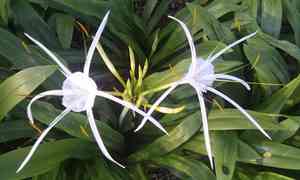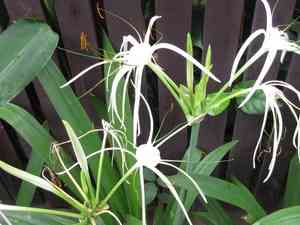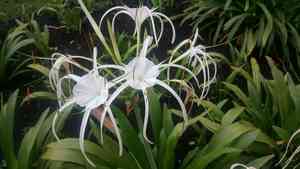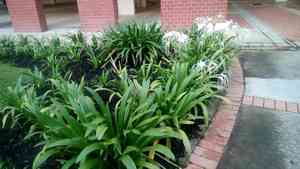
Green-tinge spiderlily(Hymenocallis speciosa)

Green-tinge spiderlily (Hymenocallis speciosa)

Also known as: Spider Lily, Beach Spider Lily, Green-tinge Spider Lily

Hymenocallis speciosa, known as the green-tinge spiderlily, is a notable species within the genus Hymenocallis, originally found in the Windward Islands of the eastern Caribbean. This bulb-forming perennial is admired for its ornamental value and has been introduced to places like Cuba and the Bahamas.

The plant features a stipe that can grow up to 50 cm tall. Its lanceolate leaves can reach lengths of up to 50 cm and widths of about 10 cm, tapering into a petiole. Each umbel can bear up to 20 striking flowers. The flowers are predominantly white with a characteristic greenish tinge, and their tepals reflex, or curl backward, during blooming.

Attributes of Green-tinge spiderlily

Lifespan
Perennial
Plant Type
Herb
Plant Height
50 cm
Spread
50 cm
Leaf Color
Green
Flower Size
5-6 inches (12-15 cm)
Flower Color
White

ForwardPlant - Identify plants with a snap

Identify and diagnose plants, get toxicity alerts, and explore safety guides for all types of fungi.

Try for Free

Images of Green-tinge spiderlily

Green-tinge spiderlily(Hymenocallis speciosa)

Quickly Identify Green-tinge spiderlily

1
Hymenocallis speciosa can be identified by its long, strap-like leaves that are dark green and glossy. The flowers are large, white, and fragrant with six slender, elongated lobes that curve outward. The plant typically blooms in the late spring to early summer.

Scientific Classification of Green-tinge spiderlily

Phylum
Vascular plants
Class
Monocotyledons
Order
Asparagales
Family
Amaryllis
Genus
insmene
Species
Green-tinge spiderlily

Planting and Growing of Green-tinge spiderlily

Care Difficulty
Easy
Watering Schedule
Every 2 days
Sunlight Requirements
Partial sun
Sunshine Duration
4-6 hours
Ideal Temperature
65-75℉
Soil Type
Potting Mix, Peat Mix
Soil pH
6.5-7.5
Fertilizer Type
Balanced
Pruning Season
Spring, Summer
Pruning Area
Branches, Leaves
Pruning Frequency
2 times a year
Repotting Season
Spring
Pot Type
Plastic, Terracotta

water icon How to Water Green-tinge spiderlily?

For Hymenocallis speciosa, aim to water until the soil is evenly moist without waterlogging. This usually means approximately 500 milliliters per session. Always ensure that excess water can drain away, as this plant dislikes sitting in stagnant water.
What are the symptoms of an underwatered Green-tinge spiderlily?
What should I do if my Green-tinge spiderlily is not getting enough water?
What are the symptoms of an overwatered Green-tinge spiderlily?
How to save an overwatered Green-tinge spiderlily?

sunlight icon What Are the Sunlight Requirements for Green-tinge spiderlily?

Sunlight Requirements: Partial sun
Duration of light: 4-6 hours of sunlight
Hymenocallis speciosa flourishes with partial sun, about 4-6 hours of sunlight a day, ideally during morning or late afternoon. This ideal range ensures balanced photosynthesis, promoting healthy and vibrant growth.
What is the ideal amount of sunlight for Hymenocallis speciosa?
How can you ensure Hymenocallis speciosa gets the right amount of light?
What are the benefits of giving Hymenocallis speciosa its ideal light?

temperature icon What Is the Ideal Temperature Range for Green-tinge spiderlily?

Ideal Temperature: 65 ~ 75℉
The ideal temperature range for Hymenocallis speciosa is between 65°F and 75°F. This range ensures optimal growth and blooming, providing a favorable climate that mimics their natural habitat. Within this temperature range, the plant maintains its physiological processes effectively.

soil icon What Soil is Best for Green-tinge spiderlily?

Soil type: Sandy loam, Loam, Sandy soil
Soil PH: 6.5 ~ 7.5
Hymenocallis speciosa thrives in well-drained soil, which ensures that water does not stagnate, preventing root rot. This type of soil promotes healthy root growth and nutrient absorption, essential for vibrant blossoms. This plant prefers soil that has moderate levels of nutrients. Excessive nutrients can lead to lush foliage at the expense of flowers, while too little can stunt growth. Balanced nutrition facilitates robust growth and blooming. A slightly acidic to neutral pH helps in maintaining nutrient availability in soil, crucial for the plant's health. An optimal pH aids in the efficient uptake of essential minerals, keeping the plant well-nourished.

fertilize icon How to Fertilize Green-tinge spiderlily?

Fertilizer type: Balanced
For Hymenocallis speciosa, a balanced 10-10-10 liquid fertilizer should be diluted to half strength. Apply approximately 1/2 tablespoon per gallon of water for optimal results.

prune icon How to Prune Green-tinge spiderlily?

Pruning Time: Spring, Summer
Ensure your pruning tools are clean and sharp before use. This reduces stress on the plant and decreases the likelihood of introducing pathogens through open cuts. Sanitizing your tools between plants is also advisable to prevent cross-contamination. Be careful not to over-prune Hymenocallis speciosa, as trimming too much foliage can stress the plant and hinder its ability to photosynthesize effectively. Aim to remove no more than 20-30% of the plant at any one time. Early morning is the ideal time for pruning, as cooler temperatures and reduced sunlight minimize the risk of plant stress and evaporation. This allows the plant to heal more efficiently throughout the day. More About Pruning Techniques

propagate icon How to Propagate Green-tinge spiderlily plant?

Propagate Time: Spring, Early spring
1
Soak the seeds in warm water for 24 hours to soften the seed coat. This enhances germination rates by allowing moisture to penetrate the seed more effectively.
2
Sow the treated seeds in a seed tray filled with a well-draining seed starting mix. Cover lightly with soil and water gently to ensure consistent moisture without waterlogging.
3
Carefully dig up the parent plant and separate the bulbs. Ensure each separated bulb has roots and a shoot for successful growth when replanted.
More About Propagating Techniques

repot icon How to Repot Green-tinge spiderlily plant?

Repotting frequency: Every two to three years
1
Repot Hymenocallis speciosa when you observe stunted growth, roots emerging from the drainage holes, or if the plant seems top-heavy and unstable in its pot. Spring is the optimal time to repot, as the growing conditions favor root establishment.
2
Select a pot that's 2-3 inches bigger in diameter than the current one. Ensure it has adequate drainage holes to prevent waterlogging, which can lead to root rot. A pot that's slightly larger will provide space for root expansion.
3
Choose well-drained loamy soil rich in organic matter. The right soil mix facilitates proper drainage and aeration, helping prevent water stagnation that Hymenocallis speciosa roots despise.

ForwardPlant - Identify plants with a snap

Find the best spots for them to optimize their health, simply using your phone.

Try for Free

Toxicity

Ingestion

Identify toxic plants for your safety

Learn which plants are harmful to you and your pets, and make informed choices for a safer home!

Try for Free
WARNING
The judgment on toxicity and danger is for reference only. We DO NOT GUARANTEE any accuracy of such judgment. Therefore, you SHALL NOT rely on such judgment. It is IMPORTANT TO SEEK PROFESSIONAL ADVICE in advance when necessary.