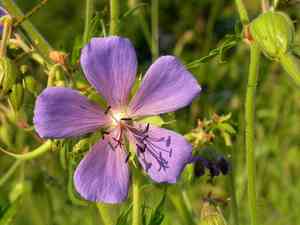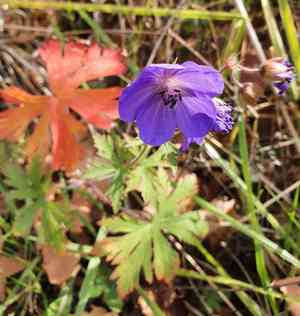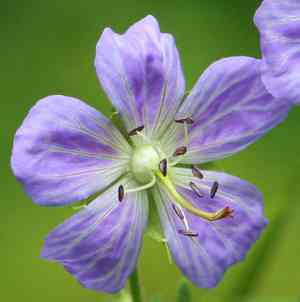
Meadow crane's-bill(Geranium pratense)

Meadow crane's-bill (Geranium pratense)

Also known as: Meadow Crane's-bill, Meadow Geranium

An herbaceous plant native to Europe and Asia, the Hollyhock (Alcea rosea) stands out for its impressive height and vibrant saucer-shaped flowers in pink, purple, and blue hues. Commonly planted in borders and cottage gardens, it serves as an excellent source of pollen and nectar for bees and other pollinators.

Attributes of Meadow crane's-bill

Lifespan
Perennial, Annual
Plant Type
Herb
Plant Height
30 cm to 50 cm
Spread
60 cm to 75 cm
Leaf Color
Green
Flower Size
2.5 cm to 5 cm
Flower Color
Blue White Purple Violet Pink

ForwardPlant - Identify plants with a snap

Identify and diagnose plants, get toxicity alerts, and explore safety guides for all types of fungi.

Try for Free

Images of Meadow crane's-bill

Meadow crane's-bill(Geranium pratense)

Quickly Identify Meadow crane's-bill

1
Identifying Geranium pratense involves looking for its deeply divided, serrated leaves and its distinctively lobed appearance. The flowers are typically blue or violet with five petals, and the plant grows upright with a branched structure.

Scientific Classification of Meadow crane's-bill

Phylum
Vascular plants
Class
Dicotyledons
Order
Geraniales
Family
Geranium
Genus
Geraniums
Species
Meadow crane's-bill

Planting and Growing of Meadow crane's-bill

Care Difficulty
Easy
Watering Schedule
Every 3 days
Sunlight Requirements
Full sun
Sunshine Duration
6-10 hours
Ideal Temperature
65-75℉
Soil Type
Potting Mix, Peat Mix
Soil pH
6.5-7.5
Fertilizer Type
Balanced
Pruning Season
Spring, Summer
Pruning Area
Branches, Leaves
Pruning Frequency
2 times a year
Repotting Season
Spring
Pot Type
Terracotta, Plastic

water icon How to Water Meadow crane's-bill?

Geranium pratense appreciates consistent moisture without being waterlogged. The goal is to provide approximately 500 milliliters per watering session, ensuring the soil is evenly moist, but not drenched. A deep soak is preferred to shallow, frequent watering to encourage healthy root growth.
What are the symptoms of an underwatered Meadow crane's-bill?
What should I do if my Meadow crane's-bill is not getting enough water?
What are the symptoms of an overwatered Meadow crane's-bill?
How to save an overwatered Meadow crane's-bill?

sunlight icon What Are the Sunlight Requirements for Meadow crane's-bill?

Sunlight Requirements: Full sun, Partial sun
Duration of light: 6-8 hours daily
For optimal health, Geranium pratense benefits most from full sun to partial sun. This ensures healthy foliage, strong growth patterns, and abundant flowering.
How much sunlight does it need?
What can be done to achieve ideal lighting?
What are the benefits of ideal lighting?
More About Sunlight Requirements Techniques

temperature icon What Is the Ideal Temperature Range for Meadow crane's-bill?

Ideal Temperature: 65 ~ 75℉
The ideal temperature range for Geranium pratense is between 65°F to 75°F. Maintaining this range ensures optimal growth and flowering, as these temperatures mimic their natural habitat conditions. Ensuring stable temperatures within this range will help the plant thrive and remain healthy throughout its growing season.

soil icon What Soil is Best for Meadow crane's-bill?

Soil type: Loam, Sandy loam, Clay soil
Soil PH: 6.5 ~ 7.5
Geranium pratense thrives in soil with good drainage. Well-drained soil prevents waterlogging, which can lead to root rot, promoting healthy root growth and vibrant blooms. A nutrient-rich soil boosts the plant's vigor and enhances its flowering capacity. Incorporating organic matter such as compost can improve the soil's fertility, ensuring robust plant development. While the soil needs good drainage, it should also retain enough moisture to sustain the plant. Balanced moisture levels are crucial for Geranium pratense to maintain lush foliage and continuous blooms. More About Soil

fertilize icon How to Fertilize Meadow crane's-bill?

Fertilizer type: Balanced
For Geranium pratense, the fertilizer amount should be moderate. Use a balanced fertilizer such as a 10-10-10 NPK formula. For liquid fertilizers, dilute it to half the recommended strength to avoid potential root burn. Apply approximately 1 liter of diluted solution per square meter. More About Fertilizing Techniques

prune icon How to Prune Meadow crane's-bill?

Pruning Time: Spring, Summer
In spring, cut back old or damaged stems to encourage new growth. This helps to shape the plant and promotes a fuller appearance. Use sharp, clean shears to make precise cuts, ideally just above a leaf node. Ensure that your cuts angle slightly, which helps rainwater to run off and minimizes disease risk. During summer, prune lightly to enhance the plant's shape and remove any spent flowers. This encourages continuous blooming. Deadheading, or removing spent blooms, directs the plant's energy toward producing new blossoms rather than seed formation. Additionally, you can selectively trim stems that disrupt the plant's desired form. More About Pruning Techniques

propagate icon How to Propagate Meadow crane's-bill plant?

Propagate Time: Spring,Early spring,Early autumn
1
Start by filling a seed tray with a well-draining seed starting mix. Sprinkle Geranium pratense seeds on top, then lightly cover them with a thin layer of soil. Water gently and place the tray in a warm, bright location.
2
Select healthy, non-flowering stems and cut just below a node. Remove the lower leaves, dip the cut end in rooting hormone, and plant in a pot filled with a suitable potting mix. Keep the soil moist until roots develop.
3
In early spring, carefully dig up the plant and divide the root ball into sections, ensuring each section has roots and shoots. Replant the divisions at the same depth they were growing before and water thoroughly.
More About Propagating Techniques

repot icon How to Repot Meadow crane's-bill plant?

Repotting frequency: Every 2-3 years
1
Repotting is necessary when you observe that the soil is drying out too quickly or roots start poking out of the drainage holes. This indicates the Geranium pratense needs more room to grow or a refresh in nutrients, typically visible in early Spring.
2
Choose a pot that is one size larger than the current one and has drainage holes to avoid waterlogging. A slightly bigger pot ensures room for root expansion, enhancing the plant's health and encouraging new growth.
3
Opt for a well-draining garden soil rich in organic matter. This allows roots to breathe and access nutrients efficiently, reducing the risk of root rot and promoting vigorous growth, keeping the plant vibrant and healthy.

ForwardPlant - Identify plants with a snap

Find the best spots for them to optimize their health, simply using your phone.

Try for Free

Toxicity of Meadow crane's-bill

Is Meadow crane's-bill toxic to humans?

Meadow crane's-bill exhibits a low level of toxicity to humans, mainly through ingestion. The entire plant contains the harmful compound geraniol, which can result in negative effects if ingested. Individuals consuming it may face various symptoms, including gastrointestinal distress, such as nausea and vomiting, along with possible skin irritation. Since all parts of the meadow crane's-bill are toxic, it is wise to exercise caution to avoid accidental ingestion, especially given that the plant is not commonly eaten. The mild toxicity associated with meadow crane's-bill highlights the significance of recognizing and steering clear of unintentional consumption of this plant to protect human health.

Is Meadow crane's-bill toxic to cat?

Meadow crane's-bill is regarded as having mild toxicity for cats. The entire plant is harmful, and cats could suffer poisoning if they unintentionally eat any portion of it. Ingestion can lead to general symptoms that suggest physical discomfort or illness in cats. Geraniol is the toxic compound present in meadow crane's-bill, so it's vital to observe pets carefully for any signs of distress. Should poisoning be suspected, it is imperative to seek prompt treatment at a veterinary clinic to safeguard the health and well-being of the affected cat.

Is Meadow crane's-bill toxic to dog?

The plant known as meadow crane's-bill is regarded as having a mild toxic effect on dogs. Consumption of any part of this plant can lead to poisoning in dogs, as the whole plant is toxic. If ingested accidentally, a dog might show symptoms like gastrointestinal distress or skin irritation. The chemical compound causing these adverse reactions in dogs is Geraniol. Should you suspect that your dog has eaten meadow crane's-bill, it is crucial to obtain prompt veterinary assistance to secure appropriate treatment and address any potential poisoning.

Identify toxic plants for your safety

Learn which plants are harmful to you and your pets, and make informed choices for a safer home!

Try for Free
WARNING
The judgment on toxicity and danger is for reference only. We DO NOT GUARANTEE any accuracy of such judgment. Therefore, you SHALL NOT rely on such judgment. It is IMPORTANT TO SEEK PROFESSIONAL ADVICE in advance when necessary.
More About Toxic Techniques