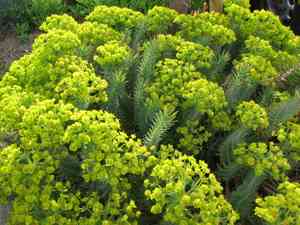
Upright myrtle spurge (Euphorbia rigida)
Also known as: Silver spurge, Rigid spurge
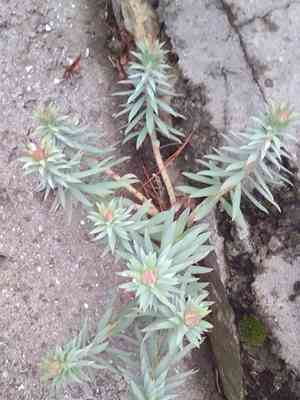
The upright myrtle spurge (Euphorbia rigida) is a visually striking perennial often perceived as a succulent. It features tightly spiraled blue-green leaves with clusters of bright yellow-green flowers. However, caution is advised as the plant is toxic if ingested, and its milky sap can cause skin irritation.
In This Article
Attributes of Upright myrtle spurge
Lifespan
Perennial
Plant Type
Herb
Plant Height
30 cm to 61 cm
Spread
60 cm to 90 cm
Leaf Color
Green Blue
Flower Size
2.5 cm
Flower Color
Yellow Green
Images of Upright myrtle spurge
Quickly Identify Upright myrtle spurge
1
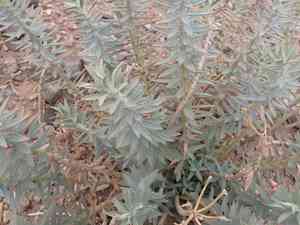
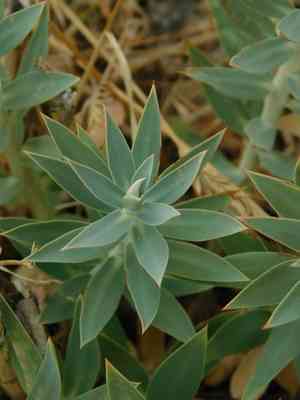
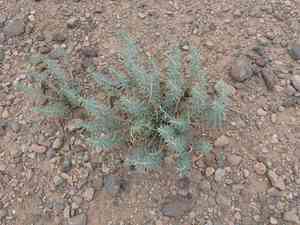
Compact shrub reaching 2 feet (60 cm) tall with steel blue-green lanceolate leaves in spiral patterns.
2
Showy chartreuse-yellow bracts surrounding small green flowers, creating a vivid floral display.
3
Lobed oval fruit capsule with green coloration, less than an inch in size, may change texture.
4
Succulent, lance-shaped leaves transitioning to red and bronze tones in fall, with simple vein pattern.
Scientific Classification of Upright myrtle spurge
Phylum
Vascular plants
Class
Dicotyledons
Order
Malpighiales
Family
Spurge
Genus
Spurges
Species
Upright myrtle spurge
Planting and Growing of Upright myrtle spurge
Care Difficulty
Easy
Watering Schedule
Every 2 days
Sunlight Requirements
Full sun
Sunshine Duration
4-6 hours
Ideal Temperature
65-75℉
Soil Type
Potting Mix, Peat Mix
Soil pH
6.5-7.5
Fertilizer Type
Balanced
Pruning Season
Spring, Summer
Pruning Area
Leaves, Branches
Pruning Frequency
2 times a year
Repotting Season
Spring
Pot Type
Plastic, Ceramic
 How to Water Upright myrtle spurge?
Euphorbia rigida prefers a specific watering regimen—deep yet infrequent is the key. Ensure the soil is thoroughly soaked yet allow it to dry completely before the next watering. This simulates its natural arid habitat, preventing root rot and promoting root health.
What are the symptoms of an underwatered Upright myrtle spurge?
›
What should I do if my Upright myrtle spurge is not getting enough water?
›
What are the symptoms of an overwatered Upright myrtle spurge?
›
How to save an overwatered Upright myrtle spurge?
›
 What Are the Sunlight Requirements for Upright myrtle spurge?
Full to partial sunlight is ideal, benefiting Euphorbia rigida by providing ample energy for growth. This light regimen fosters robust health, vibrant color, and resilience against pests and environmental stressors.
More About Sunlight Requirements Techniques→
Best Time to Position
›
Preventing Sunburn
›
Moving for Maximum Exposure
›
 What Is the Ideal Temperature Range for Upright myrtle spurge?
The ideal temperature range for Euphorbia rigida is between 65°F to 75°F. This range provides optimal conditions for the plant's growth and flowering, ensuring that metabolic processes can function properly. Consistency within this temperature range reduces stress and promotes healthy development.
 What Soil is Best for Upright myrtle spurge?
Euphorbia rigida thrives in well-drained soil, which prevents waterlogging and root rot. This type of soil ensures that excess water is efficiently directed away from the roots, allowing the plant to grow healthily without the risk of drowning or fungal infections. While not overly demanding, Euphorbia rigida benefits from moderately fertile soil. This condition provides essential nutrients that support its growth and flowering, ensuring lush foliage and vibrant blooms without the need for excessive fertilization. This plant prefers a soil pH that ranges from neutral to slightly alkaline. Such pH levels ensure optimal nutrient availability and uptake, promoting healthy growth and reducing the risk of nutrient deficiencies.
 How to Fertilize Upright myrtle spurge?
Euphorbia rigida requires a balanced nutrient input to thrive. For liquid fertilizers, a quarter-strength dilution of a balanced liquid fertilizer is ideal. When using slow-release granules, apply approximately 30 grams per square meter, ensuring even distribution around the base of the plant.
 How to Prune Upright myrtle spurge?
Begin by sterilizing your pruning shears to prevent disease spread. Identify any dead, damaged, or diseased stems and cut them back to the base. If the plant is becoming too leggy, selectively trim back some of the older growth to encourage a denser form. Remove any stems that are crossing or overcrowding to improve airflow and light penetration. Always cut back to a node or where the stem meets another stem to ensure clean healing and lush regrowth.
More About Pruning Techniques→
 How to Propagate Upright myrtle spurge plant?
1
Collect seeds from mature Euphorbia rigida plants by allowing the seed pods to dry and crack open. Gather the seeds, ensuring they are dry before storing them in a cool, dry place until planting.
2
Choose a healthy stem from the parent plant and use sharp shears to cut a section about 10-15 cm long. Remove any lower leaves and dip the cut end in rooting hormone to encourage root development.
3
Sow seeds in trays filled with well-draining soil. Keep them in a warm location with moderate sunlight, maintaining constant moisture until germination. Transplant seedlings to pots once they reach a suitable size.
 How to Repot Upright myrtle spurge plant?
1
Euphorbia rigida shows signs of needing repotting when the roots start to outgrow the pot's drainage holes or the soil seems to degrade, causing poor water retention or drainage. Ideally, observe these signals in the spring or autumn when the plant is dormant or shows slowed growth, allowing it to adjust without overstressing.
2
Select a pot that is one to two inches larger in diameter than the current one to provide ample room for root growth. Ensure that it has sufficient drainage holes to prevent waterlogging, which can lead to root rot, maintaining health and vigor in your Euphorbia rigida.
3
Select a well-draining cactus mix to provide the best aeration and prevent overwatering, which could be detrimental. A blend with perlite or sand is ideal, as it mimics the plant's natural habitat, ensuring optimal growth and moisture control.
Toxicity
Ingestion, Skin Contact
WARNING
The judgment on toxicity and danger is for reference only. We DO NOT GUARANTEE any accuracy of such judgment. Therefore, you SHALL NOT rely on such judgment. It is IMPORTANT TO SEEK PROFESSIONAL ADVICE in advance when necessary.
Learn More About Upright myrtle spurge Diseases
Anthracnose
Bacterial Leaf Spot
Bacterial Soft Rot
Chemical Injury
Crown Gall
Damping-off
Downy Mildew
Drought Stress
Fusarium Wilt
Gray Mold
Leaf Spot
Mosaic
Nutrient Deficiency
Nutrient Toxicity
Powdery Mildew
Root Rot
Root-knot Nematode
Rusts
Sooty Mold
Spider Mites
Temperature Stress
Thrips Damage
White Mold



