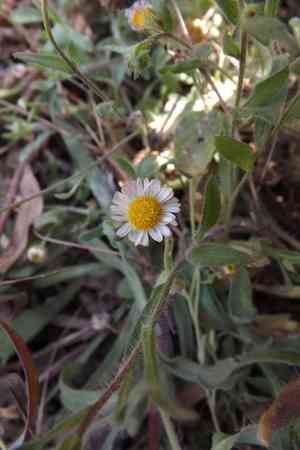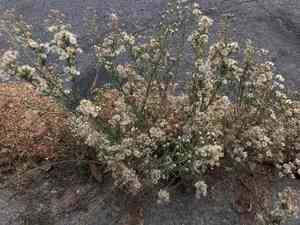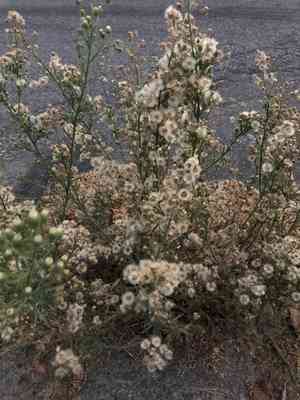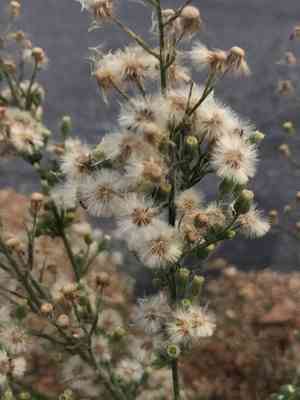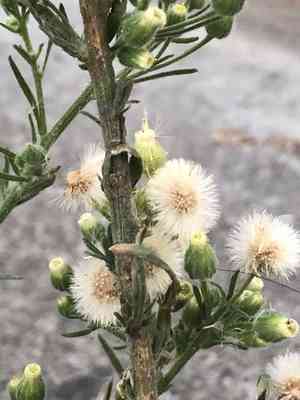
Hairy fleabane(Erigeron pubescens)

Hairy fleabane (Erigeron pubescens)

Also known as: Pubescent Fleabane

Hairy fleabane (Conyza bonariensis) is a hardy annual or biennial plant characterized by its erect, branched, and hairy stems. It typically grows 1-3 feet (30-90 cm) tall. The plant features narrow, lance-shaped leaves covered in fine hairs, forming a rosette at the base. Its small, clustered flowers are white to yellowish, resembling tiny daisies, and bloom primarily from spring to early summer.

**Growing conditions**:

- **Sunlight**: Prefers full sun.
- **Soil**: Adapts well to well-drained soils, including rocky or sandy types.
- **Water**: Demonstrates notable drought tolerance once established, though occasional watering can be beneficial.
- **Climate**: Flourishes in temperate to subtropical regions.

Hairy fleabane is commonly found in disturbed areas such as roadsides and agricultural fields, where it easily colonizes open spaces.

Attributes of Hairy fleabane

Lifespan
Perennial
Plant Type
Herb
Plant Height
10-40 cm
Spread
20-30 cm
Leaf Color
Green
Flower Size
1-2 cm
Flower Color
White, Pink, Yellow center

ForwardPlant - Identify plants with a snap

Identify and diagnose plants, get toxicity alerts, and explore safety guides for all types of fungi.

Try for Free

Images of Hairy fleabane

Hairy fleabane(Erigeron pubescens)

Quickly Identify Hairy fleabane

1
Look for its hairy leaves and stems, along with its typical daisy-like flowers which are usually white or pink with a yellow center. The plant grows in clumps and has a somewhat bushy appearance.

Scientific Classification of Hairy fleabane

Phylum
Vascular plants
Class
Dicotyledons
Order
Asterales
Family
Daisy
Genus
Fleabanes
Species
Hairy fleabane

Planting and Growing of Hairy fleabane

Care Difficulty
Easy
Watering Schedule
Every 3 days
Sunlight Requirements
Full sun
Sunshine Duration
6-8 hours
Ideal Temperature
60-75℉
Soil Type
Potting Mix, Peat Mix
Soil pH
6.5-7.5
Fertilizer Type
Balanced
Pruning Season
Spring, Summer
Pruning Area
Branches, Leaves
Pruning Frequency
2 times a year
Repotting Season
Spring
Pot Type
Plastic, Terracotta

water icon How to Water Hairy fleabane?

Ensure that each watering provides about 250 milliliters of water. This plant enjoys a balance between slightly moist and dry soil. Make sure the soil is well-drained, so each watering session leaves the soil feeling slightly damp but not soggy.
What are the symptoms of an underwatered Hairy fleabane?
What should I do if my Hairy fleabane is not getting enough water?
What are the symptoms of an overwatered Hairy fleabane?
How to save an overwatered Hairy fleabane?

sunlight icon What Are the Sunlight Requirements for Hairy fleabane?

Sunlight Requirements: Full sun, Partial sun
Duration of light: 6-8 hours of sunlight
Erigeron pubescens ideal lighting spans full sun to partial sun. This range supports its flowering pattern and overall plant vigor, maximizing blooms and maintaining compact growth.
What is the best lighting condition for Erigeron pubescens?
How can I achieve the ideal lighting for Erigeron pubescens?
What are the benefits of ideal lighting conditions for Erigeron pubescens?

temperature icon What Is the Ideal Temperature Range for Hairy fleabane?

Ideal Temperature: 60 ~ 75℉
The ideal temperature range for growing Erigeron pubescens is between 60°F and 75°F. This range ensures optimal growth and flowering. Maintaining this temperature range will help the plant develop healthy foliage and robust root systems. Ensuring the plant's environment stays within these bounds will generally promote better overall health and resilience.

soil icon What Soil is Best for Hairy fleabane?

Soil type: Sandy loam, Loam
Soil PH: 6.5 ~ 7.5
Erigeron pubescens thrives best in nutrient-rich soil. This abundance of nutrients ensures robust growth and vibrant blooms by providing all necessary macro and micronutrients. A well-draining soil prevents the detrimental effects of waterlogged roots. This condition promotes healthy root systems, enabling the plant to absorb nutrients efficiently. While Erigeron pubescens prefers moderate moisture levels, the soil should be able to retain some water without being consistently damp, promoting steady water availability.

fertilize icon How to Fertilize Hairy fleabane?

Fertilizer type: Balanced
For Erigeron pubescens, you should be cautious with fertilizer amounts. Generally, use a balanced liquid fertilizer diluted to half the recommended strength. For solid fertilizers, a light top dressing with a slow-release type is sufficient. Over-fertilizing can lead to rapid, weak growth and can harm the plant.

prune icon How to Prune Hairy fleabane?

Pruning Time: Spring, Summer
Begin pruning Erigeron pubescens during the early spring to encourage bushy growth and continued blooming. Use clean, sharp shears to avoid damaging the plant and ensure crisp cuts. Regularly remove spent blooms to prolong flowering. Snip wilted flowers just above the first set of healthy leaves, which redirects the plant's energy towards producing new growth and flowers. More About Pruning Techniques

propagate icon How to Propagate Hairy fleabane plant?

Propagate Time: Early spring,Spring
1
The first step in propagation is to sow Erigeron pubescens seeds in a seed tray filled with a moist potting mix, lightly covering them with soil.
2
Select a healthy, non-flowering stem and cut a 4-6 inch piece just below a node. Remove the lower leaves to prepare it for planting.
3
Carefully dig up an established Erigeron pubescens, gently separate the roots into smaller clumps, and replant these divisions into prepared garden beds.
More About Propagating Techniques

repot icon How to Repot Hairy fleabane plant?

Repotting frequency: Every 1-2 years
1
Erigeron pubescens signals its need for repotting when its roots begin to circle the soil surface, or you notice diminished growth and water retention. The best times to repot are during spring or autumn when the plant is not in its peak growing phase, facilitating recovery with minimal stress.
2
Select a pot that's just a couple of inches larger in diameter than the current one to avoid excess soil that may retain water and cause root rot. A pot with drainage holes is essential as it prevents waterlogging and promotes healthy root growth by allowing excess water to escape.
3
Opt for a well-draining soil mix, preferably with added perlite or sand, ensuring good aeration and moisture control. This type of soil mimics its natural environment and promotes robust, healthy growth while reducing the risk of root rot and other soil-borne issues.

ForwardPlant - Identify plants with a snap

Find the best spots for them to optimize their health, simply using your phone.

Try for Free