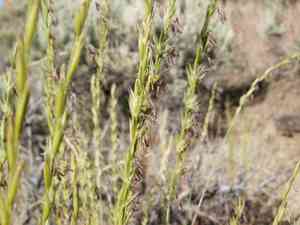
Blue bunch wheat grass (Elymus spicatus)
Also known as: Bluebunch Wheatgrass
Bluebunch wheatgrass is notable for its seedheads, which have awns that protrude almost perpendicular to the stem, and it often has a bluish hue. One key adaptation for surviving in dry soils is its wax-coated roots, which help prevent water loss. Additionally, in more humid conditions, this grass can develop rhizomes.
In This Article
Attributes of Blue bunch wheat grass
Lifespan
Perennial
Plant Type
Grass
Plant Height
30 cm to 1.8 m
Spread
N/A
Leaf Color
Blue-green
Flower Size
N/A
Flower Color
Greenish
Images of Blue bunch wheat grass
Quickly Identify Blue bunch wheat grass
1
Bluebunch Wheatgrass can be identified by its blue-green leaves, narrow and spiky flower heads, and the presence of long awns on the seeds.
Scientific Classification of Blue bunch wheat grass
Phylum
Vascular plants
Class
Monocotyledons
Order
Poales
Family
Grass
Genus
Couch grasses
Species
Blue bunch wheat grass
Planting and Growing of Blue bunch wheat grass
Care Difficulty
Easy
Watering Schedule
Every day
Sunlight Requirements
Full sun
Sunshine Duration
4-8 hours
Ideal Temperature
50-75℉
Soil Type
Potting Mix, Peat Mix
Soil pH
6.5-7.5
Fertilizer Type
Balanced
Pruning Season
Spring, Summer
Pruning Area
Branches, Leaves
Pruning Frequency
2 times a year
Repotting Season
Spring
Pot Type
Plastic, Ceramic
 How to Water Blue bunch wheat grass?
Elymus spicatus prefers infrequent watering that mimics its natural, drought-tolerant environment. Water thoroughly until the soil is moist but not waterlogged. The principle is to ensure the roots receive ample moisture without risking root rot.
What are the symptoms of an underwatered Blue bunch wheat grass?
›
What should I do if my Blue bunch wheat grass is not getting enough water?
›
What are the symptoms of an overwatered Blue bunch wheat grass?
›
How to save an overwatered Blue bunch wheat grass?
›
 What Are the Sunlight Requirements for Blue bunch wheat grass?
Elymus spicatus ideally requires full sun to partial sun exposure for 6 to 8 hours. Adequate light encourages photosynthesis, resulting in thriving growth and improved plant health.
What type of lighting does Elymus spicatus prefer?
›
How can I ensure Elymus spicatus receives ideal lighting?
›
What are the benefits of providing ideal lighting for Elymus spicatus?
›
 What Is the Ideal Temperature Range for Blue bunch wheat grass?
The ideal temperature range for Elymus spicatus is between 50°F and 75°F. This range allows the plant to grow optimally, facilitating essential physiological processes such as photosynthesis and nutrient absorption. Maintaining this temperature range ensures that the plant can thrive, demonstrating healthy foliage and root development.
 What Soil is Best for Blue bunch wheat grass?
Elymus spicatus thrives in well-drained soil which prevents root rot and allows adequate air circulation. This type of soil helps the plant access nutrients efficiently, promoting healthy growth and robust plant structure. While Elymus spicatus is not highly demanding of nutrients, a moderately fertile soil ensures adequate growth. It can efficiently utilize available nutrients, striking a balance between excessive and insufficient nourishment, helping the plant endure various environmental stressors. A balanced loamy texture can support Elymus spicatus by maintaining moisture without being waterlogged. This soil texture aids in root development and stabilizes the plant against environmental factors such as wind and rain.
 How to Fertilize Blue bunch wheat grass?
When it comes to fertilization, Elymus spicatus requires moderate amounts. Use a balanced fertilizer, applying liquid fertilizer at half strength to prevent over-fertilization. Ensure the soil doesn't get overly saturated with nutrients.
 How to Prune Blue bunch wheat grass?
Begin by examining the plant for any dead or damaged foliage. These parts are typically discolored and can be easily removed to promote healthy growth. Cut back older stems to encourage new shoots. Make clean, angular cuts to ensure water doesn't pool on the cut surface, which could lead to rot. Shape Elymus spicatus by trimming to maintain a tidy appearance. This involves removing overgrown stems and maintaining a balanced shape for aesthetic appeal.
 How to Propagate Blue bunch wheat grass plant?
1
Harvest seeds from mature Elymus spicatus plants in the autumn. Ensure seeds are fully dry and store them in a cool, dark place until early spring when they can be sown.
2
For division propagation, prepare the planting area by loosening the soil and incorporating organic matter. This improves drainage and provides a nutrient-rich environment for new growth.
3
When planting divisions, space them appropriately to allow room for growth. Cover the roots fully with soil and water thoroughly to settle the plant in its new location.
 How to Repot Blue bunch wheat grass plant?
1
Repot Elymus spicatus when you notice roots growing out of the drainage holes or the plant appears root-bound and growth is stunted. These are signs that the grass has outgrown its container and needs more space to thrive. The ideal time for repotting is during early spring or autumn when the plant is not in an active growth phase, allowing it to settle into the new pot more comfortably.
2
Select a pot that is one size larger than the current one, with ample drainage holes to prevent waterlogging. A terra cotta pot is excellent as it promotes air circulation around the roots and also helps in regulating soil moisture. This choice prevents root rot and encourages a healthy root system, which is vital for the plant's overall vitality and growth.
3
Choose a well-draining loamy soil that retains sufficient moisture but also allows excess water to escape easily. This soil mix should contain a balance of sand, silt, and clay, providing nutrients while preventing water retention that leads to root rot. A well-mixed loamy soil promotes aeration, supports robust root health, and aids in optimal plant growth.
Learn More About Blue bunch wheat grass Diseases
Anthracnose
Bacterial Leaf Spot
Bacterial Wilt
Chemical Injury
Cyst Nematode
Damping-off
Downy Mildew
Drought Stress
Fusarium Wilt
Gray Mold
Leaf Spot
Mosaic
Nutrient Deficiency
Nutrient Toxicity
Powdery Mildew
Root Rot
Root-knot Nematode
Rusts
Sooty Mold
Spider Mites
Temperature Stress
Thrips Damage
White Mold



