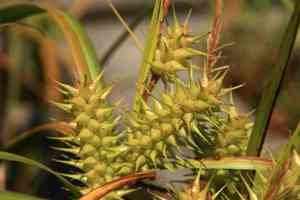
False hop sedge (Carex lupuliformis)
Also known as: False Hop Sedge, Hop-like Sedge
one to two terminal male spikes." Fruiting occurs between late summer through early fall. Fruit is described as "perigynia ascending to spreading inflated strongly veined sessile lance-ovoid shiny glabrous; beak conical; achenes stipitate broadly diamond-shaped scarcely if at all longer than wide concave faces angles thickened prominently knobbed with hard nipplelike points."
In This Article
Attributes of False hop sedge
Lifespan
Perennial
Plant Type
Grass
Plant Height
60-150 cm
Spread
N/A
Leaf Color
Green
Flower Size
N/A
Flower Color
White
Images of False hop sedge
Quickly Identify False hop sedge
1
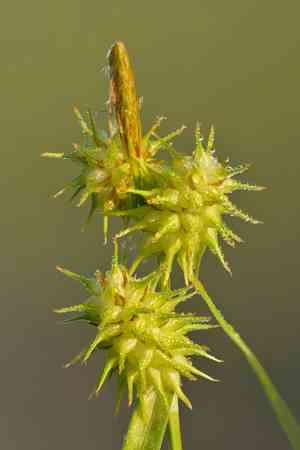
Carex lupuliformis can be identified by its clump-forming habit, long and narrow leaves, and distinctive hop-like flower spikes. The plant often grows in moist or wet habitats, such as marshes and swamps.
Scientific Classification of False hop sedge
Phylum
Vascular plants
Class
Monocotyledons
Order
Poales
Family
Sedge
Genus
True sedges
Species
False hop sedge
Planting and Growing of False hop sedge
Care Difficulty
Easy
Watering Schedule
Every 4 days
Sunlight Requirements
Partial sun
Sunshine Duration
4-8 hours
Ideal Temperature
60-75℉
Soil Type
Potting Mix, Peat Mix
Soil pH
6.5-7.5
Fertilizer Type
Balanced
Pruning Season
Spring, Summer
Pruning Area
Branches, Leaves
Pruning Frequency
Once a year
Repotting Season
Spring
Pot Type
Terracotta, Plastic
 How to Water False hop sedge?
When watering Carex lupuliformis, aim for about 250 ml each time, ensuring that the soil is evenly moistened but not saturated. The key is to keep the top inch of soil consistently damp. Pay attention to avoid waterlogging by checking that excess water drains properly.
What are the symptoms of an underwatered False hop sedge?
›
What should I do if my False hop sedge is not getting enough water?
›
What are the symptoms of an overwatered False hop sedge?
›
How to save an overwatered False hop sedge?
›
 What Are the Sunlight Requirements for False hop sedge?
Carex lupuliformis prefers partial sun, thriving in an environment that offers moderated sunlight. Ideal lighting facilitates healthy growth, sturdy structure, and vibrant coloration.
What is the ideal lighting for Carex lupuliformis?
›
How can you achieve the ideal lighting?
›
What benefits does ideal lighting bring to Carex lupuliformis?
›
 What Is the Ideal Temperature Range for False hop sedge?
Carex lupuliformis thrives best in temperatures between 60°F and 75°F. This range provides optimal conditions for photosynthesis and nutrient uptake, which are critical for healthy growth and development.
 What Soil is Best for False hop sedge?
The plant requires soil that retains moisture well, crucial for its growth and thriving condition. Loamy soils are excellent for this, providing the right balance between water retention and drainage, preventing roots from drowning while ensuring they remain hydrated. Carex lupuliformis benefits from a nutrient-rich soil, which supports healthy foliage and robust growth. Peat soils are particularly beneficial in this aspect because they are rich in organic matter, enhancing the plant's ability to absorb essential nutrients. Aeration is vital for promoting healthy root systems. Sandy loam soils are favored as they ensure roots have access to oxygen while facilitating nutrient intake — key factors for optimum plant health and development.
 How to Fertilize False hop sedge?
When fertilizing Carex lupuliformis, it's essential to use a balanced fertilizer to provide all necessary nutrients without overwhelming the plant. Use around 1/4 teaspoon of liquid fertilizer per gallon of water or a tablespoon of slow-release granular fertilizer per square foot for the best results.
 How to Prune False hop sedge?
Begin by removing any dead or damaged foliage at the base of the plant. Use sharp, clean shears to ensure a clean cut, as this minimizes damage and reduces disease risk. Trim the plant to maintain its shape and encourage denser growth. Always make cuts just above a node or leaf blade to promote healthy regrowth. Focus on maintaining the natural arching form of the sedge. Trim the outer edges to keep the clump tidy, making sure to follow the natural curve of the leaves. Avoid cutting all stems to the same length, as this may cause the plant to lose its natural grace and aesthetics.
More About Pruning Techniques→
 How to Propagate False hop sedge plant?
1
Collect seeds from mature Carex lupuliformis plants in the autumn and store them in a cool, dry place until early spring. Before sowing, soak the seeds in warm water for 24 hours to soften the seed coat, enhancing germination success.
2
In early spring, select a mature Carex lupuliformis plant for division. Use a sharp spade to carefully dig up the plant and separate it into smaller clumps, ensuring each division has a healthy root system and some foliage.
3
Replant the divisions in well-prepared soil in a partially shaded area. Water them thoroughly after planting and maintain consistent moisture levels to encourage establishment of the new plantlets.
 How to Repot False hop sedge plant?
1
Knowing when to repot Carex lupuliformis is crucial to ensure its continued growth and health. Signs include roots growing out of drainage holes, compacted soil, or slowed growth. Generally, early spring or the onset of autumn is ideal since these seasons provide less stress for the plant and allow for adaptation before peak growing or dormancy.
2
Selecting the appropriate pot for Carex lupuliformis ensures healthy root development and proper growth. Choose a pot that is 1-2 inches larger in diameter than the current one, with good drainage holes. This provides adequate space for root expansion without water retention, minimizing risks of root rot.
3
Opt for a moist yet well-draining soil mix for Carex lupuliformis. A combination of garden loam, organic compost, and perlite creates the ideal environment. This blend retains sufficient moisture for growth while ensuring extra water flows away, preventing root rot and promoting healthy vegetation.



