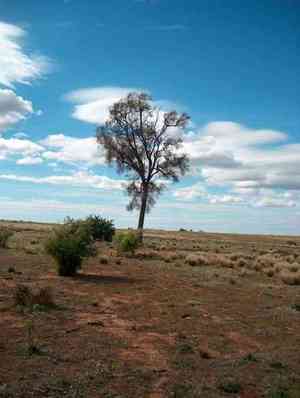
Bull-oak(Allocasuarina luehmannii)

Bull-oak (Allocasuarina luehmannii)

Also known as: Bull Oak, Scrub She-oak

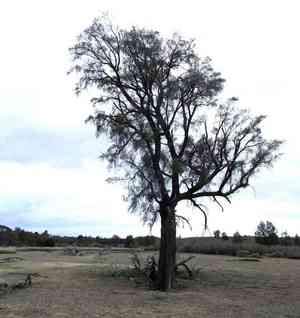
The bull-oak tree, known scientifically as Allocasuarina luehmannii, exhibits several adaptations that enable it to flourish in dry, sandy environments:

1. **Deep Root System**: The tree's extensive root network allows it to tap into deep water reserves, essential for survival in arid conditions.
2. **Needle-like Branchlets**: Resembling pine needles, its slender branchlets reduce water loss by minimizing transpiration and giving the tree a feathery appearance.
3. **Rough, Furrowed Bark**: This characteristic bark provides protection and aids in the tree's resilience to harsh, dry conditions.
4. **Sun Tolerance**: Thriving in full sunlight, the bull-oak optimizes photosynthesis and growth in open, sunlit areas.
5. **Conical Seed Cones**: These contribute to the tree's distinct silhouette and reproductive success.
6. **Drought Adaptation**: Physiological mechanisms enable the tree to endure frequent droughts, making it well-suited for dry environments.

These traits collectively ensure the bull-oak's robustness and ability to thrive in challenging, sandy terrains.

Attributes of Bull-oak

Lifespan
Perennial
Plant Type
Tree
Plant Height
15-20 meters
Spread
4-8 meters
Leaf Color
Green (needle-like branchlets)
Flower Size
0.5-1 cm
Flower Color
Red or Brown (often inconspicuous)

ForwardPlant - Identify plants with a snap

Identify and diagnose plants, get toxicity alerts, and explore safety guides for all types of fungi.

Try for Free

Images of Bull-oak

Bull-oak(Allocasuarina luehmannii)

Quickly Identify Bull-oak

1
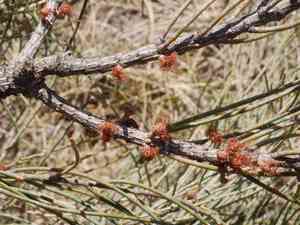
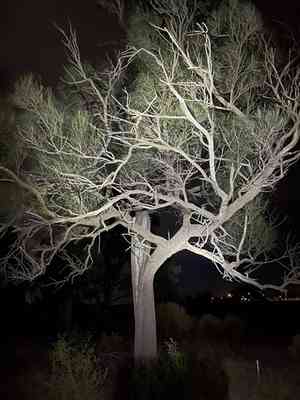
Allocasuarina luehmannii can be identified by its needle-like branchlets which are often mistaken for leaves. The true leaves are reduced to small scales encircling the branchlets. Additionally, the tree has a distinctive cylindrical shape and produces small, woody cones.

Scientific Classification of Bull-oak

Phylum
Vascular plants
Class
Dicotyledons
Order
Fagales
Family
Sheoaks
Genus
She-oak
Species
Bull-oak

Planting and Growing of Bull-oak

Care Difficulty
Moderate
Watering Schedule
Every 2 days
Sunlight Requirements
Full sun
Sunshine Duration
6-10 hours
Ideal Temperature
60-75℉
Soil Type
Potting Mix, Peat Mix
Soil pH
6.5-7.5
Fertilizer Type
Balanced
Pruning Season
Spring, Summer
Pruning Area
Branches, Leaves
Pruning Frequency
2 times a year
Repotting Season
Spring
Pot Type
Plastic, Ceramic

water icon How to Water Bull-oak?

Allocasuarina luehmannii thrives with moderate watering. This plant prefers the soil to dry out between watering sessions. As such, it's crucial not to saturate the soil. A good rule of thumb is to provide approximately 500 milliliters of water per session, ensuring that the water penetrates to a depth that reaches the root system without remaining stagnant.
What are the symptoms of an underwatered Bull-oak?
What should I do if my Bull-oak is not getting enough water?
What are the symptoms of an overwatered Bull-oak?
How to save an overwatered Bull-oak?

sunlight icon What Are the Sunlight Requirements for Bull-oak?

Sunlight Requirements: Full sun, Partial sun
Duration of light: 6-8 hours daily
Allocasuarina luehmannii flourishes best with full to partial sunlight, ideally soaking up 6-8 hours of sun each day. This lighting condition not only fosters healthy photosynthesis but also enhances the plant's natural resilience and growth rate.
How does Allocasuarina luehmannii get ideal light?
What are the requirements for optimal lighting?
How to maintain ideal light when seasons change?

temperature icon What Is the Ideal Temperature Range for Bull-oak?

Ideal Temperature: 60 ~ 75℉
The ideal temperature range for Allocasuarina luehmannii is between 60°F and 75°F. At these temperatures, the plant can perform photosynthesis optimally, maintain healthy growth, and resist diseases. This range mimics its natural habitat, providing an environment in which the plant can thrive without strain.

soil icon What Soil is Best for Bull-oak?

Soil type: Sandy soil, Loam, Clay soil
Soil PH: 6.5 ~ 7.5
Allocasuarina luehmannii thrives in soils with good drainage. This prevents root rot, ensuring that the plant maintains strong growth and vibrant greenery even during wet seasons. A sandy or loam texture is ideal as it allows for easy root penetration. This facilitates efficient nutrient uptake, thus promoting healthy development and robust foliage. This plant benefits from nutrient-rich soils. Adequate nutrients support its growth and reproduction processes, enhancing resilience to environmental stress.

fertilize icon How to Fertilize Bull-oak?

Fertilizer type: Balanced
Allocasuarina luehmannii typically benefits from moderate fertilization. A balanced formulation of 10-10-10 NPK is optimal for this plant, complementing its growth with approximately 100 grams per square meter during the active growing season. The quantity should be adjusted depending on plant age and soil fertility.

prune icon How to Prune Bull-oak?

Pruning Time: Spring, Summer
Start by using sharp, clean pruning shears to remove any dead, damaged, or diseased branches. This not only helps the tree maintain a healthy appearance but also prevents the spread of diseases. Focus on cutting branches at the node to promote better healing and new growth. To maintain its natural conical shape, prune the lateral branches slightly. Avoid cutting back into the older wood too heavily as this might affect the tree's natural form. Just a gentle trimming to the exterior tips is advisable. More About Pruning Techniques

propagate icon How to Propagate Bull-oak plant?

Propagate Time: Late spring, Early summer
1
To propagate Allocasuarina luehmannii from seeds, start by soaking them in warm water overnight. This softens the seed coat and aids germination. Make sure the seeds are evenly spaced in the seed tray, filled with a well-draining soil mix.
2
For cutting propagation, select healthy and disease-free shoots from the parent plant. The cuttings should be about 10-15cm long, with several leaves. Cuttings should be taken in the morning when the plant is hydrated.
3
Dip the cut end of the cutting into rooting hormone powder to promote root development. Plant the cuttings in a potting mix, ensuring at least one node is buried under the soil. Water the cuttings well after planting.
More About Propagating Techniques

repot icon How to Repot Bull-oak plant?

Repotting frequency: Every 2-3 years
1
Allocasuarina luehmannii shows clear signs when it needs repotting. Look out for roots growing out of drainage holes or decreased growth. Repotting during spring or summer ensures the plant can recover swiftly due to the active growth phases.
2
Select a pot that is one size larger than the current one, with ample drainage holes. This helps prevent waterlogging, ensuring the roots do not rot. A slightly deeper pot can also accommodate the plant's taproot system better, promoting healthy growth.
3
A well-draining sandy mix mimics its natural habitat, providing the necessary drainage that prevents root rot and compaction. This soil type offers stability while allowing sufficient air circulation to the roots, crucial for its health.

ForwardPlant - Identify plants with a snap

Find the best spots for them to optimize their health, simply using your phone.

Try for Free

Toxicity

Ingestion

Identify toxic plants for your safety

Learn which plants are harmful to you and your pets, and make informed choices for a safer home!

Try for Free
WARNING
The judgment on toxicity and danger is for reference only. We DO NOT GUARANTEE any accuracy of such judgment. Therefore, you SHALL NOT rely on such judgment. It is IMPORTANT TO SEEK PROFESSIONAL ADVICE in advance when necessary.