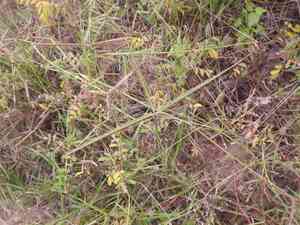
Goosegrass (Acrachne racemosa)
Also known as: Matted Lovegrass
Goosegrass is a tufted annual herb commonly found in warm, sunny areas. It thrives in compacted, well-drained soils, often appearing in lawns, sports fields, and roadsides. Native to tropical and subtropical regions of Africa, Asia, and Australasia, it can also be found near riverbanks and lakes.
In This Article
Attributes of Goosegrass
Lifespan
Annual
Plant Type
Grass
Plant Height
0.1 to 0.3 meters
Spread
Variable, dependent on growth spread
Leaf Color
Green
Flower Size
Small, less than 1 cm
Flower Color
Greenish, inconspicuous
Images of Goosegrass
Quickly Identify Goosegrass
1
Identified by its creeping stolons, narrow leaves, and racemose inflorescence. It forms dense mats and has fine, wiry stems.
Scientific Classification of Goosegrass
Phylum
Vascular plants
Class
Monocotyledons
Order
Poales
Family
Grass
Genus
Goosegrass
Species
Goosegrass
Planting and Growing of Goosegrass
Care Difficulty
Easy
Watering Schedule
Every 3 days
Sunlight Requirements
Partial sun
Sunshine Duration
4-6 hours
Ideal Temperature
60-75℉
Soil Type
Potting Mix, Peat Mix
Soil pH
6.5-7.5
Fertilizer Type
Balanced
Pruning Season
Spring, Summer
Pruning Area
Branches, Leaves
Pruning Frequency
2 times a year
Repotting Season
Spring
Pot Type
Plastic, Ceramic
 How to Water Goosegrass?
Ensure that you provide Acrachne racemosa with 250 ml of water each time, making sure the soil is evenly moist but not waterlogged. The key is to water thoroughly until a little water drains from the bottom of the pot, ensuring deep root hydration.
What are the symptoms of an underwatered Goosegrass?
›
What should I do if my Goosegrass is not getting enough water?
›
What are the symptoms of an overwatered Goosegrass?
›
How to save an overwatered Goosegrass?
›
 What Are the Sunlight Requirements for Goosegrass?
Partial to full sunlight ensures Acrachne racemosa has a robust growth environment, aiding photosynthesis and preventing dehydration or overexposure. This range supports overall plant health and resilience.
How much sunlight does Acrachne racemosa prefer?
›
What solutions ensure ideal light exposure?
›
What are the benefits of ideal sunlight for Acrachne racemosa?
›
 What Is the Ideal Temperature Range for Goosegrass?
Acrachne racemosa thrives in environments where the temperature remains between 60 to 75°F. This range offers optimal conditions for growth, ensuring adequate metabolic activities and minimizing stress. At these temperatures, the plant's physiological processes like photosynthesis and respiration function most efficiently.
 What Soil is Best for Goosegrass?
Acrachne racemosa thrives in soil enriched with organic matter, enhancing growth and overall plant health. A nutrient-rich medium provides essential elements, ensuring robust growth. Well-drained soil prevents waterlogging, which is vital for Acrachne racemosa. It reduces the risk of root rot and encourages healthy root development. Proper aeration helps in the proliferation of beneficial microorganisms. It encourages efficient root respiration and nutrient uptake, promoting vibrant plant growth.
 How to Fertilize Goosegrass?
For Acrachne racemosa, it is important not to over-fertilize. Use half the recommended dose for liquid fertilizers, approximately 10-15 ml per liter of water. In the case of slow-release fertilizers, a thin layer over the soil surface will suffice, usually around 10 grams per square meter.
 How to Prune Goosegrass?
To prune Acrachne racemosa, start by using clean, sharp pruning shears. Identify the dry or dead stems and carefully cut them off at the base to encourage new growth. Trim back any excessively long stems to maintain a tidy shape, making cuts above a healthy node to promote the growth of new shoots. Ensure you do not cut too close to the nodes to avoid damaging healthy tissue.
 How to Propagate Goosegrass plant?
1
Collect mature seeds from Acrachne racemosa and dry them thoroughly to enhance germination. Soak seeds in water for 24 hours before sowing to soften the seed coat and accelerate germination.
2
Fill seed trays with a well-draining growing medium and scatter the seeds over the surface. Lightly cover seeds with a thin layer of the medium to support germination through exposure to light.
3
Once the Acrachne racemosa plant is mature, divide it by cutting through the root ball. This method ensures that each division has roots and shoots, promoting a rapid and successful establishment.
 How to Repot Goosegrass plant?
1
Acrachne racemosa usually requires repotting when growth slows due to root congestion or when roots begin to escape from the drainage holes. This is typically evident during the growing season as the plant starts exhibiting signs of distress, such as yellowing leaves or stunted growth. Choose a warm spring or summer day for the best repotting success, ensuring that the plant can recover quickly in gentle sunlight.
2
Select a pot that is one size larger than the current one to give the roots space to expand. Ensure it has good drainage holes to prevent water accumulation, a crucial feature to avoid root rot. A comparatively shallow pot will work well as Acrachne racemosa prefers to spread its roots laterally rather than deeply. Materials such as terracotta or ceramic are ideal as they allow the soil to breathe and dry naturally.
3
Opt for a well-draining sandy mix, ideally customized for grasses or plants with similar watering needs. Acrachne racemosa thrives in soil that mimics its natural sandy habitat, allowing excess water to quickly percolate through while retaining enough moisture for its roots. This prevents soggy conditions that lead to fungal infections, maintaining a healthy and robust root system.



