How to Propagate Western field mouse-ear chickweed?
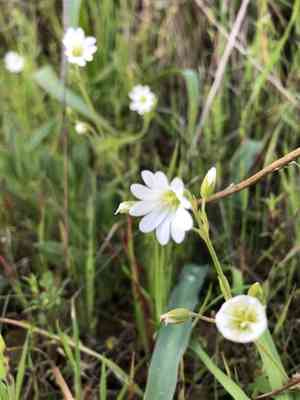
Cerastium arvense, a perennial herbaceous plant originating from Western Europe, flourishes in stony and mountainous environments. It benefits from soil that drains effectively and a location exposed to ample sunlight. Its reproduction primarily entails scattering seeds directly into cultivated plots. Make certain the seeds are thinly veiled with earth and kept damp until sprouting occurs. For optimal outcomes, utilize a delicate, sandy growing medium. This variety prefers infrequent interference, so manage young plants with care during relocation.
Optimal Time for Western Field Mouse-ear Chickweed Propagation
Propagation Method
Seeding
Propagation Period
Spring
Tools for Western Field Mouse-ear Chickweed Propagation
Seed Tray
A shallow container for uniform seed dispersal and providing an ideal germination environment. Crucial for western field mouse-ear chickweed to ensure even seed distribution and ample initial growth space.
Seedling Heat Mat
A mat providing consistent warmth from below to encourage quicker germination and stronger seedlings. Essential for western field mouse-ear chickweed to maintain optimal soil temperature for seed sprouting.
Humidity Dome
A clear cover placed over the seed tray to maintain high moisture levels. Helps create the perfect microclimate for western field mouse-ear chickweed seeds to sprout and grow without drying out.
Seed Starting Mix
A sterile, light, and nutritionally balanced medium specifically formulated for starting seeds. Offers western field mouse-ear chickweed the best substrate for root development and growth.
Spray Bottle
A device for misting seeds and seedlings to keep the soil damp without disturbing delicate seeds. Ensures western field mouse-ear chickweed seeds receive uniform moisture without the risk of overwatering.
Seed Label Markers
Markers used to identify different seed varieties planted in trays. Important for tracking western field mouse-ear chickweed and monitoring various propagation batches for better organization.
Fine-Mesh Sieve
A tool used to apply a thin layer of soil mix over seeds after sowing. Ensures western field mouse-ear chickweed seeds have the correct soil depth for improved germination.
Grow Lights
Artificial illumination providing the necessary light spectrum for seedlings, especially in low-light conditions. Guarantees western field mouse-ear chickweed receives sufficient light for healthy development when natural light is scarce.
Planting Dibber
A small pointed tool used to create holes in soil for planting seeds. Ensures precise placement of western field mouse-ear chickweed seeds into the seed starting mix.
How to Propagate Western Field Mouse-ear Chickweed?
Propagation Type
Simple
Caring for Newly Propagated Western Field Mouse-ear Chickweed
Caring for Newly Propagated Western Field Mouse-ear Chickweed
Once western field mouse-ear chickweed seedlings are robust enough, typically after developing a second set of true leaves, they can be carefully moved into individual pots or directly into the garden. Ensure they are planted in well-draining soil in a location receiving partial to full sun. Water young plants regularly, allowing the soil to dry slightly between waterings. Mulching around plants can help retain soil moisture and suppress weeds. As they mature, plants may benefit from occasional, balanced liquid fertilizer. Monitor for pests and diseases, and manage them promptly using appropriate methods.
Common Propagation Mistakes for Western Field Mouse-ear Chickweed
Overwatering
Excessive watering can lead to root rot and fungal infections, hindering healthy root development.
Poor soil drainage
Using soil that retains too much water can cause accumulation, leading to root suffocation and decay.
Insufficient light
Placing western field mouse-ear chickweed in inadequate light can impede growth and weaken the plant, reducing successful propagation.
Incorrect cutting technique
Taking cuttings that are too short or not using sanitized tools can impede rooting and increase infection risk.
Improper temperature
Exposing western field mouse-ear chickweed to extreme temperatures (too high or too low) can stress the plant, diminishing its ability to root effectively.
Tips for Propagating Western Field Mouse-ear Chickweed
Utilize well-draining soil
Ensure the propagation soil has excellent drainage to prevent waterlogging and root rot.
Monitor moisture levels
Keep the soil consistently moist but not saturated. Use a spray bottle to lightly mist the soil if needed.
Provide ample light
Place western field mouse-ear chickweed in a bright, indirect light location to promote healthy growth and successful propagation.
Use healthy cuttings
Select strong, healthy cuttings that are at least 4-6 inches long. Use sterilized scissors or a sharp knife to make a clean cut just below a node.
Maintain optimal temperature
Keep the propagation area at a stable temperature, ideally between 65-75°F (18-24°C), to support rooting and growth.



