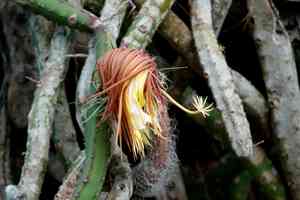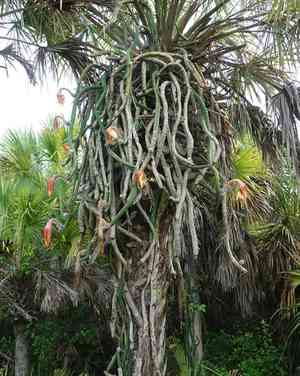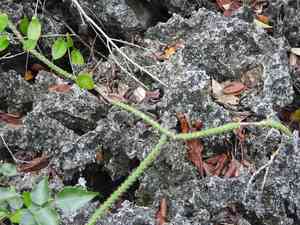
Queen of the night(Selenicereus grandiflorus)

Queen of the night (Selenicereus grandiflorus)

Also known as: Night-blooming Cereus, Queen of the Night

The Queen of the Night cactus (Selenicereus grandiflorus) is renowned for its enchanting nighttime flowers and unique adaptations:

1. **Nighttime Blooms**: The cactus produces large, aromatic white flowers that open exclusively at night, designed to attract nocturnal pollinators such as bats and moths.
2. **Growth Habit**: With slender, sprawling stems, this cactus often climbs or cascades over supports, using aerial roots to anchor itself.
3. **Epiphytic Nature**: Native to tropical forests, it typically grows on other plants or rocks, thriving in well-drained environments.
4. **Water Conservation**: Its thick stems store water, enabling it to endure dry periods.
5. **CAM Photosynthesis**: The plant utilizes CAM (Crassulacean Acid Metabolism) photosynthesis, opening its stomata at night to minimize water loss.

These features enable the Queen of the Night cactus to flourish in its natural habitat, balancing the need for moisture with efficient water use.

Attributes of Queen of the night

Lifespan
Perennial
Plant Type
Shrub
Plant Height
20 cm
Spread
15 cm
Leaf Color
N/A (reduced to scales)
Flower Size
Up to 30 centimeters
Flower Color
White

ForwardPlant - Identify plants with a snap

Identify and diagnose plants, get toxicity alerts, and explore safety guides for all types of fungi.

Try for Free

Images of Queen of the night

Queen of the night(Selenicereus grandiflorus)

Quickly Identify Queen of the night

1
The plant can be identified by its climbing or sprawling growth habit, ribbed stems with numerous nodules, and its large, fragrant white flowers that bloom at night. The flowers usually open in a spectacular display that lasts only for a single night.

Scientific Classification of Queen of the night

Phylum
Vascular plants
Class
Dicotyledons
Order
Pinks, cacti, and allies
Family
Cactuses
Genus
Selenicereus
Species
Queen of the night

Planting and Growing of Queen of the night

Care Difficulty
Moderate
Watering Schedule
Every 2 days
Sunlight Requirements
Full sun
Sunshine Duration
4-6 hours
Ideal Temperature
65-77℉
Soil Type
Potting Mix, Peat Mix
Soil pH
6.5-7.5
Fertilizer Type
Balanced
Pruning Season
Spring, Summer
Pruning Area
Branches, Leaves
Pruning Frequency
2 times a year
Repotting Season
Spring
Pot Type
Plastic, Ceramic

water icon How to Water Queen of the night?

Selenicereus grandiflorus has a unique requirement for watering. It is imperative to allow the soil to dry out completely between watering sessions. This plant prefers deep watering sessions, approximately 250 ml, which allows water to reach the deeper roots but ensures that there is no excess moisture around the roots for extended periods.
What are the symptoms of an underwatered Queen of the night?
What should I do if my Queen of the night is not getting enough water?
What are the symptoms of an overwatered Queen of the night?
How to save an overwatered Queen of the night?

sunlight icon What Are the Sunlight Requirements for Queen of the night?

Sunlight Requirements: Full sun, Partial sun
Duration of light: 4 to 6 hours
Partial to full sun conditions suit Selenicereus grandiflorus best. Adequate light promotes robust blooming and energy-efficient photosynthesis, crucial for the cactus's growth and health.
What is the best location?
How to adjust during different seasons?
What tools help in measuring light?

temperature icon What Is the Ideal Temperature Range for Queen of the night?

Ideal Temperature: 65 ~ 77℉
The ideal temperature range for the growth of Selenicereus grandiflorus is between 65°F and 77°F. Maintaining this temperature range ensures the plant can photosynthesize efficiently and grow robustly. This range mimics the plant's natural environment, providing the best conditions for healthy development and flowering.

soil icon What Soil is Best for Queen of the night?

Soil type: Sandy loam, Calcareous soil
Soil PH: 6.5 ~ 7.5
Selenicereus grandiflorus thrives in well-drained soil as it prevents root rot by avoiding waterlogging. The proper drainage helps maintain essential aeration around the roots, essential for healthy growth. A nutrient-rich soil ensures that Selenicereus grandiflorus gets the necessary minerals for vibrant flowering. The presence of organic matter in the soil boosts fertility, which in turn supports vibrant and prolific blooms. While the soil should be well-drained, it is important that it retains some moisture to support Selenicereus grandiflorus' cellular activities. This balance helps in sustaining the plant during dry spells without drowning it.

fertilize icon How to Fertilize Queen of the night?

Fertilizer type: Balanced
When fertilizing Selenicereus grandiflorus, it is critical to apply a balanced fertilizer diluted to half strength. This practice helps avoid root burn and nutrient overload, which can be detrimental to the plant's health. A 20-20-20 NPK liquid fertilizer mixed at half strength is typically sufficient.

prune icon How to Prune Queen of the night?

Pruning Time: Spring, Summer, Autumn, Winter
Begin by sterilizing your pruning shears to prevent the spread of disease. Identify dead, damaged, or overcrowded stems and cut them off at the base. Be careful to make clean cuts just above a healthy node. Remove any stems growing inwards to allow better air circulation and light penetration. Always assess the plant's natural shape and aim to maintain this while removing no more than one-third of the plant to prevent shock. More About Pruning Techniques

propagate icon How to Propagate Queen of the night plant?

Propagate Time: Spring, Early Spring
1
Choose healthy, disease-free stems that are at least 10-15 cm long. Ensure the cutting includes several nodes for optimal rooting success.
2
After cutting, allow the stems to dry and form calluses in a shaded area for several days. This helps in preventing rot when planted.
3
Plant the cutting in a well-draining potting mix, burying it at least 3-5 cm deep. Place it in a warm location with indirect light to encourage root development.
More About Propagating Techniques

repot icon How to Repot Queen of the night plant?

Repotting frequency: Every 2-3 years
1
Repot your Selenicereus grandiflorus when you notice its roots growing through the drainage holes or it becomes root-bound. Spring and early summer are the ideal times for repotting, as the plant is in its active growth phase. This ensures that the plant recovers more efficiently from the repotting process, minimizing stress.
2
Select a pot that is one size larger than the current pot. Ensure it has plenty of drainage holes to prevent water accumulation. Choosing a terracotta pot can be beneficial as it allows excess moisture to evaporate, reducing the potential for root rot and aiding in maintaining the ideal moisture balance for your cactus.
3
Use a well-draining cactus mix, which typically includes sand or perlite mixed with regular potting soil. This composition facilitates good drainage and aeration, ensuring that the roots receive adequate oxygen and reducing the risk of root rot.

ForwardPlant - Identify plants with a snap

Find the best spots for them to optimize their health, simply using your phone.

Try for Free