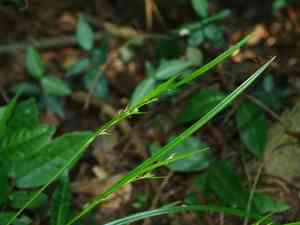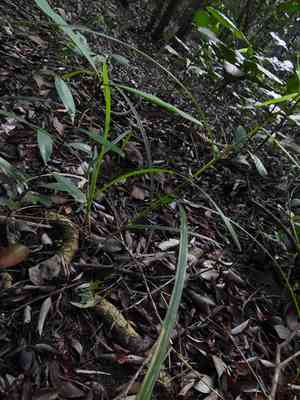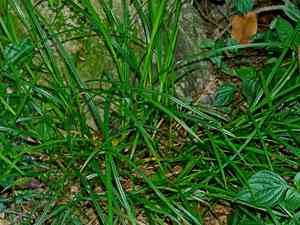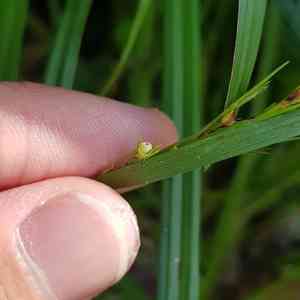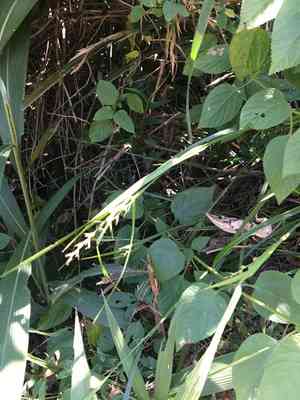
Bead nutrush(Scleria levis)

Bead nutrush (Scleria levis)

Also known as: Creeping Fimbry

The Bead nutrush (Scleria baldwinii) is a perennial sedge that flourishes in moist and sunny environments, such as marshes, wet meadows, and alongside ponds and streams. It exhibits clumped growth with narrow, linear leaves that contribute to its grass-like appearance. The plant is particularly notable for its bead-like fruits, which are more pronounced and distinctive compared to other species in its genus.

Unlike some species in the Scleria genus that may prefer drier or more varied habitats, Bead nutrush is well-adapted to consistently wet conditions. It lacks the sharp edges on its seeds that are common among its genus counterparts, making its seeds smoother. This adaptation, along with its bead-like fruits, aids in identification and sets it apart from other Scleria species.

The seeds of Bead nutrush are well-suited for dispersal by water currents, allowing the plant to effectively spread within its wetland habitats. This characteristic, combined with its preference for sunny, moist environments, differentiates it from other Scleria species that may thrive in different ecological niches.

Attributes of Bead nutrush

Lifespan
Perennial
Plant Type
Grass
Plant Height
80 cm to 1.3 m
Spread
N/A
Leaf Color
Green to greenish-brown
Flower Size
4 cm to 10 cm
Flower Color
Yellow Red

ForwardPlant - Identify plants with a snap

Identify and diagnose plants, get toxicity alerts, and explore safety guides for all types of fungi.

Try for Free

Images of Bead nutrush

Bead nutrush(Scleria levis)

Quickly Identify Bead nutrush

1
To identify Scleria levis, look for its creeping rhizomes, triangular stems, and leaves with rough margins. The plant often has small, inconspicuous flowers and produces round, smooth seeds.

Scientific Classification of Bead nutrush

Phylum
Vascular plants
Class
Monocotyledons
Order
Poales
Family
Sedge
Genus
Nutrushes
Species
Bead nutrush

Planting and Growing of Bead nutrush

Care Difficulty
Moderate
Watering Schedule
Every 2 days
Sunlight Requirements
Partial sun
Sunshine Duration
6-10 hours
Ideal Temperature
68-77℉
Soil Type
Potting Mix, Peat Mix
Soil pH
5.5-7
Fertilizer Type
Balanced
Pruning Season
Spring, Summer
Pruning Area
Branches, Leaves
Pruning Frequency
2 times a year
Repotting Season
Spring
Pot Type
Plastic, Ceramic

water icon How to Water Bead nutrush?

For Scleria levis, it's important to ensure the soil is adequately moist but not waterlogged. Aim for around 200ml of water per session, allowing the excess to drain away to prevent standing water.
What are the symptoms of an underwatered Bead nutrush? ›
What should I do if my Bead nutrush is not getting enough water? ›
What are the symptoms of an overwatered Bead nutrush? ›
How to save an overwatered Bead nutrush? ›

sunlight icon What Are the Sunlight Requirements for Bead nutrush?

Sunlight Requirements: Partial sun
Duration of light: 4 to 6 hours
Scleria levis prefers partial sun conditions. This means a few hours of morning or late afternoon sun, with dappled or filtered light during midday. This lighting fosters healthy growth and coloration.
What is the ideal light for Scleria levis? ›
How to achieve ideal light for Scleria levis? ›
What benefits does ideal lighting bring to Scleria levis? ›

temperature icon What Is the Ideal Temperature Range for Bead nutrush?

Ideal Temperature: 68 ~ 77℉
The ideal temperature range for Scleria levis is between 68°F to 77°F. This range ensures optimal growth by providing the conditions most conducive to photosynthesis and physiological processes. When temperatures are maintained within this range, the plant can efficiently manage its metabolic activities, leading to healthy growth and development.

soil icon What Soil is Best for Bead nutrush?

Soil type: Loam, Sandy soil, Sandy loam
Soil PH: 5.5 ~ 7
Scleria levis thrives in well-draining soils, which prevent waterlogging, ensuring that the roots receive sufficient oxygen. This promotes a healthy root system and reduces the risk of root rot. This plant benefits from soils rich in organic matter. The nutrients provided by such soil will enhance growth and overall plant vigor, leading to lush, robust foliage. While it requires good drainage, Scleria levis also needs soil that retains adequate moisture. This is essential during the growth phase, as constant moisture availability ensures steady plant development.

fertilize icon How to Fertilize Bead nutrush?

Fertilizer type: Balanced
For Scleria levis, it is crucial to provide a balanced amount of nutrients. When applying liquid fertilizer, use a solution diluted to half the recommended strength, generally around 10 ml per liter of water. For slow-release fertilizers, a small amount should be sprinkled evenly around the base of the plant, equivalent to one small handful per application.

prune icon How to Prune Bead nutrush?

Pruning Time: Spring, Summer, Autumn
Begin by examining the plant for any dead or diseased leaves and stems. Look for crowded areas where the plant may benefit from increased airflow and light penetration. Start pruning from the top of the plant and work your way downward. Make clean cuts just above a node or bud, angling the cut away to prevent water accumulation. Balance is key; avoid over-pruning in one session. After pruning, water the plant thoroughly and provide balanced fertilizer to aid recovery. Monitor the plant for signs of stress or disease and adjust care routines as necessary. More About Pruning Techniques→

propagate icon How to Propagate Bead nutrush plant?

Propagate Time: Spring, Early summer
1
Fill your seed trays with a well-draining potting mix. Plant the seeds at the recommended depth and maintain consistent moisture without waterlogging the soil. Position the trays in a sunny area to encourage germination.
2
For division propagation, choose a mature plant. Use a garden trowel to carefully dig around the base, ensuring not to damage the roots. Gently separate the plant into smaller sections, making sure each section has a healthy root system.
3
Transplant the seeds or divided sections into their permanent positions. Ensure the soil is nutrient-rich and maintain regular watering schedules. Mulch around the base to retain soil moisture and suppress weed growth.

repot icon How to Repot Bead nutrush plant?

Repotting frequency: Every 2 years
1
Scleria levis shows it's time to repot when you notice roots growing out of the drainage holes or when the plant's growth becomes stunted. Spring and summer are ideal seasons for repotting as the plant is in its active growth phase, making recovery from root disturbance quicker and smoother.
2
Opt for a pot that is only slightly larger than the current one, with sufficient drainage holes to prevent waterlogging. The pot should provide stability and room for root growth, ensuring the plant doesn't become root-bound too quickly. A small size increase minimizes transplant shock, promoting healthier growth.
3
Choose a soil that is moist yet well-draining, ideally a mixture that retains moisture without becoming waterlogged. This helps prevent root rot and ensures your plant receives the right balance of moisture and aeration, which is essential for maintaining healthy root systems.

ForwardPlant - Identify plants with a snap

Find the best spots for them to optimize their health, simply using your phone.

Try for Free