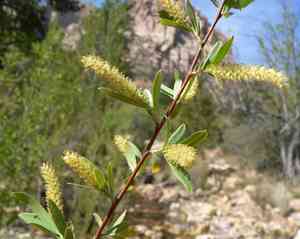
Goodding's willow (Salix gooddingii)
Also known as: Valley Willow, Black willow
The **Fremont cottonwood** (Populus fremontii) is a deciduous tree native to the riparian zones of the southwestern United States and northern Mexico. This tree is vital for providing shade and shelter to both wildlife and livestock in the region. Additionally, the North American beaver depends on the Fremont cottonwood for food and materials to construct their dams and lodges.
In This Article
Attributes of Goodding's willow
Lifespan
Perennial
Plant Type
Tree
Plant Height
3 m to 30 m
Spread
4.5 m to 8 m
Leaf Color
Green Blue
Flower Size
8 cm
Flower Color
Yellow Green
Images of Goodding's willow




Quickly Identify Goodding's willow
1
Identify by its long, narrow leaves that are finely serrated and have a glossy green appearance. It usually has a multi-trunked form with brownish to greyish bark. The flowering catkins are produced in early spring before the leaves.
Scientific Classification of Goodding's willow
Phylum
Vascular plants
Class
Dicotyledons
Order
Malpighiales
Family
Willow
Genus
Willows
Species
Goodding's willow
Planting and Growing of Goodding's willow
Care Difficulty
Easy
Watering Schedule
Every 4 days
Sunlight Requirements
Full sun
Sunshine Duration
4-8 hours
Ideal Temperature
60-75℉
Soil Type
Potting Mix, Peat Mix
Soil pH
6.5-7.5
Fertilizer Type
Balanced
Pruning Season
Spring, Summer
Pruning Area
Branches, Leaves
Pruning Frequency
2 times a year
Repotting Season
Spring
Pot Type
Plastic, Ceramic
 How to Water Goodding's willow?
Salix gooddingii thrives best with consistent watering that thoroughly moistens the soil. Ideally, water until the top 6 inches of soil are saturated but not waterlogged, ensuring sufficient moisture without drowning the roots.
What are the symptoms of an underwatered Goodding's willow?
›
What should I do if my Goodding's willow is not getting enough water?
›
What are the symptoms of an overwatered Goodding's willow?
›
How to save an overwatered Goodding's willow?
›
 What Are the Sunlight Requirements for Goodding's willow?
Salix gooddingii thrives under full sun to partial shade conditions. Adequate sunlight ensures strong growth, vibrant leaf coloration, and good structural integrity, critical for its survival and aesthetics.
More About Sunlight Requirements Techniques→
What is the ideal light condition for Salix gooddingii?
›
How can I ensure the plant receives ideal light?
›
What are the benefits of ideal lighting for this plant?
›
 What Is the Ideal Temperature Range for Goodding's willow?
The ideal temperature range for the growth of Salix gooddingii is between 60°F and 75°F. This range allows the plant to perform optimal photosynthesis and energy production. During this range, Salix gooddingii exhibits vibrant growth, ensuring healthy leaves and stems. The ideal conditions help prevent diseases and encourage a robust root system.
 What Soil is Best for Goodding's willow?
Salix gooddingii thrives in well-drained soils that allow excess water to escape easily. This condition prevents root rot and ensures that the roots have access to oxygen, promoting healthier growth. This willow requires nutrient-rich soil to support its rapid growth and vibrant foliage. Enhancing the soil with organic matter like compost can provide essential nutrients that bolster the plant's health. While good drainage is crucial, retaining some moisture is equally important for Salix gooddingii. Soil that holds adequate moisture can help the plant maintain its lushness even during drier seasons.
 How to Fertilize Goodding's willow?
Salix gooddingii, commonly known as Goodding's willow, thrives when fertilized with balanced nutrients. Use a liquid fertilizer at a dilution of 1 tablespoon per gallon of water. This ensures the right balance without overloading the plant, promoting healthy growth and vibrant foliage.
 How to Prune Goodding's willow?
Inspect the willow for dead, damaged, or crossing branches. These should be your primary targets for pruning to improve air circulation and light penetration. When removing branches, make clean cuts at a 45-degree angle to the trunk or parent branch. This helps the tree heal efficiently and prevents water from pooling at the cut site. Prune the topmost branches to encourage bushier growth and prevent the tree from becoming too tall. This is crucial if the willow is planted in a garden or near structures.
More About Pruning Techniques→
 How to Propagate Goodding's willow plant?
1
Collect seeds directly from mature Salix gooddingii plants. Dry them in a shaded, well-ventilated area to prevent mold. This increases germination rates and ensures seed viability.
2
Cut healthy stems at a roughly 45-degree angle, ensuring at least two nodes are present. Remove lower leaves to focus the plant's energy on rooting.
3
Plant seeds or cuttings in well-aerated, moist soil. Provide indirect sunlight and maintain consistent moisture without waterlogging, which can inhibit plant growth.
 How to Repot Goodding's willow plant?
1
Salix gooddingii shows signals like roots emerging from the drainage holes or reduced growth, indicating it's time to repot. Watching for these signs ensures the plant is neither stressed nor cramped, promoting healthier growth.
2
Select a pot that is slightly larger than the current one with adequate drainage holes. A pot that is too large can lead to waterlogging, while a snug fit promotes root expansion and efficient water use.
3
Opt for a loamy, well-draining soil mix to facilitate excellent aeration and moisture balance. This choice prevents root rot and supports robust root development, leading to a thriving plant.



