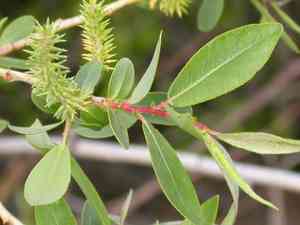
Missouri river willow (Salix eriocephala)
Also known as: American willow, Graybark willow, Strap-leaved willow, Diamond willow
A prevalent species in temperate North America is the willow, which provides a habitat for the larvae of the Mourning Cloak butterfly (Nymphalis antiopa). This fast-growing tree or large shrub, though not particularly long-lived, is highly valued for its tough and flexible branches, commonly used in basket weaving.
In This Article
Attributes of Missouri river willow
Lifespan
Perennial
Plant Type
Tree, Shrub
Plant Height
1.8 m to 7 m
Spread
3 m to 4 m
Leaf Color
Green
Flower Size
1.3 cm to 5 cm
Flower Color
White Yellow Green
Images of Missouri river willow




Quickly Identify Missouri river willow
1
To identify Salix eriocephala, look for the lance-shaped leaves with finely serrated margins, which are typically 5 to 15 cm long and 1 to 3 cm wide. The bark is smooth and gray when young, becoming more furrowed with age. Catkins (flower clusters) emerge before the leaves in the spring, and are generally hairy.
Scientific Classification of Missouri river willow
Phylum
Vascular plants
Class
Dicotyledons
Order
Malpighiales
Family
Willow
Genus
Willows
Species
Missouri river willow
Planting and Growing of Missouri river willow
Care Difficulty
Easy
Watering Schedule
Every 8 days
Sunlight Requirements
Full sun
Sunshine Duration
4-8 hours
Ideal Temperature
60-75℉
Soil Type
Potting Mix, Peat Mix
Soil pH
6.5-7.5
Fertilizer Type
Balanced
Pruning Season
Spring, Summer
Pruning Area
Branches, Leaves
Pruning Frequency
2 times a year
Repotting Season
Spring
Pot Type
Plastic, Ceramic
 How to Water Missouri river willow?
Salix eriocephala requires consistent moisture, but not over-saturation. Water it until the soil is thoroughly moist but not soggy, which typically translates to around 500 milliliters per session depending on the soil's drainage capacity.
What are the symptoms of an underwatered Missouri river willow?
›
What should I do if my Missouri river willow is not getting enough water?
›
What are the symptoms of an overwatered Missouri river willow?
›
How to save an overwatered Missouri river willow?
›
 What Are the Sunlight Requirements for Missouri river willow?
Salix eriocephala thrives with 6 to 8 hours of sunlight, ideally in full sun. Proper lighting enhances photosynthesis, contributing to stronger growth, better health, and more vibrant foliage.
More About Sunlight Requirements Techniques→
What is the best light condition for Salix eriocephala?
›
How can you achieve ideal lighting for Salix eriocephala?
›
What benefits do ideal lighting conditions offer to Salix eriocephala?
›
 What Is the Ideal Temperature Range for Missouri river willow?
The ideal temperature range for Salix eriocephala is between 60°F to 75°F. This range allows for optimal physiological processes, including photosynthesis and nutrient absorption, ensuring healthy growth and robust development.
 What Soil is Best for Missouri river willow?
Salix eriocephala thrives in soils that are capable of retaining moisture. This characteristic is crucial for the plant as it mimics its natural habitat near water bodies, ensuring an ample supply of moisture for optimal growth. A soil abundant in organic matter provides essential nutrients to Salix eriocephala. This richness enhances growth quality, promoting vibrant foliage and robust structural development, which is vital for the plant's longevity and health. While Salix eriocephala prefers moisture, well-drained soils prevent waterlogging. Proper drainage is key to preventing root rot, thus maintaining a healthy root system which is foundational to the plant's overall well-being.
 How to Fertilize Missouri river willow?
For Salix eriocephala, it is important to use fertilizers that provide balanced nutrients. Typically, apply 1 cup of a balanced, slow-release granular fertilizer per plant in early spring. Liquid fertilizers should be diluted to half-strength and used as a supplement if needed.
 How to Prune Missouri river willow?
Begin by familiarizing yourself with the overall structure of Salix eriocephala, commonly known as the willow. Identify the main branches and any crossing or inward-growing stems that might need removal. This understanding will help you decide which parts to prune to enhance its natural form and health. Select sharp, clean cutting tools such as pruning shears or loppers. These are essential for making precise cuts and preventing the spread of disease. Disinfect your tools before starting and after cutting any damaged or diseased branches to keep your willow healthy. When you prune, make clean cuts just above a node or lateral bud. This encourages new growth in the desired direction. Avoid leaving stubs, as they can become entry points for disease or pests. Be sure to remove any dead, damaged, or diseased branches first. Focus on maintaining the natural shape of the willow by removing any branches that disrupt its silhouette. Thin out any overcrowded areas to improve air circulation and light penetration, which will promote robust health and prevent fungal issues.
More About Pruning Techniques→
 How to Propagate Missouri river willow plant?
1
Collect seeds from mature Salix eriocephala plants during spring once the catkins start to dry. Ensure the seeds are healthy and free from pests.
2
Choose healthy stems approximately 6-12 inches long, remove lower leaves, and dip the cut end in rooting hormone to promote root development.
3
Divide larger clumps of Salix eriocephala at the root ball, ensuring each section has sufficient roots to support new growth when replanted.
 How to Repot Missouri river willow plant?
1
Repotting Salix eriocephala is best done in spring or autumn when the plant shows signs of becoming root-bound. Look for roots growing out of the drainage holes, slow growth, or if the pot seems too tight. These are all signals that it's time for a new home.
2
Select a pot that's one size larger than the current one, with good drainage holes. This provides the roots with room to grow and prevents water from stagnating at the bottom, which could cause root rot. Pots made of natural materials like clay are excellent, as they allow for breathability.
3
Opt for a well-draining loamy mix when repotting Salix eriocephala. This soil type ensures adequate drainage, avoiding waterlogging, while retaining enough moisture to support plant growth. A mix enriched with organic matter, like compost, enhances the soil's fertility, promoting robust root development.
Learn More About Missouri river willow Diseases
Anthracnose
Bacterial Leaf Spot
Black Spot
Chemical Injury
Crown Gall
Damping-off
Downy Mildew
Drought Stress
Gray Mold
Leaf Curl
Leaf Spot
Mosaic
Nutrient Deficiency
Nutrient Toxicity
Powdery Mildew
Root Rot
Root-knot Nematode
Rusts
Sooty Mold
Spider Mites
Temperature Stress
Thrips Damage
White Mold



