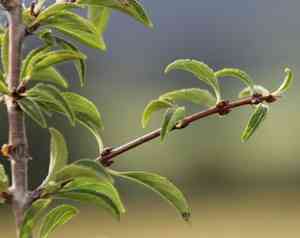
Rock buckthorn (Rhamnus saxatilis)
Also known as: Persian berry
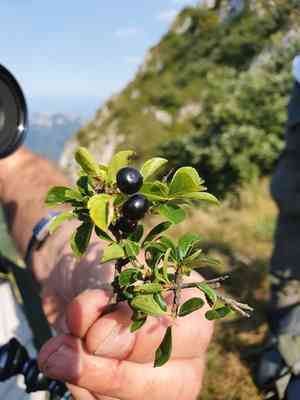
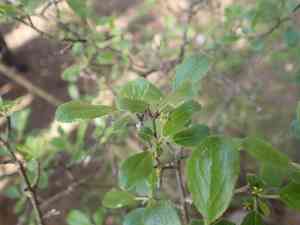
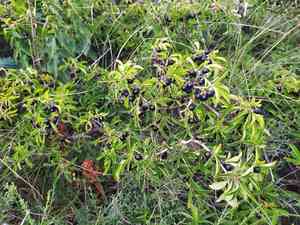
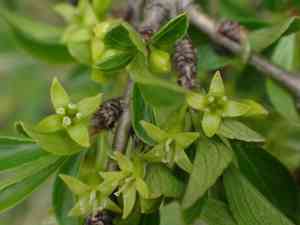
Rock buckthorn (Rhamnus saxatilis) is a hardy shrub well-suited to rocky environments, often seen on steep slopes. It has small, oval-shaped leaves that are glossy green, and its branches are notably thorny. The shrub blooms with small, greenish-yellow flowers in spring, which later develop into dark purple or black berries. Rock buckthorn prefers well-drained, calcareous soils and can often be found in sunny or partially shaded areas such as scrublands, rocky slopes, and woodland edges. Its resilience allows it to thrive in challenging, rocky conditions.
In This Article
Attributes of Rock buckthorn
Lifespan
Perennial
Plant Type
Shrub
Plant Height
20-50 cm (8-20 in)
Spread
Not specifically measured; generally dense and compact.
Leaf Color
Green
Flower Size
About 1-3 mm
Flower Color
Greenish
Images of Rock buckthorn
Quickly Identify Rock buckthorn
1
To identify Rhamnus saxatilis, look for its small, dense shrub form with ovate, green leaves. The plant produces small, greenish flowers and dark purple to black berries.
Scientific Classification of Rock buckthorn
Phylum
Vascular plants
Class
Dicotyledons
Order
Rosales
Family
Buckthorn
Genus
Buckthorns
Species
Rock buckthorn
Planting and Growing of Rock buckthorn
Care Difficulty
Easy
Watering Schedule
Every 2 days
Sunlight Requirements
Full sun
Sunshine Duration
4-8 hours
Ideal Temperature
60-70℉
Soil Type
Potting Mix, Peat Mix
Soil pH
6.5-7.5
Fertilizer Type
Balanced
Pruning Season
Spring, Summer
Pruning Area
Branches, Leaves
Pruning Frequency
2 times a year
Repotting Season
Spring
Pot Type
Plastic, Ceramic
 How to Water Rock buckthorn?
Rhamnus saxatilis, known for thriving in rocky terrains, prefers moderate watering. Ensure the soil is moist to the touch but not waterlogged, as excessively wet conditions can harm the roots. A general rule is to provide around 200 ml of water per session, allowing the soil to dry slightly between waterings.
What are the symptoms of an underwatered Rock buckthorn?
›
What should I do if my Rock buckthorn is not getting enough water?
›
What are the symptoms of an overwatered Rock buckthorn?
›
How to save an overwatered Rock buckthorn?
›
 What Are the Sunlight Requirements for Rock buckthorn?
This plant prefers full sun to partial sun conditions. Ideal lighting ensures vigorous growth, proper leaf coloration, and robust plant health by providing the necessary energy for photosynthesis and metabolic processes.
What is the ideal lighting for Rhamnus saxatilis?
›
How can I achieve the desired lighting conditions?
›
What benefits does ideal lighting provide?
›
 What Is the Ideal Temperature Range for Rock buckthorn?
Rhamnus saxatilis prefers a temperate climate with temperatures ranging ideally from 60°F to 70°F. This range provides optimal conditions for growth, ensuring the plant can photosynthesize efficiently and maintain vigorous health throughout its growing season.
 What Soil is Best for Rock buckthorn?
Rhamnus saxatilis thrives in well-drained soils, which prevent waterlogging that can lead to root rot. Good drainage allows roots to access oxygen, supporting strong plant growth. This plant prefers soils enriched with organic matter, providing essential nutrients that enhance its natural robustness and ability to produce healthy foliage. Rhamnus saxatilis does well in soils with a pH level ranging from neutral to slightly alkaline, allowing efficient uptake of nutrients and maintaining optimal health.
 How to Fertilize Rock buckthorn?
For Rhamnus saxatilis, it's important to maintain a balanced approach to fertilization. Typically, using around 150 grams of a balanced 10-10-10 NPK fertilizer per plant annually should suffice. It's crucial to ensure that the fertilizer is evenly spread around the base of the shrub and mixed into the top few inches of soil to aid absorption.
 How to Prune Rock buckthorn?
Begin by examining the overall shape and structure of the Rhamnus saxatilis. Identify any dead, diseased, or crossing branches that need removal. This initial assessment helps you make targeted cuts. Prune lateral branches back to the main trunk or to a bud that faces the outside of the plant to encourage an open structure. Cuts should be made just above a healthy bud to promote vigorous growth. To improve light penetration and air circulation, remove some of the inner branches. Do not remove more than a third of the plant at any one time, as this can stress the plant. After removing problematic branches, step back and shape the shrub to your desired outline. Rhamnus saxatilis can be maintained as a dense, compact mound or a more natural, open form.
More About Pruning Techniques→
 How to Propagate Rock buckthorn plant?
1
Gather ripe berries from the Rhamnus saxatilis plant and extract the seeds. Clean the seeds thoroughly to remove any pulp, which may inhibit germination if left on.
2
Select healthy, non-flowering stems from the plant. Make a clean cut below a node using pruning shears, and remove any leaves from the lower half of the cutting.
3
Carefully dig up the plant, ensuring minimal root disturbance. Separate the root clumps by gently pulling them apart, ensuring each division has an adequate portion of roots.
 How to Repot Rock buckthorn plant?
1
Watch for roots coming out of drainage holes or when you notice stunted growth. These are clear indicators that Rhamnus saxatilis needs more space. Spring and Autumn offer perfect conditions with mild temperatures to ease the transition when repotting.
2
Select a pot that is one size larger than the current one, ensuring it has proper drainage holes. This prevents waterlogging and promotes healthy root growth, allowing your Rhamnus saxatilis to thrive in its new environment.
3
Opt for a well-draining soil mix, preferably one designed for shrubs. This kind of soil not only provides essential nutrients but also maintains the right moisture balance, crucial for the health of Rhamnus saxatilis.
Toxicity
Ingestion
WARNING
The judgment on toxicity and danger is for reference only. We DO NOT GUARANTEE any accuracy of such judgment. Therefore, you SHALL NOT rely on such judgment. It is IMPORTANT TO SEEK PROFESSIONAL ADVICE in advance when necessary.



