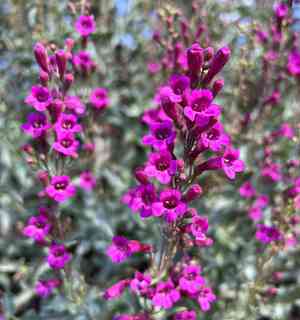
Cleveland's beardtongue (Penstemon clevelandii)
Also known as: Cleveland's Beardtongue, Cleveland Penstemon, Beardtongue
**Penstemon spectabilis**, commonly known as Showy Penstemon, is a striking perennial shrub indigenous to Southern California's chaparral and coastal sage scrub regions. This plant typically reaches heights of 60-90 cm and features narrow, lance-shaped leaves. From late spring through early summer, it produces clusters of tubular flowers in shades of lavender to pink, which are highly attractive to hummingbirds and bees. Showy Penstemon is well-suited to well-drained soils, showcasing its adaptability to the dry, rocky terrain of its native habitat.
In This Article
Attributes of Cleveland's beardtongue
Lifespan
Perennial
Plant Type
Herb
Plant Height
30 cm to 91 cm
Spread
Typically up to 2 feet (0.6 meters)
Leaf Color
Green to gray-green
Flower Size
1 to 2 inches (2.5 to 5 centimeters)
Flower Color
Pink, violet, or purple with white throats
Images of Cleveland's beardtongue
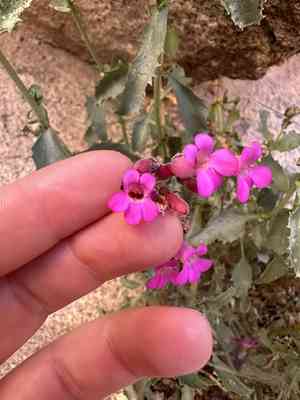
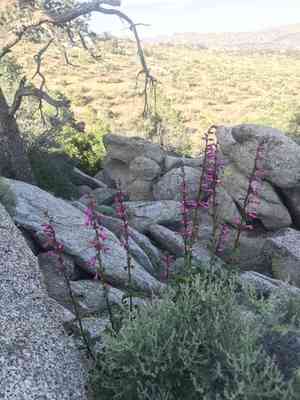
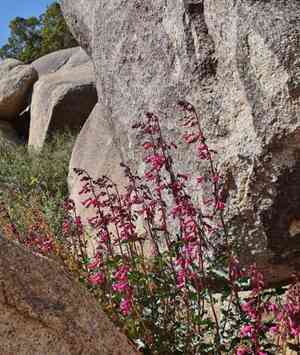
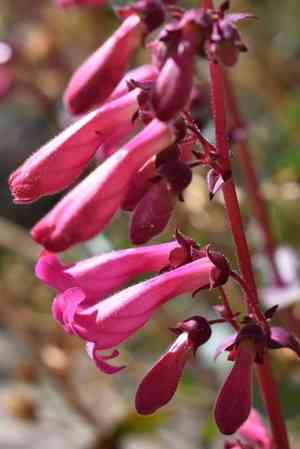
Quickly Identify Cleveland's beardtongue
1
Penstemon clevelandii can be identified by its tubular, two-lipped flowers and narrow, lance-shaped leaves. The flowers are typically pink to violet with white throats. The plant forms a basal rosette and sends up tall flower spikes.
Scientific Classification of Cleveland's beardtongue
Phylum
Vascular plants
Class
Dicotyledons
Order
Lamiales
Family
Plantain
Genus
Penstemon
Species
Cleveland's beardtongue
Planting and Growing of Cleveland's beardtongue
Care Difficulty
Moderate
Watering Schedule
Every 2 days
Sunlight Requirements
Full sun
Sunshine Duration
4-6 hours
Ideal Temperature
65-75℉
Soil Type
Potting Mix, Peat Mix
Soil pH
6.5-7.5
Fertilizer Type
Balanced
Pruning Season
Spring, Summer
Pruning Area
Branches, Leaves
Pruning Frequency
2 times a year
Repotting Season
Spring
Pot Type
Plastic, Ceramic
 How to Water Cleveland's beardtongue?
When watering Penstemon clevelandii, it is crucial to soak the soil thoroughly without waterlogging it. Aim for about 300 milliliters per session, letting the soil absorb moisture without puddling. Ensure good drainage to prevent root rot.
What are the symptoms of an underwatered Cleveland's beardtongue?
›
What should I do if my Cleveland's beardtongue is not getting enough water?
›
What are the symptoms of an overwatered Cleveland's beardtongue?
›
How to save an overwatered Cleveland's beardtongue?
›
 What Are the Sunlight Requirements for Cleveland's beardtongue?
Penstemon clevelandii prospers best in full sun exposure for 6-8 hours. Ideal lighting ensures strong foliage, prolific blooming, and minimized pest and disease pressures.
How much sunlight does Penstemon clevelandii need?
›
What methods can provide optimal light conditions?
›
Benefits of ideal lighting for Penstemon clevelandii
›
 What Is the Ideal Temperature Range for Cleveland's beardtongue?
Maintaining the ideal temperature range of 65-75°F for Penstemon clevelandii ensures optimal growth and flowering. Within this range, the plant can efficiently photosynthesize, uptake nutrients, and avoid stress-related issues. Deviations from this temperature can lead to slowed growth or reduced flowering. In a consistent and favorable environment, this plant will thrive and display its characteristic vibrant blooms.
 What Soil is Best for Cleveland's beardtongue?
Penstemon clevelandii thrives in well-draining soils, preventing root rot and waterlogging. This requirement is crucial as it enhances the plant's ability to absorb nutrients efficiently without suffocating the roots. Although Penstemon clevelandii can tolerate poor soil, a nutrient-rich composition can boost its growth and flowering. The presence of organic matter can provide essential nutrients, resulting in vibrant blooms. This plant prefers soils with moderate fertility levels. While high fertility can lead to excessive foliage at the expense of blooms, the right balance ensures healthy growth with a beautiful display of flowers.
 How to Fertilize Cleveland's beardtongue?
When fertilizing Penstemon clevelandii, use a balanced, water-soluble fertilizer diluted to half the strength recommended on the package. This ensures that the plant receives necessary nutrients without becoming overloaded, allowing for healthy growth and vibrant blooms.
 How to Prune Cleveland's beardtongue?
Start by light trimming of the plant by removing spent blooms. This allows the plant to conserve energy and redirect it towards new growth and flowering. During the early spring, cut back up to one-third of the older growth. This will rejuvenate the plant, making space for new, robust stems and an enhanced flowering display. Maintain the desired shape and structure by trimming any wayward stems. This keeps the plant neat and makes it easier for sunlight to penetrate all areas, supporting optimal flowering. Be cautious not to over-prune. Excessive pruning can stress the plant, reducing its ability to produce flowers and compromising its overall health.
More About Pruning Techniques→
 How to Propagate Cleveland's beardtongue plant?
1
Begin by filling seed trays with a well-draining potting mix. Sow the seeds on the surface and gently press them into the soil. Water lightly and keep the trays in a warm, bright area.
2
Use sharp pruners to cut 4-6 inch healthy stems from the parent plant. Remove the lower leaves and dip the cut end in rooting hormone before planting it in a pot filled with a suitable mix.
3
Keep the soil consistently moist but not waterlogged by watering regularly. Ensure the seedlings or cuttings receive indirect sunlight and maintain a temperature conducive for germination or rooting.
 How to Repot Cleveland's beardtongue plant?
1
Penstemon clevelandii shows signs that it's ready for repotting when its roots begin to protrude from the drainage holes or its growth becomes stunted. Ideally, this should be done during its active growing seasons, spring or autumn, when the plant can easily adapt to its new surroundings with resilient energy.
2
Select a pot that is only slightly larger than the current one to avoid water retention issues which can damage Penstemon's roots. A pot made of breathable material like terracotta can ensure good airflow and prevent root rot, providing the ideal environment for healthy growth.
3
Ensure you choose a well-draining sandy mix that mirrors its natural habitat. This type of soil prevents excess moisture accumulation, reducing risks of fungal infections while keeping the root system healthy and thriving in its arid-like conditions.
Learn More About Cleveland's beardtongue Diseases
Anthracnose
Bacterial Leaf Spot
Bacterial Soft Rot
Bacterial Wilt
Black Spot
Chemical Injury
Crown Gall
Cyst Nematode
Damping-off
Downy Mildew
Drought Stress
Fusarium Wilt
Gray Mold
Leaf Curl
Leaf Spot
Mosaic
Nutrient Deficiency
Nutrient Toxicity
Powdery Mildew
Root Rot
Root-knot Nematode
Rusts
Sooty Mold
Spider Mites
Temperature Stress
Thrips Damage
White Mold



