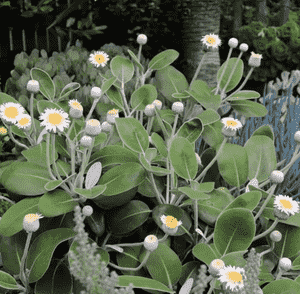
Marlborough rock daisy (Pachystegia insignis)
Also known as: Kaikoura rock daisy
Growing naturally in rocky, coastal areas, marlborough rock daisy is a drought tolerant plant occasionally used in xeriscaping. The small shrub produces flowers similar to daisies in the summer and keeps its attractive greenish-grey foliage throughout the year to provide continual garden interest.
In This Article
Attributes of Marlborough rock daisy
Lifespan
Perennial
Plant Type
Shrub
Plant Height
40 cm
Spread
60 cm
Leaf Color
Green
Flower Size
5-8 cm
Flower Color
White
Images of Marlborough rock daisy
Quickly Identify Marlborough rock daisy
1
It can be identified by its robust, glossy green leaves with a white underside, and large white daisy-like flowers with yellow centers. It typically grows on rocky outcrops and coastal cliffs.
Scientific Classification of Marlborough rock daisy
Phylum
Vascular plants
Class
Dicotyledons
Order
Asterales
Family
Daisy
Genus
Pachystegia
Species
Marlborough rock daisy
Planting and Growing of Marlborough rock daisy
Care Difficulty
Hard
Watering Schedule
Every 2 days
Sunlight Requirements
Full sun
Sunshine Duration
4-8 hours
Ideal Temperature
65-75℉
Soil Type
Potting Mix, Peat Mix
Soil pH
5.5-7.5
Fertilizer Type
Balanced
Pruning Season
Spring, Summer
Pruning Area
Branches, Leaves
Pruning Frequency
Once a year
Repotting Season
Spring
Pot Type
Plastic, Ceramic
 How to Water Marlborough rock daisy?
Pachystegia insignis prefers moderate watering. Directly pour 500ml of water onto the soil until it's thoroughly soaked. Always avoid overwatering which could lead to water-logging issues.
What are the symptoms of an underwatered Marlborough rock daisy?
›
What should I do if my Marlborough rock daisy is not getting enough water?
›
What are the symptoms of an overwatered Marlborough rock daisy?
›
How to save an overwatered Marlborough rock daisy?
›
 What Are the Sunlight Requirements for Marlborough rock daisy?
The ideal light range for Pachystegia insignis is moderate to bright light. This allows optimal photosynthesis leading to an increase in plant growth and vigor. It also promotes flowering and maintains the vibrant foliage color.
Question: How to provide Pachystegia insignis with ideal sunlight?
›
Question: What kind of sunlight is optimal for Pachystegia insignis?
›
Question: How to maintain ideal sunlight for Pachystegia insignis?
›
 What Is the Ideal Temperature Range for Marlborough rock daisy?
The Pachystegia Insignis thrives in a temperature range between 65F and 75F. This temperature range allows the plant to fully participate in photosynthesis and nutrient absorption, leading to optimal growth.
 What Soil is Best for Marlborough rock daisy?
Pachystegia insignis requires well-drained soil to prevent waterlogging, which can lead to rotting of its roots. Good drainage also allows for proper aeration, aiding root development and overall health of the plant. This plant benefits from sandy soils as they provide the good drainage it requires. In addition to its drainage properties, sandy soil also typically contains higher levels of oxygen, essential for root health. Pachystegia insignis prefers soil with a slightly acidic to neutral pH level. This range allows for optimal nutrient availability for the plant, promoting robust growth.
 How to Fertilize Marlborough rock daisy?
Pachystegia insignis generally prefers a moderate approach to fertilization. A dose of slow-release granular fertilizer at the outset of the plant's growing season ought to be sufficient, with a diluted liquid feed every fortnight as a supplementary treat. A key point is to avoid over-fertilization, which can be detrimental to its health.
 How to Prune Marlborough rock daisy?
Pruning at the wrong time could possibly stress the plant and restrict the growth. It's advised to prune Pachystegia insignis in Spring just before the onset of new growth or in Autumn when the plant is relatively dormant. Over-pruning can put too much stress on the plant. Instead of removing large sections of the Pachystegia insignis all at once, aim to remove only a third of the plant’s total volume in a single pruning session. Remember to prune selectively to maintain the plant's natural habit.
More About Pruning Techniques→
 How to Propagate Marlborough rock daisy plant?
1
The first step in propagation is to collect cuttings from the parent plant. Cuttings should be taken from healthy, disease-free branches using sterilized pruning shears.
2
For seed propagation, seeds can be sown directly into a container filled with a suitable potting mix. It is important to provide the right conditions for germination by keeping them warm and moist.
3
The final step in propagation is to let the cuttings or seeds develop roots. Once roots have sufficiently developed, they can be transplanted into a larger container or directly into the garden.
 How to Repot Marlborough rock daisy plant?
1
Pachystegia insignis shows signs for repotting when roots start to crowd at surface or through drainage holes. This typically happens every 2 years. Spring or Autumn, when the plant is actively growing, is the optimal time.
2
A pot with adequate drainage holes is crucial to prevent waterlogging. The pot should slightly larger than the previous one, providing enough room for root development. A slightly larger pot also instigates stronger growth.
3
Pachystegia insignis prefers a well-drained, sandy loam. This type of soil structure allows for efficient water drainage and provides ample aeration to roots, fostering healthier and stronger plant growth.
Learn More About Marlborough rock daisy Diseases
Anthracnose
Bacterial Leaf Spot
Black Spot
Chemical Injury
Crown Gall
Damping-off
Downy Mildew
Drought Stress
Fusarium Wilt
Gray Mold
Leaf Curl
Leaf Spot
Mosaic
Nutrient Deficiency
Nutrient Toxicity
Powdery Mildew
Root Rot
Root-knot Nematode
Rusts
Sooty Mold
Spider Mites
Temperature Stress
Thrips Damage
White Mold



