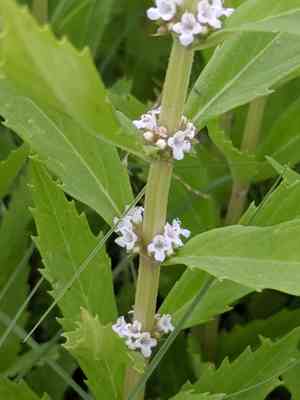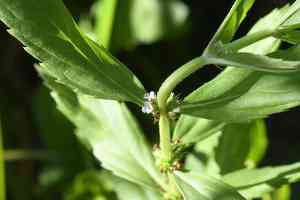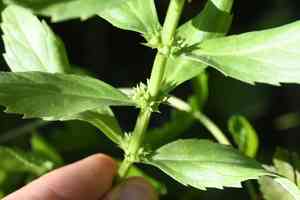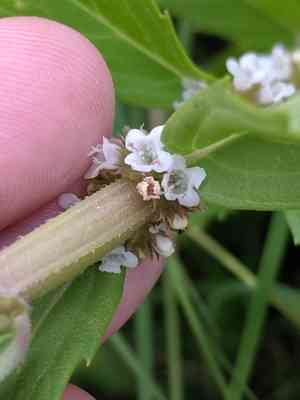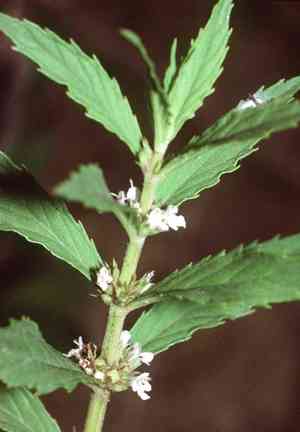
Rough bugleweed(Lycopus asper)

Rough bugleweed (Lycopus asper)

Also known as: Rough Bugleweed, Water Horehound

Sure, here's a revised response based on your reference:

The perennial herb you're referring to likely grows from a rhizome characterized by thick, knobby tips. The plant typically stands erect and can reach up to 80-100 centimeters in height. It features an upright stem adorned with pairs of narrow, lance-shaped leaves. These leaves are arranged alternately and may have a slightly toothed edge. The plant produces small flowers, generally white and just a few millimeters in size, which emerge from the leaf axils.

The plant thrives in warm, humid environments with well-drained, fertile soil. It requires regular watering but should not be left in waterlogged conditions. Propagation is usually done by dividing the rhizomes. The rhizomes are typically ready for harvest around 8-10 months after planting, indicated by the yellowing of the plant's leaves.

Attributes of Rough bugleweed

Lifespan
Perennial
Plant Type
Herb
Plant Height
15 cm to 91 cm
Spread
Not typically measured as it is a herbaceous plant
Leaf Color
Green
Flower Size
0.3-0.5 cm
Flower Color
White

ForwardPlant - Identify plants with a snap

Identify and diagnose plants, get toxicity alerts, and explore safety guides for all types of fungi.

Try for Free

Images of Rough bugleweed

Rough bugleweed(Lycopus asper)

Quickly Identify Rough bugleweed

1
Lycopus asper can be identified by its square stems and opposite leaves that are sharply toothed. During its flowering period, small white flowers can be seen in the leaf axils. The leaves are also characterized by a rough texture.

Scientific Classification of Rough bugleweed

Phylum
Vascular plants
Class
Dicotyledons
Order
Lamiales
Family
Mint
Genus
Water horehounds
Species
Rough bugleweed

Planting and Growing of Rough bugleweed

Care Difficulty
Easy
Watering Schedule
Every 4 days
Sunlight Requirements
Partial sun
Sunshine Duration
6-12 hours
Ideal Temperature
68-77℉
Soil Type
Potting Mix, Peat Mix
Soil pH
6.5-7.5
Fertilizer Type
Balanced
Pruning Season
Spring, Summer
Pruning Area
Branches, Leaves
Pruning Frequency
2 times a year
Repotting Season
Spring
Pot Type
Plastic, Ceramic

water icon How to Water Rough bugleweed?

For Lycopus asper, it is crucial to maintain its moist soil without waterlogging. Water about 200 milliliters each session, ensuring the water penetrates thoroughly to reach the roots. Water should be applied until it dribbles from the bottom drainage holes, but avoid standing water to prevent root rot.
What are the symptoms of an underwatered Rough bugleweed?
What should I do if my Rough bugleweed is not getting enough water?
What are the symptoms of an overwatered Rough bugleweed?
How to save an overwatered Rough bugleweed?

sunlight icon What Are the Sunlight Requirements for Rough bugleweed?

Sunlight Requirements: Partial sun, Full shade
Duration of light: 3 to 6 hours
Lycopus asper prefers partial sun to full shade, benefiting from consistent filtered light. This range promotes healthy growth, better flowering, and maintains foliage vibrancy.
What is the ideal light for Lycopus asper?
How to maintain these lighting conditions?
What are the benefits of ideal lighting?

temperature icon What Is the Ideal Temperature Range for Rough bugleweed?

Ideal Temperature: 68 ~ 77℉
The ideal temperature range for cultivating Lycopus asper is between 68°F and 77°F. This range provides optimal conditions for growth and development, promoting healthy foliage and robust plant structure.

soil icon What Soil is Best for Rough bugleweed?

Soil type: Loam, Sandy loam
Soil PH: 6.5 ~ 7.5
Lycopus asper thrives in soils with good moisture retention. Loamy soils allow for adequate water holding capacity, preventing the plant from wilting in dry periods. This quality ensures constant hydration, promoting healthy growth and development. Rich, loamy soil brimming with organic matter supports Lycopus asper by offering ample nutrients. These nutrients are easily accessible to the plant, enhancing its metabolic processes and boosting overall vitality. Proper soil aeration is essential for Lycopus asper. Loamy soils are well-aerated, enabling sufficient oxygen flow to the roots. This promotes efficient nutrient and water uptake, resulting in robust plant growth and health.

fertilize icon How to Fertilize Rough bugleweed?

Fertilizer type: Balanced
When fertilizing Lycopus asper, it's important to provide nutrients without overwhelming the plant. A moderate application of a balanced 10-10-10 fertilizer is recommended. Use approximately 1 tablespoon per gallon of water, ensuring the solution is evenly distributed across the soil surface. This ratio maintains optimal growth without risking nutrient burn.

prune icon How to Prune Rough bugleweed?

Pruning Time: Spring, Summer
Begin by identifying the overcrowded or weak-looking shoots. Remove these to allow sunlight and air to reach all parts of the plant, promoting vigorous growth. Focus on cutting back overgrown stems to maintain a preferred shape. This can be achieved by cutting just above a leaf node, encouraging a fuller and more pleasing form. After pruning, gather and dispose of any removed plant material properly. This is crucial to prevent any spread of disease or pests that might have been present. More About Pruning Techniques

propagate icon How to Propagate Rough bugleweed plant?

Propagate Time: Spring,Late spring,Early spring,Summer
1
Collect mature seeds from a healthy plant. Clean and dry them thoroughly to prevent mold formation before planting in a sterilized potting mix.
2
Choose a healthy, non-flowering stem and cut it at an angle. Ideally, each cutting should be about 4-6 inches long with at least two leaf nodes for better rooting.
3
Dig up established plants and carefully divide the root ball into sections, ensuring each section has roots and shoots. Replant immediately to minimize the shock.
More About Propagating Techniques

repot icon How to Repot Rough bugleweed plant?

Repotting frequency: Every 2-3 years
1
Lycopus asper usually signals that it needs repotting when roots begin circling the pot or poking through drainage holes. This plant thrives in new soil environments in the spring or autumn, as these seasons offer optimal growth conditions. Look for signs like slowed growth, wilting despite proper watering, and the appearance of yellowed leaves. These are clear indicators that it's time for a change.
2
Select a pot that is slightly larger than the current one, ideally with a diameter increase of about 2 inches. Ensure that it has sufficient drainage holes to prevent waterlogging, which Lycopus asper is susceptible to. The material can vary, but terra-cotta is often a good choice as it allows for breathability while providing sturdiness. A well-selected pot ensures stability, adequate root space, and effective water drainage.
3
Opt for a moisture-retentive yet well-draining soil mix, rich in organic matter. This type of soil retains necessary moisture without becoming soggy and ensures proper aeration around the roots. A blend containing peat, perlite, and some organic compost works wonders. The advantage of using this soil is that it supports the plant's growth while preventing root rot by allowing surplus water to drain away.

ForwardPlant - Identify plants with a snap

Find the best spots for them to optimize their health, simply using your phone.

Try for Free