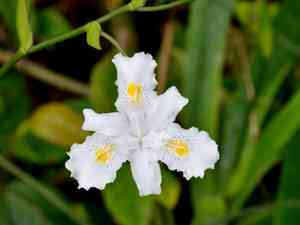
Bamboo iris (Iris confusa)
Also known as: Bamboo Iris, Walking Iris
The plant in question is the Iris japonica, also known as the Fringed Iris or Japanese Iris. This rhizomatous perennial from the Iris family is notable for its bamboo-like stems and broad, evergreen foliage. It prefers dappled shade, mirroring its natural woodland environments in China. In the spring, it produces cascading clusters of lavender-blue flowers adorned with a central yellow or white splash, enhancing its decorative charm.
In This Article
Attributes of Bamboo iris
Lifespan
Perennial
Plant Type
Herb
Plant Height
90 cm
Spread
90 cm
Leaf Color
Green
Flower Size
5-8 cm
Flower Color
White with yellow markings
Images of Bamboo iris
Quickly Identify Bamboo iris
1
Iris confusa can be identified by its fan-like clusters of broad, sword-shaped leaves and its white flowers with yellow markings that appear in clusters.
Scientific Classification of Bamboo iris
Phylum
Vascular plants
Class
Monocotyledons
Order
Asparagus and allies
Family
Iris
Genus
Irises
Species
Bamboo iris
Planting and Growing of Bamboo iris
Care Difficulty
Easy
Watering Schedule
Every 4 days
Sunlight Requirements
Full sun
Sunshine Duration
4-8 hours
Ideal Temperature
60-75℉
Soil Type
Potting Mix, Peat Mix
Soil pH
6.5-7.5
Fertilizer Type
Balanced
Pruning Season
Spring, Summer
Pruning Area
Branches, Leaves
Pruning Frequency
Once a year
Repotting Season
Spring
Pot Type
Plastic, Ceramic
 How to Water Bamboo iris?
For Iris confusa, the right watering approach is to aim for deep and thorough saturation. Approximately 500 ml of water per session should suffice, ensuring the moisture reaches the root level without causing water logging. It's wise to let the top layer of soil dry out a bit between waterings to mimic its natural environment.
What are the symptoms of an underwatered Bamboo iris?
›
What should I do if my Bamboo iris is not getting enough water?
›
What are the symptoms of an overwatered Bamboo iris?
›
How to save an overwatered Bamboo iris?
›
 What Are the Sunlight Requirements for Bamboo iris?
Iris confusa thrives in conditions of partial to full sun, particularly with four to six hours of daily exposure. Adequate lighting promotes healthy blooming and prevents problems related to poor light access.
 What Is the Ideal Temperature Range for Bamboo iris?
The ideal temperature range for Iris confusa is between 60°F and 75°F. This range ensures optimal growth and helps the plant thrive without stress. Maintaining this temperature in your garden or home will give the iris the conditions it needs for healthy foliage and blooms.
 What Soil is Best for Bamboo iris?
Iris confusa thrives in well-drained soil that prevents waterlogging, which could lead to root rot. This type of soil allows for proper air circulation, promoting healthy root growth and vigorous blooming. This plant benefits from nutrient-rich soil, which provides the essential elements for growth and flowering. Fertile soil supports robust foliage and larger, more vibrant blooms that make the plant a standout in any garden. The soil should have moderate moisture retention, enabling the plant to access water when needed without remaining too wet. This balance helps to sustain the plant during dry spells without causing damp conditions that could harm the roots.
 How to Fertilize Bamboo iris?
For Iris confusa, the recommended amount of fertilizer is moderate. Liquid fertilizers should be diluted to half-strength, approximately 1 tablespoon per gallon of water. Solid slow-release fertilizers are generally safe at about 1 teaspoon per square foot of soil. This ensures the plant receives enough nutrients without the risk of over-fertilization.
 How to Prune Bamboo iris?
Begin by carefully removing any dead or damaged leaves at the base. This helps improve the overall health of the plant by reducing disease risks and allows for better air circulation. After blooming, trim back the flower stalks to the base. This prevents the plant from wasting energy on seed production and encourages new growth for the upcoming season. If the plant becomes too dense, thin out crowded areas by removing some of the growth at the base. This ensures good air circulation, reducing the chances of fungal diseases.
More About Pruning Techniques→
 How to Propagate Bamboo iris plant?
1
Select a well-draining soil mix suited for Iris confusa. Enrich the soil with compost to provide nutrients. Ensure the pH level is slightly acidic to neutral for optimal growth.
2
Place seeds in seed trays filled with the prepared soil mix. Lightly cover with compost and water gently. Maintain a warm temperature and keep the soil moist until germination occurs.
3
Carefully dig around the plant to expose the rhizomes. Use a clean knife or spade to cut through the rhizome, ensuring each piece has roots and shoots. Replant immediately in prepared soil.
 How to Repot Bamboo iris plant?
1
Observe for signals like roots crowding the pot, water not draining properly, or stunted growth indicating repotting is needed for Iris confusa.
2
Choose a pot slightly larger than the current one with drainage holes to ensure healthy root growth and prevent waterlogging for Iris confusa.
3
Opt for a well-draining soil mix containing perlite or sand to provide aeration and prevent root rot in Iris confusa.
Toxicity
Ingestion, contact with sap, chewing the leaves or stems
WARNING
The judgment on toxicity and danger is for reference only. We DO NOT GUARANTEE any accuracy of such judgment. Therefore, you SHALL NOT rely on such judgment. It is IMPORTANT TO SEEK PROFESSIONAL ADVICE in advance when necessary.
Learn More About Bamboo iris Diseases
Anthracnose
Bacterial Leaf Spot
Bacterial Soft Rot
Bacterial Wilt
Black Spot
Chemical Injury
Crown Gall
Cyst Nematode
Damping-off
Downy Mildew
Drought Stress
Fusarium Wilt
Gray Mold
Leaf Curl
Leaf Spot
Mosaic
Nutrient Deficiency
Nutrient Toxicity
Powdery Mildew
Root Rot
Root-knot Nematode
Rusts
Sooty Mold
Spider Mites
Temperature Stress
Thrips Damage
White Mold



