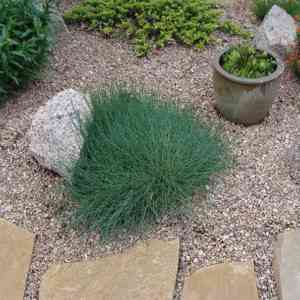
Death valley jointfir (Ephedra funerea)
Also known as: Desert Tea, Mormon Tea
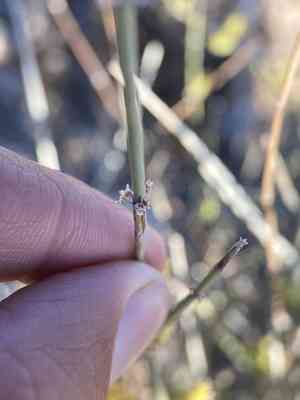
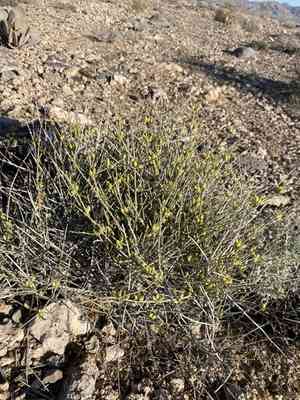
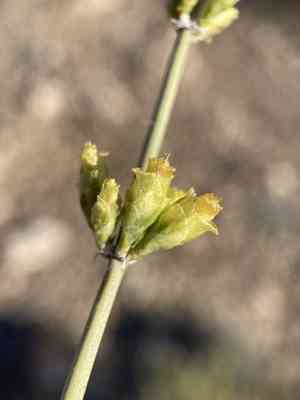
Ephedra funerea, commonly known as Death Valley jointfir, features erect, slender twigs that start as gray-green and turn gray and cracked with age. These twigs bear tiny leaves at the nodes. Male shrubs produce small, yellowish pollen cones at the nodes, measuring up to 8 millimeters in length. Female shrubs generate slightly longer seed cones, which sometimes grow on short stalks.
In This Article
Attributes of Death valley jointfir
Lifespan
Perennial
Plant Type
Shrub
Plant Height
1 to 3 feet
Spread
2 to 4 feet
Leaf Color
Green (though leaves are reduced to scales)
Flower Size
N/A (Cones do not have petals)
Flower Color
Yellow-brown (cones)
Images of Death valley jointfir
Quickly Identify Death valley jointfir
1
Ephedra funerea can be identified by its jointed, narrow, green stems that resemble twigs. The plant lacks true leaves, which have been reduced to small scales. It typically grows in a sprawling, shrub-like manner. Presence of small yellowish-brown cones is also a distinguishing characteristic.
Scientific Classification of Death valley jointfir
Phylum
Vascular plants
Class
Gnetophytes
Order
Ephedrales
Family
Mormon-tea
Genus
Joint-pines
Species
Death valley jointfir
Planting and Growing of Death valley jointfir
Care Difficulty
Easy
Watering Schedule
Every day
Sunlight Requirements
Full sun
Sunshine Duration
4-8 hours
Ideal Temperature
68-77℉
Soil Type
Potting Mix, Peat Mix
Soil pH
6.5-7.5
Fertilizer Type
Balanced
Pruning Season
Spring, Summer
Pruning Area
Branches, Leaves
Pruning Frequency
2 times a year
Repotting Season
Spring
Pot Type
Plastic, Ceramic
 How to Water Death valley jointfir?
Ephedra funerea prefers to be watered deeply but infrequently. Allow around 250 milliliters of water per session, ensuring the soil is thoroughly moistened but not waterlogged. This replicates the plant’s natural environment where rainfall is sporadic, but substantial.
What are the symptoms of an underwatered Death valley jointfir?
›
What should I do if my Death valley jointfir is not getting enough water?
›
What are the symptoms of an overwatered Death valley jointfir?
›
How to save an overwatered Death valley jointfir?
›
 What Are the Sunlight Requirements for Death valley jointfir?
Ephedra funerea performs best in full sun to partial sun situations. Plenty of light ensures optimal photosynthesis, promoting healthy, vigorous growth, and the plant's natural energy processes.
How to Achieve Ideal Lighting?
›
What Are Specific Steps for Optimal Lighting?
›
Benefits of Perfect Lighting Conditions?
›
 What Is the Ideal Temperature Range for Death valley jointfir?
For optimal growth, Ephedra funerea thrives best at a temperature range of 68°F to 77°F. This range supports active photosynthesis and metabolic processes, ensuring robust plant health and development. Maintaining this temperature range can lead to the best vegetative and reproductive growth for the plant.
 What Soil is Best for Death valley jointfir?
Ephedra funerea thrives in well-drained soils that prevent root rot. Such soils facilitate proper water drainage, ensuring roots remain healthy and oxygenated, which is essential for plant vitality. This plant is adapted to grow in nutrient-poor soils, reflecting its desert origins. Over-fertilization can harm it; hence, nutrient-poor conditions encourage stronger root development and drought resistance. Ephedra funerea does well in soils with low organic matter. This mimics its native desert environments where decomposed materials are minimal, helping the plant manage water sparingly and efficiently.
 How to Fertilize Death valley jointfir?
For Ephedra funerea, use a very light hand when it comes to fertilization. This plant thrives in nutrient-poor soils, so a diluted fertilizer (1/4 of the standard strength) is sufficient when applying liquid fertilizers. For solid fertilizers, use a small amount–a tablespoonful around the base of the plant is more than enough.
 How to Prune Death valley jointfir?
Ephedra funerea does not require extensive pruning. However, occasional trims help maintain its shape and encourage healthier growth. It's important to start with clean, sharp tools to prevent disease transmission. Begin by removing any dead or damaged branches, which can harbor pests and impede growth. Focus on cutting just above a node to promote new growth. For shaping, consider the natural form of the plant, which is typically shrub-like. Use pruning to emphasize this structure while ensuring airflow between the branches. When thinning, choose the most crowded or crossing branches to remove, which will help prevent future overcrowding and allow more light to reach all parts of the plant.
More About Pruning Techniques→
 How to Propagate Death valley jointfir plant?
1
Begin by soaking the seeds in water for 24 hours to soften the seed coat. This step helps in breaking dormancy and enhancing germination rates.
2
Sow the soaked seeds in seed starting trays filled with a well-draining potting mix. Cover lightly with soil and maintain moisture until germination occurs.
3
Select healthy stems and take 4-6 inch cuttings. Remove lower leaves and dip the cut end in rooting hormone to encourage root formation.
 How to Repot Death valley jointfir plant?
1
Ephedra funerea needs repotting when its roots become visible through the drainage holes, the plant appears to be top-heavy, or growth has noticeably slowed. These signs often indicate that the plant has outgrown its current pot or the soil has lost its fertility.
2
Select a pot that is slightly larger than the current one, with ample drainage holes to prevent waterlogging. A ceramic or terracotta pot is ideal as these materials allow moisture to evaporate, avoiding root rot while providing stability to this naturally upright plant.
3
The ideal soil should be sandy and well-draining to mimic the plant's natural desert environment. A mix that contains perlite, coarse sand, and a small amount of organic material will provide the best conditions, ensuring good drainage and preventing root rot.
Learn More About Death valley jointfir Diseases
Anthracnose
Bacterial Leaf Spot
Bacterial Soft Rot
Bacterial Wilt
Black Spot
Chemical Injury
Crown Gall
Cyst Nematode
Damping-off
Downy Mildew
Drought Stress
Fusarium Wilt
Gray Mold
Leaf Spot
Mosaic
Nutrient Deficiency
Nutrient Toxicity
Powdery Mildew
Root Rot
Root-knot Nematode
Rusts
Sooty Mold
Spider Mites
Temperature Stress
Thrips Damage
White Mold



