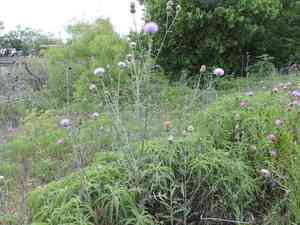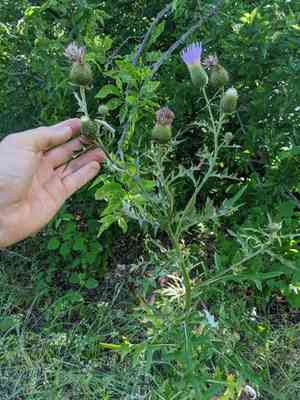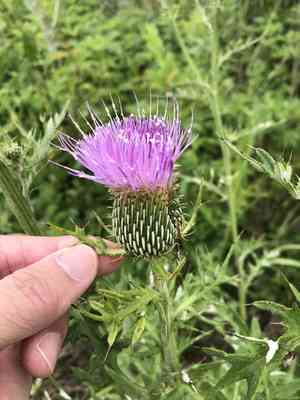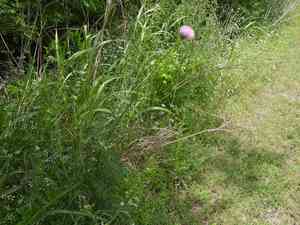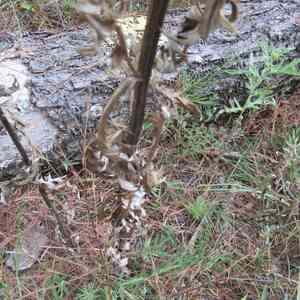
Engelmann's thistle(Cirsium engelmannii)

Engelmann's thistle (Cirsium engelmannii)

Also known as: Engelmann's Thistle

Engelmann's thistle (Cirsium engelmannii) thrives in rocky outcrops and grasslands due to several specialized features:

1. **Adapted Foliage**: The spiny, velvety leaves reduce water loss and deter herbivores, making it well-suited for harsh environments.
2. **Deep Taproot**: This robust root system secures the plant in rocky soil and accesses deep water reserves, crucial for survival in dry conditions.
3. **Perennial Growth**: As a perennial, Engelmann's thistle can endure and regenerate year after year, even in challenging climates.
4. **Height Advantage**: Growing up to three feet, it stands above shorter plants, making it more visible to pollinators like butterflies.
5. **Nectar-Rich Flowers**: The striking purple flowers attract various pollinators, ensuring successful reproduction and genetic diversity.

Attributes of Engelmann's thistle

Lifespan
Perennial
Plant Type
Herb
Plant Height
30 cm to 1.8 m
Spread
Not typically applicable; generally refers to trees.
Leaf Color
Green with a silvery appearance due to fine hairs
Flower Size
2 to 5 centimeters
Flower Color
Purple

ForwardPlant - Identify plants with a snap

Identify and diagnose plants, get toxicity alerts, and explore safety guides for all types of fungi.

Try for Free

Images of Engelmann's thistle

Engelmann's thistle(Cirsium engelmannii)

Quickly Identify Engelmann's thistle

1
This plant has sharp spiny leaves and often features a woolly or cobwebby appearance. Its flower heads are usually purple, with distinctive long spines extending from the bracts.

Scientific Classification of Engelmann's thistle

Phylum
Vascular plants
Class
Dicotyledons
Order
Asterales
Family
Daisy
Genus
Thistles
Species
Engelmann's thistle

Planting and Growing of Engelmann's thistle

Care Difficulty
Moderate
Watering Schedule
Every 2 days
Sunlight Requirements
Full sun
Sunshine Duration
6-8 hours
Ideal Temperature
60-75℉
Soil Type
Potting Mix, Peat Mix
Soil pH
6.5-7.5
Fertilizer Type
Balanced
Pruning Season
Spring, Summer
Pruning Area
Branches, Leaves
Pruning Frequency
2 times a year
Repotting Season
Spring
Pot Type
Plastic, Ceramic

water icon How to Water Engelmann's thistle?

Cirsium engelmannii requires a careful balance when it comes to watering. Water should be applied until it penetrates the soil around the roots but without creating a waterlogged environment. Generally, 500 ml is recommended to ensure enough moisture reaches down to the depth of the plant’s root system without causing soggy roots which can lead to root rot.
What are the symptoms of an underwatered Engelmann's thistle?
What should I do if my Engelmann's thistle is not getting enough water?
What are the symptoms of an overwatered Engelmann's thistle?
How to save an overwatered Engelmann's thistle?

sunlight icon What Are the Sunlight Requirements for Engelmann's thistle?

Sunlight Requirements: Full sun, Partial sun
Duration of light: 6-8 hours per day
Full sun to partial sun is ideal, offering Cirsium engelmannii the resources for photosynthesis, promoting growth, and vibrant flowering. Consistent exposure within this range enhances resilience and longevity, ensuring sustained aesthetic appeal and ecological function.
What is the ideal light availability for Cirsium engelmannii?
How can I optimize lighting for indoor growth?
What happens if Cirsium engelmannii receives its optimal lighting?

temperature icon What Is the Ideal Temperature Range for Engelmann's thistle?

Ideal Temperature: 60 ~ 75℉
For optimal growth of Cirsium engelmannii, maintaining temperatures within a range of 60°F to 75°F is critical. This range ensures that the plant can efficiently carry out photosynthesis, and metabolic processes, thus promoting healthy development. It’s important to note that consistent temperatures facilitate better nutrient uptake and moisture retention, both of which are essential for this species.

soil icon What Soil is Best for Engelmann's thistle?

Soil type: Sandy loam, Loam
Soil PH: 6.5 ~ 7.5
Cirsium engelmannii thrives in well-drained soils to prevent root rot. This type of soil ensures adequate aeration and helps the plant to absorb nutrients efficiently, resulting in healthier growth. The plant requires moderately fertile soils, which provide necessary nutrients without overwhelming the plant. An optimal balance of nutrients supports robust growth and bloom production. While Cirsium engelmannii can tolerate some drought, it prefers soils that retain moisture without becoming waterlogged. Consistent moisture levels facilitate steady growth and prevent stress.

fertilize icon How to Fertilize Engelmann's thistle?

Fertilizer type: Balanced
Cirsium engelmannii benefits from moderate fertilization due to its adaptability to various conditions. Apply 1 teaspoon of a balanced 10-10-10 fertilizer per gallon of water for liquid feeds. For solid fertilizers, use approximately 2 tablespoons per plant. Avoid over-fertilization, as it can harm the plant.

prune icon How to Prune Engelmann's thistle?

Pruning Time: Spring, Summer
Start by examining your plant closely and look for dead, damaged, or weak stems. These should be prioritized for removal, as eliminating them enhances air circulation and light penetration, ultimately bolstering plant health and vigor. When you have identified the stems to prune, make your cuts at a 45-degree angle. This angle helps water runoff, preventing moisture-related diseases, and ensures the wound heals efficiently, reducing stress on the plant. More About Pruning Techniques

propagate icon How to Propagate Engelmann's thistle plant?

Propagate Time: Spring, Early spring
1
Begin by filling the seed trays with potting soil. Sow the seeds thinly across the surface, ensuring they have sufficient space to grow. Lightly cover the seeds with a thin layer of soil or vermiculite and water gently to settle the seeds.
2
Place the seed trays in a location where they can receive ample sunlight. Maintaining a temperature of around 65-70°F (18-21°C) facilitates quicker germination. Use a humidity dome to retain moisture if necessary.
3
Once the seedlings have developed two to three true leaves, carefully transplant them to larger pots or directly into the garden. Ensure each plant has enough room to grow and establish its root system effectively.
More About Propagating Techniques

repot icon How to Repot Engelmann's thistle plant?

Repotting frequency: Every 2-3 years
1
Cirsium engelmannii shows a need for repotting when its roots start to circle the pot or protrude through the drainage holes. These signs, indicating root crowding or insufficient space, usually emerge after the plant has enjoyed a good growth period, typically in spring. For the optimal health and growth of your plant, tackling repotting during these times ensures it rebounds quickly and develops robustly.
2
Select a pot with a diameter 2-3 inches larger than the current one, and ensure it has sufficient drainage holes. A larger pot provides ample room for root expansion, promoting vigorous growth, while adequate drainage prevents waterlogging that could lead to root rot. Ideally, you should choose a pot made from breathable materials like terra cotta to help regulate moisture levels.
3
Opt for a well-draining potting mix enriched with sand, perlite, or vermiculite. This type of soil ensures that water doesn’t linger around the roots for extended periods, which is crucial for preventing fungal diseases and root rot. It also provides an airy environment that mimics its natural habitat, promoting healthy and accelerated growth.

ForwardPlant - Identify plants with a snap

Find the best spots for them to optimize their health, simply using your phone.

Try for Free