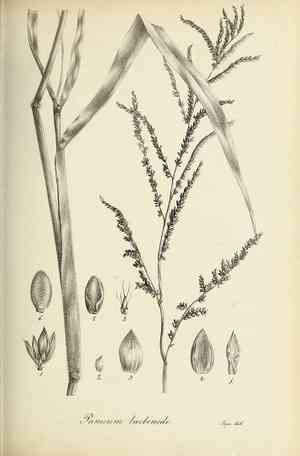
Para grass (Brachiaria mutica)
Also known as: Parana, Giant couch, Scotch grass, California grass
Para grass is a robust, semi-prostrate perennial featuring creeping stolons that can extend up to 5 meters. Its stems are characterized by hairy nodes and leaf sheaths, while the leaf blades can reach up to 30 cm in length and 2 cm in width. The flower-head is an open, loose panicle that can grow up to 30 cm long, with branches that spread outwards. The spikelets, arranged in uneven pairs, are elliptical and measure between 2.5 to 5 mm in length. The rachis often has a purplish hue.
In This Article
Attributes of Para grass
Lifespan
Perennial
Plant Type
Grass
Plant Height
5 m
Spread
Up to 2 meters
Leaf Color
Light green
Flower Size
30 cm
Flower Color
Green
Images of Para grass
Quickly Identify Para grass
1
The key features for identifying Brachiaria mutica include its stoloniferous growth habit, light green leaves that are hairy on the lower surface, and its dense mat-forming capability.
Scientific Classification of Para grass
Phylum
Vascular plants
Class
Monocotyledons
Order
Poales
Family
Grass
Genus
Signalgrasses
Species
Para grass
Planting and Growing of Para grass
Care Difficulty
Easy
Watering Schedule
Every 8 days
Sunlight Requirements
Partial sun
Sunshine Duration
6-12 hours
Ideal Temperature
75-85℉
Soil Type
Potting Mix, Peat Mix
Soil pH
5.5-8
Fertilizer Type
Balanced
Pruning Season
Spring, Summer
Pruning Area
Branches, Leaves
Pruning Frequency
2 times a year
Repotting Season
Spring
Pot Type
Plastic, Ceramic
 How to Water Para grass?
Brachiaria mutica requires a consistent watering schedule with about 1500 milliliters per session. The goal is to keep the soil moist but not waterlogged. It should be damp to a 5-10 cm depth, emulating its natural marshy environment.
What are the symptoms of an underwatered Para grass?
›
What should I do if my Para grass is not getting enough water?
›
What are the symptoms of an overwatered Para grass?
›
How to save an overwatered Para grass?
›
 What Are the Sunlight Requirements for Para grass?
Brachiaria mutica thrives in partial to full sun conditions. Ideal lighting fosters strong growth, vibrant health, and enhances its forage and ornamental benefits.
More About Sunlight Requirements Techniques→
Question: What is the best light condition for Brachiaria mutica?
›
Question: How can I achieve ideal lighting for Brachiaria mutica?
›
Question: What are the benefits of ideal lighting for this plant?
›
 What Is the Ideal Temperature Range for Para grass?
Brachiaria mutica thrives best in temperatures ranging from 75°F to 85°F. This range provides optimal conditions for photosynthesis and growth, ensuring the plant remains healthy and productive. Any deviation from this range might lead to stress and affect overall plant health.
 What Soil is Best for Para grass?
Brachiaria mutica thrives in soils with good drainage. Proper drainage prevents waterlogging, which can cause root rot. A well-drained soil allows roots to access oxygen, leading to healthier plant growth. This grass species benefits from nutrient-rich soils. Regular addition of organic matter can improve nutrient levels, supporting robust growth and enhancing resistance to pests and diseases. While Brachiaria mutica requires well-drained soil, it also benefits from moderate moisture retention. This balance ensures the plant gets enough water, especially in dry periods, without staying waterlogged.
 How to Fertilize Para grass?
Brachiaria mutica, commonly known as Para grass, requires a balanced approach to fertilization. Typically, apply a liquid fertilizer diluted to half strength every two weeks during the growing season. For solid fertilizers, consider spreading a slow-release granular fertilizer three times a year with a tablespoon per square meter, ensuring it's well distributed to avoid nutrient hotspots.
 How to Prune Para grass?
Before pruning, examine the grass for diseases or pests. Remove any damaged or infested parts promptly to prevent spread, ensuring the remaining grass stays healthy and robust. Trim Brachiaria mutica to a height of about 2-4 inches, ensuring optimal growth and health. Cutting too short can stress the grass, while insufficient cutting may lead to overgrowth and invasion by unwanted species. After pruning, collect and properly dispose of clippings. Leaving them can lead to thatch build-up, which can suffocate the grass and hinder light and nutrient penetration.
More About Pruning Techniques→
 How to Propagate Para grass plant?
1
Before propagation, choose healthy, disease-free plants. Check for adequate maturity and robustness to ensure successful root or stem development. Remove any damaged or unhealthy parts.
2
For seeds, gather mature seeds from existing plants. For cuttings, use young shoots and cut them at a 45-degree angle to increase the surface area for rooting.
3
Sow seeds in seed trays and cover with a thin layer of soil. For cuttings, insert them into pre-watered soil. Maintain consistent moisture and provide indirect sunlight to encourage growth.
 How to Repot Para grass plant?
1
Brachiaria mutica should be repotted when it shows signs of root-bound growth, such as roots emerging from the drainage holes. Spring is ideal as the plant enters its active growth phase, allowing it to recover quickly from the transplant shock and to establish in the new potting medium.
2
Select a pot that is just one size larger than the current one. This restricts excessive root growth and focuses energy on foliage development, ensuring a balanced plant size. A pot with adequate drainage holes is vital to prevent waterlogging, which could harm the root system.
3
A well-draining potting mix with organic matter is essential. This soil type provides the right balance of moisture retention and drainage, offering the plant's roots a healthy environment to spread and absorb nutrients, thus promoting vigorous growth.
Toxicity
Ingestion
WARNING
The judgment on toxicity and danger is for reference only. We DO NOT GUARANTEE any accuracy of such judgment. Therefore, you SHALL NOT rely on such judgment. It is IMPORTANT TO SEEK PROFESSIONAL ADVICE in advance when necessary.



