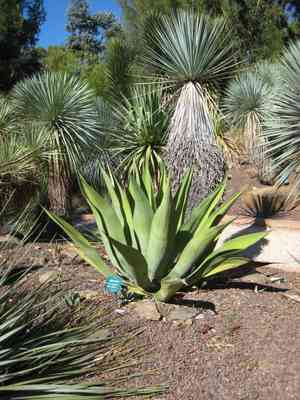
Weber's century plant (Agave weberi)
Also known as: Webber's Agave, Maguey Liso
The plant in question is likely the agave, specifically Weber's century plant. This succulent features broad, fleshy leaves arranged in a central rosette, with gray-green hues and finely toothed edges that taper to pointed tips. Adapted to arid environments, it stores water in its leaves to survive extended dry periods. Its most dramatic feature is the towering flower spike it produces, which can grow to impressive heights and attract pollinators, making a striking statement in its native landscape.
In This Article
Attributes of Weber's century plant
Lifespan
Perennial
Plant Type
Succulent
Plant Height
91 cm to 22 m
Spread
300-400 cm
Leaf Color
Blue-green
Flower Size
Up to 5 cm
Flower Color
Yellow
Images of Weber's century plant
Quickly Identify Weber's century plant
1
Fleshy, gray-green rosette leaves with fine marginal spines.
2
Tall 20-foot (6-meter) branched stalk with bright yellow flowers.
3
Spread of 6-10 feet wide (1.8 to 3 meters) at maturity.
4
Elegant tapered silhouette despite robust dimensions.
5
Subdued gray hue and minute marginal spines on leaves.
Scientific Classification of Weber's century plant
Phylum
Vascular plants
Class
Monocotyledons
Order
Asparagales
Family
Asparagus
Genus
Agaves
Species
Weber's century plant
Planting and Growing of Weber's century plant
Care Difficulty
Easy
Watering Schedule
Every day
Sunlight Requirements
Full sun
Sunshine Duration
4-8 hours
Ideal Temperature
65-85℉
Soil Type
Potting Mix, Peat Mix
Soil pH
6.5-7.5
Fertilizer Type
Balanced
Pruning Season
Spring, Summer
Pruning Area
Branches, Leaves
Pruning Frequency
2 times a year
Repotting Season
Spring
Pot Type
Plastic, Ceramic
 How to Water Weber's century plant?
For Agave weberi, aim to water approximately 250 milliliters each time. Ensure the soil is thoroughly soaked, allowing excess water to drain. Then, let the soil dry out completely before the next watering to prevent root rot.
What are the symptoms of an underwatered Weber's century plant?
›
What should I do if my Weber's century plant is not getting enough water?
›
What are the symptoms of an overwatered Weber's century plant?
›
How to save an overwatered Weber's century plant?
›
 What Are the Sunlight Requirements for Weber's century plant?
Agave weberi flourishes in full to partial sun, benefiting from 6-8 hours of sunlight daily, promoting photosynthesis and supporting a strong, healthy structure.
What is the best location for Agave weberi?
›
What time of day is best for sunlight?
›
How can I ensure Agave weberi gets enough light indoors?
›
 What Is the Ideal Temperature Range for Weber's century plant?
For Agave weberi, the ideal temperature range is between 65°F and 85°F. This range provides optimal growing conditions by ensuring the plant has enough warmth to facilitate metabolic processes without causing heat stress. Ensuring that the plant remains within this range promotes healthy growth and prevents stress-related issues.
 What Soil is Best for Weber's century plant?
Agave weberi thrives best in well-draining soil that prevents waterlogging, which can be detrimental to its roots. Well-draining soil ensures excess water flows away, mimicking the plant's natural desert habitat and reducing the risk of root rot. This agave species can excel in nutrient-poor soils, requiring minimal soil fertility to grow. This allows it to adapt to harsh, arid environments efficiently, promoting slow and healthy growth without over-fertilizing. Soils with a gravelly or sandy texture provide the perfect balance of structure and drainage for Agave weberi. These textures mimic its native conditions and support its agave-like tolerance to drought.
 How to Fertilize Weber's century plant?
Agave weberi does not demand heavy fertilization, owing to its adaptation to arid conditions. Use a balanced, water-soluble fertilizer diluted to half-strength. Apply approximately 1/4 cup per plant of granulated fertilizer or follow the package instructions for liquid fertilizer to avoid nutrient burn.
 How to Prune Weber's century plant?
Examine the plant for any dead, damaged, or diseased leaves, focusing on those that are brown or wilting. These leaves should be the primary targets for removal during the pruning process. For best results and the least stress to the plant, prune leaves as close to the base as possible where they emerge from the main stalk. This technique helps in maintaining the plant's natural aesthetic and encourages robust growth. After completing the pruning process, it's crucial to disinfect your tools to prevent any potential disease spread. This can be done by wiping the blades with rubbing alcohol or a similar disinfectant.
More About Pruning Techniques→
 How to Propagate Weber's century plant plant?
1
To propagate Agave weberi from seeds, start with healthy seeds, ensuring they are fresh and viable. Soak the seeds in lukewarm water for 24 hours to facilitate germination. This process helps to soften the seed coat, allowing moisture to penetrate more easily.
2
For cutting propagation, choose a healthy leaf or offset from the base of the agave plant. Ensure the chosen cutting is disease-free and preferably several inches long. Allow the cut end to dry and callous over for a few days before planting it to reduce rot risk.
3
During division propagation, carefully select offsets that are well-developed and separate them from the parent plant using a sterile knife. Ensure each offset has a portion of the rhizome to encourage successful root growth. Plant them in a suitable potting mix and water lightly.
 How to Repot Weber's century plant plant?
1
Repot your Agave weberi when its roots start to outgrow the current pot or when it becomes top-heavy, usually indicated by stunted growth or yellowing leaves. Spring or autumn is ideal as the plant is most resilient during these periods, allowing for quicker recovery.
2
Select a pot that is slightly larger than the current one, with ample drainage holes. A pot made of terracotta is ideal as it allows the soil to dry more efficiently, mimicking the natural arid habitat of Agave weberi, which helps prevent root rot and over-watering issues.
3
Use a well-draining soil mix, like a cactus mix, to replicate the natural environment of Agave weberi. This prevents waterlogging and provides good aeration and nutrient availability, ensuring the plant's roots remain healthy and avoid fungal infections.
Toxicity
Ingestion, skin contact
WARNING
The judgment on toxicity and danger is for reference only. We DO NOT GUARANTEE any accuracy of such judgment. Therefore, you SHALL NOT rely on such judgment. It is IMPORTANT TO SEEK PROFESSIONAL ADVICE in advance when necessary.



