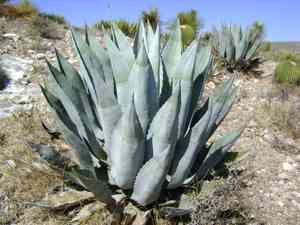
Rough agave(Agave scabra)

Rough agave (Agave scabra)

Also known as: Rough Leaved Agave, Century Plant

The rough agave (Agave scabra) has several notable adaptations for surviving in its native arid environments:

1. **Thick, Rough-Textured Leaves**: These grayish-green leaves store water and end in sharp tips, deterring herbivores.
2. **Waxy Coating**: This white, waxy layer helps reflect sunlight and significantly reduces water loss.
3. **Dense Rosette Formation**: The plant’s rosette shape channels water to its base and protects its core from extreme conditions.
4. **Tall Flower Spike**: This periodic growth indicates the plant's maturity and is a key part of its reproductive strategy.

These features collectively enable the rough agave to thrive in hot, dry regions.

Attributes of Rough agave

Lifespan
Perennial
Plant Type
Succulent
Plant Height
1 m
Spread
1.5 m
Leaf Color
Grey-green
Flower Size
Small (individual flowers), part of a large inflorescence
Flower Color
Yellow

ForwardPlant - Identify plants with a snap

Identify and diagnose plants, get toxicity alerts, and explore safety guides for all types of fungi.

Try for Free

Images of Rough agave

Rough agave(Agave scabra)

Quickly Identify Rough agave

1
Look for large rosettes of rough, thick, and pointed leaves. The leaves are grey-green and may have marginal teeth. The plant produces a tall flower stalk with branching clusters of yellow flowers.

Scientific Classification of Rough agave

Phylum
Vascular plants
Class
Monocotyledons
Order
Asparagales
Family
Asparagus
Genus
Agaves
Species
Rough agave

Planting and Growing of Rough agave

Care Difficulty
Moderate
Watering Schedule
Every 2 days
Sunlight Requirements
Full sun
Sunshine Duration
4-8 hours
Ideal Temperature
68-77℉
Soil Type
Potting Mix, Peat Mix
Soil pH
6.5-7.5
Fertilizer Type
Balanced
Pruning Season
Spring, Summer
Pruning Area
Branches, Leaves
Pruning Frequency
2 times a year
Repotting Season
Spring
Pot Type
Plastic, Ceramic

water icon How to Water Rough agave?

The Agave scabra thrives on the principles of caution when it comes to watering. This means ensuring the soil is completely dry before adding any water, which usually translates to about 250 milliliters. Watering should be just enough for the water to slightly seep out from the bottom of the container, ensuring root moisture without causing root rot.
What are the symptoms of an underwatered Rough agave?
What should I do if my Rough agave is not getting enough water?
What are the symptoms of an overwatered Rough agave?
How to save an overwatered Rough agave?

sunlight icon What Are the Sunlight Requirements for Rough agave?

Sunlight Requirements: Full sun
Duration of light: 6 to 8 hours
Agave scabra thrives in full sunlight environments, where it receives 6 to 8 hours of sunlight daily. This exposure contributes to vigorous growth and improves the plant's ability to store water, crucial for its resilience.
How much light is optimal?
What if I live in a shaded area?
Why is full sun important?

temperature icon What Is the Ideal Temperature Range for Rough agave?

Ideal Temperature: 68 ~ 77℉
Agave scabra flourishes in an ideal temperature range of 68°F to 77°F. These temperatures provide an optimal environment for this plant to photosynthesize efficiently and maintain healthy growth. This range closely mimics their natural habitat’s climate, where they are accustomed to warm, sunny days.

soil icon What Soil is Best for Rough agave?

Soil type: Sandy soil, Sandy loam
Soil PH: 6.5 ~ 7.5
Agave scabra thrives best in well-drained soils. This prevents waterlogging, which can lead to root rot, thus ensuring the plant's longevity and health. Agave scabra is adapted to nutrient-poor soils. Over-fertilizing can harm these plants, so lean soil supports healthy growth without promoting unwanted rapid expansion. This species prefers soils with lower organic content, replicating its native desert conditions, which diminish the risk of diseases and pests attracted by rich organic matter.

fertilize icon How to Fertilize Rough agave?

Fertilizer type: Balanced
For Agave scabra, the amount of fertilizer should be minimal to moderate. When using a liquid fertilizer, a half-strength solution applied every two weeks is generally sufficient. Over-fertilizing can lead to excessive growth and damage the plant's structural integrity.

prune icon How to Prune Rough agave?

Pruning Time: Spring, Summer
Begin by thoroughly examining your Agave scabra for any signs of yellowing, damaged, or diseased leaves. Remove these leaves carefully to improve the plant's health by cutting them as close to the base as possible. Once damaged leaves are removed, you can shape the plant by trimming any overgrown areas to maintain its symmetry. Cut leaves back to a natural point, taking care not to damage the core of the plant. Agave scabra often produces offshoots or ‘pups’ at the base. If desired, these can be removed with a sharp tool to control the plant's spread. These pups can also be replanted to propagate new plants. More About Pruning Techniques

propagate icon How to Propagate Rough agave plant?

Propagate Time: Spring, Early summer
1
Choose a bright, well-ventilated area for propagation, ideally with indirect sunlight. Prepare the soil mix by combining well-draining sand with cactus soil to mimic the natural habitat, ensuring ample drainage and root aeration.
2
Sow seeds shallowly in firm seed trays, covering them lightly with soil mix. Lightly mist the surface with water to provide moisture without waterlogging. This method encourages robust root development and optimal germination conditions.
3
For division, carefully extract the agave plant ensuring minimal root disturbance. Use a sterilized knife to separate offsets from the parent plant. Replant the divisions promptly into prepared soil to minimize shock and encourage quick establishment.
More About Propagating Techniques

repot icon How to Repot Rough agave plant?

Repotting frequency: Every 2-3 years
1
Repot Agave scabra when you notice the roots filling the pot or protruding from the drainage holes. Another signal is slower growth or the plant becoming top-heavy, indicating it's time for a change. Spring and summer are ideal seasons for repotting, as the plant is in its active growth phase.
2
Select a pot that is slightly larger than the current one, with ample drainage holes to prevent waterlogging. A terracotta pot is a great option as it allows better air circulation and evaporation, reducing the risk of root rot. The new pot should provide some space for the roots to grow without being excessively large.
3
Opt for a well-draining cactus mix when repotting Agave scabra. This type of soil mimics the plant's natural desert habitat, providing excellent drainage and preventing water retention. Proper soil composition promotes healthy root development and prevents diseases associated with excess moisture.

ForwardPlant - Identify plants with a snap

Find the best spots for them to optimize their health, simply using your phone.

Try for Free

Toxicity

Ingestion, Contact with sap

Identify toxic plants for your safety

Learn which plants are harmful to you and your pets, and make informed choices for a safer home!

Try for Free
WARNING
The judgment on toxicity and danger is for reference only. We DO NOT GUARANTEE any accuracy of such judgment. Therefore, you SHALL NOT rely on such judgment. It is IMPORTANT TO SEEK PROFESSIONAL ADVICE in advance when necessary.

