How to Propagate Fairy bentspur orchid?
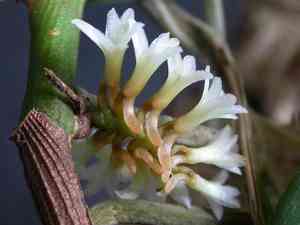
The captivating epiphytic orchid, Fairy bentspur orchid, a member of the Orchidaceae family, is best propagated through division. Gently detach the offsets from the main plant, taking care to minimize disruption to the root system. Plant them in a damp, free-draining substrate and maintain steady humidity levels. Regularly inspect for typical pests and guarantee sufficient air movement to avert decay. Given appropriate attention, these divisions will take root and flourish, enhancing any orchid assortment.
Optimal Time for Propagating Fairy Bentspur Orchid
Propagation Method
Separation
Propagation Period
Spring,Autumn
Tools Required for Fairy Bentspur Orchid Propagation
Sterile Pruning Shears
These are crucial for making clean, precise cuts when dividing fairy bentspur orchid. Sterilization helps prevent disease transmission, ensuring the plant's health during and after propagation.
Rooting Hormone
Applying rooting hormone to cut sections can boost root development in fairy bentspur orchid. This tool significantly increases successful propagation by stimulating faster, stronger root growth.
Clean Potting Medium
Using a well-draining, sterile potting mix specifically for orchid cultivation is vital. It provides the correct moisture and aeration balance, essential for newly divided fairy bentspur orchid sections to flourish.
Propagation Trays
Propagation trays allow for organizing and monitoring newly divided plants. These trays offer a controlled environment, simplifying the maintenance of optimal humidity and temperature levels needed for fairy bentspur orchid.
Humidity Domes
To maintain the high humidity fairy bentspur orchid prefers, use humidity domes over propagation trays. This creates a microenvironment that reduces stress and promotes healthy root and shoot development.
Labeling Tags
Accurately labeling each fairy bentspur orchid division with tags ensures proper identification and helps track growth progress. This is especially useful when propagating multiple plants and needing individual monitoring.
Sterile Gloves
Wearing sterile gloves can prevent the spread of pathogens that could harm fairy bentspur orchid. Maintaining hygiene throughout the propagation process is critical for the plant's overall health and viability.
How to Propagate Fairy Bentspur Orchid
Propagation Difficulty
Simple
Caring for Your Newly Propagated Fairy Bentspur Orchid
Caring for Your Newly Propagated Fairy Bentspur Orchid
Once established in new pots, maintain humidity by regular misting or using a humidity tray. Monitor for stress or disease, adjusting care as needed. Water consistently, but avoid waterlogging the medium to prevent root rot. Fertilize with a balanced orchid fertilizer every two to four weeks during the growing season to encourage robust growth and flowering.
Common Errors to Avoid When Propagating Fairy Bentspur Orchid
Over-watering
Since fairy bentspur orchid is epiphytic, excessive water can lead to root rot and other moisture-related ailments.
Improper mounting
Failure to properly secure fairy bentspur orchid to its growing surface can impede root attachment and stability, crucial for its development.
Low humidity
Insufficient humidity can cause dehydration, as fairy bentspur orchid relies more on ambient moisture than soil-bound plants.
Inadequate light
Providing too little light will hinder growth and affect blooming, as fairy bentspur orchid typically thrives in bright, indirect light.
Tips for Propagating Fairy Bentspur Orchid
Utilize mounting techniques
Attach fairy bentspur orchid to a tree branch, bark slab, or suitable mount to replicate its natural growing conditions.
Ensure optimal humidity
Maintain a high-humidity environment using misting systems or by placing fairy bentspur orchid in humid areas, ensuring moist air.
Provide sufficient air circulation
Good airflow helps prevent fungal infections and supports overall health, so ensure the environment is well-ventilated.
Monitor watering carefully
Water fairy bentspur orchid moderately, allowing roots to dry slightly between waterings, to prevent rot and encourage healthy growth.



