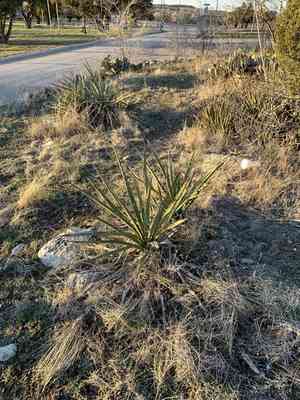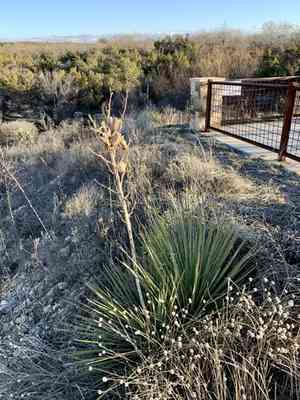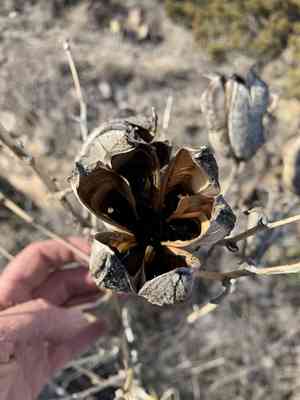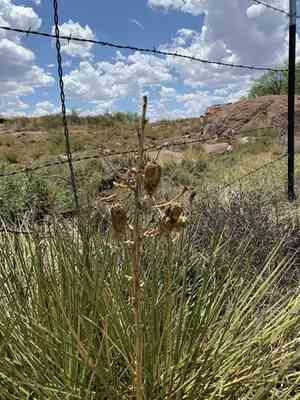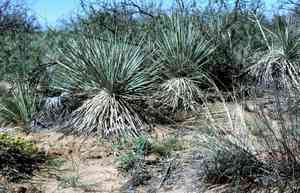
Plains yucca(Yucca campestris)

Plains yucca (Yucca campestris)

Also known as: Soapweed, Texas Yucca

Plains yucca (Yucca glauca) is a resilient perennial characterized by its stiff, sword-shaped leaves that grow in a rosette formation. The leaves are typically edged with white fibers and exhibit a blue-green hue. In the blooming season, it sends up tall flower stalks adorned with clusters of creamy white or greenish flowers, creating a striking visual against its native backdrop.

This plant is indigenous to the Great Plains, stretching from southern Canada through the central United States and into northern Mexico. It thrives in dry, well-drained soils and is commonly found in prairies, open woodlands, and rocky terrains. Plains yucca is exceptionally drought-tolerant, making it well-suited to survive in harsh, arid environments.

Attributes of Plains yucca

Lifespan
Perennial
Plant Type
Shrub, Succulent
Plant Height
30 cm to 91 cm
Spread
1 to 1.5 meters
Leaf Color
Blue-green
Flower Size
5 to 7.5 centimeters
Flower Color
Yellowish-white

ForwardPlant - Identify plants with a snap

Identify and diagnose plants, get toxicity alerts, and explore safety guides for all types of fungi.

Try for Free

Images of Plains yucca

Plains yucca(Yucca campestris)

Quickly Identify Plains yucca

1
Identify Yucca campestris by its dense rosettes of narrow, blue-green leaves, yellowish-white flowers borne on tall spikes, and its adaptation to arid environments.

Scientific Classification of Plains yucca

Phylum
Vascular plants
Class
Monocotyledons
Order
Asparagales
Family
Asparagus
Genus
Yuccas
Species
Plains yucca

Planting and Growing of Plains yucca

Care Difficulty
Easy
Watering Schedule
Every day
Sunlight Requirements
Full sun
Sunshine Duration
4-8 hours
Ideal Temperature
68-77℉
Soil Type
Potting Mix, Peat Mix
Soil pH
6.5-7.5
Fertilizer Type
Balanced
Pruning Season
Spring, Summer
Pruning Area
Branches, Leaves
Pruning Frequency
2 times a year
Repotting Season
Spring
Pot Type
Plastic, Ceramic

water icon How to Water Plains yucca?

For Yucca campestris, the principle is to water deeply but infrequently. When watering, make sure the soil is moistened evenly throughout the pot, ideally achieving a 500 ml distribution to reach the root zone.
What are the symptoms of an underwatered Plains yucca? ›
What should I do if my Plains yucca is not getting enough water? ›
What are the symptoms of an overwatered Plains yucca? ›
How to save an overwatered Plains yucca? ›

sunlight icon What Are the Sunlight Requirements for Plains yucca?

Sunlight Requirements: Full sun
Duration of light: 6 to 8 hours
Yucca campestris does best in full sun conditions. Adequate sunlight exposure is key to maintaining its vibrant foliage and strong growth, making it a resilient and appealing addition to any bright, sunny area.
What is the ideal lighting condition for Yucca campestris? ›
How can I achieve ideal lighting conditions for my Yucca campestris? ›
What benefits does Yucca campestris gain from ideal lighting conditions? ›

temperature icon What Is the Ideal Temperature Range for Plains yucca?

Ideal Temperature: 68 ~ 77℉
The ideal temperature range for Yucca campestris is between 68°F and 77°F. This range supports optimal growth by providing a warm environment that mimics its natural habitat. Cultivating the plant within this temperature range ensures healthy foliage development and overall plant vigor.

soil icon What Soil is Best for Plains yucca?

Soil type: Sandy soil, Loam, Sandy loam
Soil PH: 6.5 ~ 7.5
Yucca campestris thrives in well-draining soils that prevent waterlogging which can lead to root rot. Ensuring the soil has good drainage helps in maintaining root health and fostering a robust plant growth. While Yucca campestris is not overly demanding, a soil rich in organic matter can promote better growth by providing necessary nutrients. Amending the soil with compost can help maintain fertile conditions. A soil pH between 6.5 and 7.5 is ideal, as it allows for optimal nutrient uptake. This pH range supports the overall health and vigor of Yucca campestris.

fertilize icon How to Fertilize Plains yucca?

Fertilizer type: Balanced
Yucca campestris generally requires a light approach to fertilization due to its ability to thrive in low-nutrient environments. Use a low-nitrogen general-purpose fertilizer diluted to half-strength. For liquid fertilizers, a small dose of approximately 1/4 cup per plant is usually sufficient.

prune icon How to Prune Plains yucca?

Pruning Time: Spring, Summer
Begin by identifying and removing any yellowing or brown leaves. Gently pull them off if they come away easily, or use shears to cut them close to the trunk. If your yucca plant looks overly dense, thin out overcrowded areas to improve light penetration. This also allows more air to circulate, aiding in disease prevention. To retain the yucca's natural shape, trim selectively rather than excessively. Focus on removing stray growths that deviate from the plant's desired outline. Avoid over-pruning, as removing too much at once can stress the plant and hinder growth. Aim to remove no more than 20% of the plant's foliage at any given time. More About Pruning Techniques→

propagate icon How to Propagate Plains yucca plant?

Propagate Time: Spring, Early Spring
1
Choose a robust and disease-free Yucca campestris for propagation. Ensure it has multiple healthy stems and leaves as this plant will be the source of your cuttings or seeds, impacting the success of the new plants.
2
Use a sterilized knife or shears to take cuttings of about 10 to 15 cm in length from the plant's stem. Make sure each cutting includes at least one node, as this is essential for rooting.
3
Prepare a well-draining soil mix, ideally with a combination of sand and perlite. Yucca campestris requires soil that does not retain too much moisture to prevent root rot, which is a common issue with this type of plant.
More About Propagating Techniques→

repot icon How to Repot Plains yucca plant?

Repotting frequency: Every 2-3 years
1
Observe the roots: If they are protruding from the drainage holes, it's time to repot. Also, consider repotting if the plant's growth has significantly slowed despite optimal conditions, indicating it's become root-bound. Choose early spring for best results.
2
Select a pot that’s one size larger than the current one, with drainage holes. A slightly larger pot allows ample space for root expansion without water retention, which prevents root rot and promotes healthier growth.
3
Opt for cactus mix or sandy soil to ensure excellent drainage. These substrates prevent waterlogging, providing the perfect environment for Yucca campestris' roots to thrive by mimicking its natural habitat's soil conditions.

ForwardPlant - Identify plants with a snap

Find the best spots for them to optimize their health, simply using your phone.

Try for Free