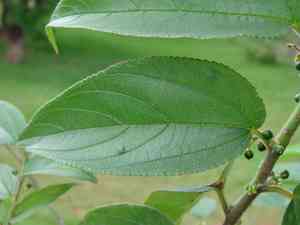
Florida trema(Trema micrantha)

Florida trema (Trema micrantha)

Also known as: Capulin, Nettletree

The Florida trema (Trema micrantha) is a rapidly growing pioneer species that commonly inhabits disturbed sites and forest openings. It plays a crucial role in reforestation by swiftly colonizing barren areas, thereby improving the conditions for other plants to establish and thrive.

To identify the Florida trema, note its key physical features:
- **Leaves**: Simple, alternate, and elliptic with serrated margins, measuring 5-15 cm in length and having a rough upper surface.
- **Flowers**: Small, greenish, and grouped in clusters, though not particularly noticeable.
- **Fruit**: Small, spherical, and dark purple or black when mature, about 3-5 mm in diameter.
- **Bark**: Light gray to brown with a smooth texture that may develop small fissures over time.

These characteristics make the Florida trema identifiable and underscore its importance in creating a conducive environment for forest regeneration.

Attributes of Florida trema

Lifespan
Perennial
Plant Type
Tree, Shrub
Plant Height
10 m
Spread
3-10 meters (10-33 feet)
Leaf Color
Green
Flower Size
Less than 1 cm (0.39 inches)
Flower Color
Green

ForwardPlant - Identify plants with a snap

Identify and diagnose plants, get toxicity alerts, and explore safety guides for all types of fungi.

Try for Free

Images of Florida trema

Florida trema(Trema micrantha)

Quickly Identify Florida trema

1
Trema micrantha can be identified by its small, ovate to lanceolate leaves with toothed margins, and its clusters of small greenish-yellow flowers. The bark is smooth and pale gray when young, becoming rough and fissured with age. The tree produces small, berry-like fruits that are initially green and turn black when ripe.

Scientific Classification of Florida trema

Phylum
Vascular plants
Class
Dicotyledons
Order
Rosales
Family
Hemp
Genus
Trema
Species
Florida trema

Planting and Growing of Florida trema

Care Difficulty
Easy
Watering Schedule
Every 3 days
Sunlight Requirements
Full sun
Sunshine Duration
6-10 hours
Ideal Temperature
68-77℉
Soil Type
Potting Mix, Peat Mix
Soil pH
6.5-7.5
Fertilizer Type
Balanced
Pruning Season
Spring, Summer
Pruning Area
Branches, Leaves
Pruning Frequency
2 times a year
Repotting Season
Spring
Pot Type
Plastic, Ceramic

water icon How to Water Florida trema?

Trema micrantha thrives best when kept moderately moist. Watering should be thorough, ensuring the soil is evenly moist but not waterlogged. It's essential to allow the top layer of soil to dry out slightly between waterings. Each session should involve approximately 250 ml of water to achieve this balance.
What are the symptoms of an underwatered Florida trema? ›
What should I do if my Florida trema is not getting enough water? ›
What are the symptoms of an overwatered Florida trema? ›
How to save an overwatered Florida trema? ›

sunlight icon What Are the Sunlight Requirements for Florida trema?

Sunlight Requirements: Full sun, Partial sun
Duration of light: 6 to 8 hours
Trema micrantha flourishes in full to partial sun exposure. This ideal lighting promotes vigorous growth, vibrant foliage, and successful flowering.
What is the best lighting condition for Trema micrantha? ›
How can we achieve ideal lighting for Trema micrantha? ›
What benefits does optimal light provide this plant? ›
More About Sunlight Requirements Techniques→

temperature icon What Is the Ideal Temperature Range for Florida trema?

Ideal Temperature: 68 ~ 77℉
Trema micrantha thrives best in a stable temperature range from 68°F to 77°F. This range facilitates optimal photosynthesis and metabolic processes, ensuring healthy growth and vibrant foliage. Maintaining these conditions helps the plant utilize nutrients effectively.

soil icon What Soil is Best for Florida trema?

Soil type: Loam, Clay soil, Sandy loam
Soil PH: 6.5 ~ 7.5
Trema micrantha thrives in nutrient-rich soil that supports its vigorous growth. Such soils provide the essential macro and micronutrients the plant requires for robust health, ensuring lush foliage and rapid development. This plant demands well-drained soil to prevent root rot. Ensuring good drainage means roots can access oxygen more effectively, promoting healthy root development and therefore strong overall plant structure. While the plant requires proper drainage, retaining some moisture is crucial. This balance helps sustain the plant during dry spells, providing a more consistent supply of water to the roots.

fertilize icon How to Fertilize Florida trema?

Fertilizer type: Balanced
Trema micrantha, commonly known as Jamaican nettletree, has a moderate nutrient requirement. It's advisable to use a balanced fertilizer with equal parts nitrogen (N), phosphorus (P), and potassium (K). For a liquid fertilizer, use a concentration of half a teaspoon per gallon of water. When applying solid fertilizer, about 1/4 pound per plant annually is a good start, and it can be adjusted based on the soil fertility and plant response.

prune icon How to Prune Florida trema?

Pruning Time: Spring, Summer
Identify any damaged, dead, or crossing branches initially, removing them to promote air circulation. Cutting just above a node or lateral branch encourages healthy growth and structural integrity. As a fast-growing species, prune lightly to maintain its natural shape. Over-pruning can cause stress to Trema micrantha, so selective trimming is key to healthy growth. More About Pruning Techniques→

propagate icon How to Propagate Florida trema plant?

Propagate Time: Spring,Early summer
1
Start by soaking the seeds in water for 24 hours to soften the seed coat, which enhances germination. Then, place them on a moist seed tray with a well-draining potting mix.
2
Cut a healthy, non-flowering branch about 10-15 cm in length using pruning shears. Ensure the cutting has at least two leaves and cut just below a node to encourage rooting.
3
Insert the cutting into a pot with a mixture of peat and perlite. Moisten the medium and cover with a plastic bag to retain humidity. Place the pot in indirect sunlight.
More About Propagating Techniques→

repot icon How to Repot Florida trema plant?

Repotting frequency: Every 2-3 years
1
Inspect Trema micrantha for root-bound conditions, yellowing leaves, or soil that dries out quickly. These are clear indicators that it's time for a new pot. Optimal repotting happens in the growing seasons of spring or early summer when the plant is most robust.
2
Select a pot that is one size larger and has adequate drainage holes. A slightly larger pot promotes healthy growth by giving roots more space to extend and helps prevent waterlogging, which can lead to root rot.
3
Use a well-draining potting mix rich in organic matter. This type of soil supports healthy root development and ensures that the plant remains adequately hydrated without becoming waterlogged.

ForwardPlant - Identify plants with a snap

Find the best spots for them to optimize their health, simply using your phone.

Try for Free

