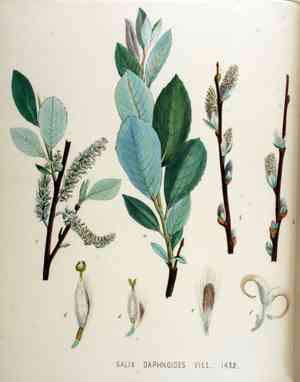
European violet-willow (Salix daphnoides)
Also known as: Daphne willow
The tree features a rounded crown with widely spreading branches and smooth, gray bark. Twigs are dark reddish-brown, hairless, and somewhat glossy. The tree has sizeable buds, which can be either smooth or adorned with stiff, upright hairs. Leaves are oblong to narrow and obovate, typically measuring 7 to 12 cm in length and 2 to 3 cm in width.
In This Article
Attributes of European violet-willow
Lifespan
Perennial
Plant Type
Tree, Shrub
Plant Height
2 m to 6 m
Spread
2 to 6 meters
Leaf Color
Yellow Green
Flower Size
Small (approximately 1-2 cm, in catkins)
Flower Color
Yellow Green Gray Silver
Images of European violet-willow


Quickly Identify European violet-willow
1
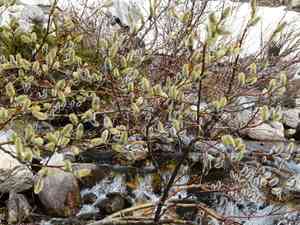
Salix daphnoides can be identified by its smooth, violet-colored young shoots, and slender, lanceolate leaves. The catkins appear in early spring before the leaves. Male and female catkins are borne on separate plants.
Scientific Classification of European violet-willow
Phylum
Vascular plants
Class
Dicotyledons
Order
Malpighiales
Family
Willow
Genus
Willows
Species
European violet-willow
Planting and Growing of European violet-willow
Care Difficulty
Easy
Watering Schedule
Every 3 days
Sunlight Requirements
Full sun
Sunshine Duration
6-10 hours
Ideal Temperature
50-77℉
Soil Type
Potting Mix, Peat Mix
Soil pH
6.5-7.5
Fertilizer Type
Balanced
Pruning Season
Spring, Summer
Pruning Area
Branches, Leaves
Pruning Frequency
2 times a year
Repotting Season
Spring
Pot Type
Plastic, Ceramic
 How to Water European violet-willow?
Salix daphnoides, commonly known as the violet willow, requires a balance of moisture in the soil. Water it generously, ensuring about 800 ml of water per session. The soil should be moist but not waterlogged, allowing water to seep to the roots without causing root rot.
What are the symptoms of an underwatered European violet-willow?
›
What should I do if my European violet-willow is not getting enough water?
›
What are the symptoms of an overwatered European violet-willow?
›
How to save an overwatered European violet-willow?
›
 What Are the Sunlight Requirements for European violet-willow?
Salix daphnoides thrives best in conditions ranging from full sun to partial sun. Ideal light ensures efficient photosynthesis, promoting lush growth, strong stems, and an impressive canopy. This exposure also boosts flowering and overall vigor.
What is the ideal lighting solution for Salix daphnoides?
›
How can I ensure Salix daphnoides gets ideal lighting?
›
What are the benefits if Salix daphnoides receives ideal lighting?
›
 What Is the Ideal Temperature Range for European violet-willow?
The ideal temperature range for Salix daphnoides is between 50°F and 77°F. This range provides optimal conditions for growth and photosynthesis. It ensures that the plant's metabolic processes are functioning efficiently, which supports vigorous growth and a healthy appearance.
 What Soil is Best for European violet-willow?
Salix daphnoides thrives in well-drained soils that allow excess moisture to escape. This prevents root rot and promotes healthy root development, supporting the plant's overall growth and resilience. Rich in organic matter, the soil needs to provide essential nutrients. This fosters vigorous growth and enhances the willow's ability to withstand environmental stressors, ensuring a lush and vibrant appearance. While drainage is crucial, the soil should also retain enough moisture to support the willow's high water requirements. This balance aids in preventing drought stress and promoting sustained growth.
 How to Fertilize European violet-willow?
For Salix daphnoides, a moderately hungry plant, use 1/2 cup of balanced liquid fertilizer per application during its growing season. This ensures that it gets the necessary nutrients without the risk of over-fertilizing. Ensure even distribution around the plant's base, avoiding concentrated doses that might burn the roots.
 How to Prune European violet-willow?
Begin by removing any dead or diseased branches, as these can spread infections to healthy parts of the plant. Use clean, sharp pruning shears to make clean cuts, which minimize stress and promote quicker healing. Once the unhealthy growth is removed, focus on trimming back any crossing or rubbing branches, as these can cause wounds or lead to structural weaknesses. Shape the plant by trimming excess growth to create an open, balanced structure that encourages uniform sunlight distribution. If the tree becomes too large for its space, carefully select and prune back the longest branches, cutting just above a healthy bud or lateral branch. This not only reduces size but also encourages bushier growth.
More About Pruning Techniques→
 How to Propagate European violet-willow plant?
1
Choose a healthy parent plant with vigorous growth. Look for branches that are free from disease and pests, as these will provide the strongest cuttings for propagation.
2
Use pruning shears to take 6-8 inch cuttings from the plant. Ensure each cutting has a few leaves and a node. It’s best to do this in early morning when plants are well-hydrated.
3
Dip the cut end of each cutting into rooting hormone powder. Plant the cuttings in a mix of potting soil and perlite for good drainage, ensuring that at least one node is buried below the soil.
 How to Repot European violet-willow plant?
1
Salix daphnoides should be repotted when you notice its roots circling the pot, emerging from drainage holes, or when water drainage becomes insufficient. These are indicators that the plant needs more space to grow and thrive.
2
Choose a pot that is 1-2 inches larger in diameter than the current one. A container with good drainage holes is essential to avoid waterlogging and root rot. The new pot should promote healthier root expansion and stabilization of the plant.
3
A high-quality soil mix that retains moisture yet drains well is ideal. A mix rich in organic matter supports healthy growth, allowing oxygen flow to roots while holding enough moisture to prevent drying out.



