
Barclay's willow (Salix barclayi)
Also known as: None
Barclay's willow is a hardy deciduous shrub with slender, lance-shaped leaves adorning its branches. It flourishes in cool climates, particularly in moist environments such as wetlands and along riverbanks. This shrub's deep roots help stabilize soil and efficiently absorb nutrients. In the spring, it produces small catkins, characteristic of the willow family.
In This Article
Attributes of Barclay's willow
Lifespan
Perennial
Plant Type
Tree
Plant Height
Typically 1 to 4 meters (3 to 13 feet) tall
Spread
Can spread up to 1 to 3 meters (3 to 10 feet)
Leaf Color
Green
Flower Size
Typically not measured; flowers are inconspicuous and form in catkins
Flower Color
Yellow to greenish
Images of Barclay's willow



Quickly Identify Barclay's willow
1
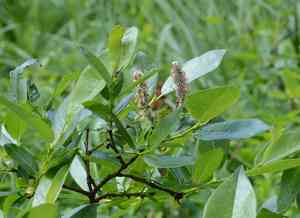
Identifying Salix barclayi can be done by looking for its characteristic leaves which are narrow, tapering to a point, and have finely serrated or smooth edges. The bark is typically smooth and grayish-brown.
Scientific Classification of Barclay's willow
Phylum
Vascular plants
Class
Dicotyledons
Order
Malpighiales
Family
Willow
Genus
Willows
Species
Barclay's willow
Planting and Growing of Barclay's willow
Care Difficulty
Moderate
Watering Schedule
Every 4 days
Sunlight Requirements
Full sun
Sunshine Duration
4-6 hours
Ideal Temperature
55-70℉
Soil Type
Potting Mix, Peat Mix
Soil pH
6.5-7.5
Fertilizer Type
Balanced
Pruning Season
Spring, Summer
Pruning Area
Branches, Leaves
Pruning Frequency
2 times a year
Repotting Season
Spring
Pot Type
Terracotta, Plastic
 How to Water Barclay's willow?
For Salix barclayi, ensure to water until the soil is well-moistened but not soggy, imitating the plant's natural environment. This equates to about 500 ml per watering session, ensuring that water reaches deep into the root zone.
What are the symptoms of an underwatered Barclay's willow?
›
What should I do if my Barclay's willow is not getting enough water?
›
What are the symptoms of an overwatered Barclay's willow?
›
How to save an overwatered Barclay's willow?
›
 What Are the Sunlight Requirements for Barclay's willow?
Partial sun with 4 to 8 hours of sunlight daily is optimal for Salix barclayi. This balance promotes robust growth and vibrant foliage without overwhelming the plant.
What is the best location for Salix barclayi?
›
How can I ensure consistent lighting for Salix barclayi?
›
What benefits come from ideal sunlight exposure?
›
 What Is the Ideal Temperature Range for Barclay's willow?
The ideal temperature range for Salix barclayi is between 55°F and 70°F. In this range, the plant can grow optimally, maximizing photosynthesis and nutrient absorption. Maintaining these temperatures helps ensure healthy leaves and branches.
 What Soil is Best for Barclay's willow?
Salix barclayi thrives in soil that retains moisture well, ensuring the roots have a consistent supply of water. This supports its lush growth and helps the plant resist drought stress. Nutrient-rich soil is essential for the optimal growth of Salix barclayi, providing it with essential minerals and nutrients for vigorous stem and leaf development. While this willow thrives in moist conditions, it also requires good drainage to prevent root rot and other waterlogged conditions that can hinder its health.
 How to Fertilize Barclay's willow?
For Salix barclayi, the amount of fertilizer should be moderate. Use approximately half the recommended dose of a balanced liquid fertilizer when fertilizing. Ensure the solution is diluted to prevent root burn.
 How to Prune Barclay's willow?
Start by removing any dead, dying, or diseased branches. These branches can harbor pests and diseases that might spread to healthy parts of the plant. Cut these branches back to healthy wood, making clean cuts to ensure quick healing. Trim the plant to maintain its desired shape and size. Focus on cutting back long shoots to encourage branching and a fuller appearance. Always cut just above a bud to direct the plant's growth in the desired direction. Remove any branches that cross or rub against each other, as this can cause wounds that invite disease. Opening up the structure allows for better airflow, which reduces the risk of fungal infections and encourages vigorous growth.
More About Pruning Techniques→
 How to Propagate Barclay's willow plant?
1
To propagate Salix barclayi by seeds, it’s important to collect seeds during the late summer or early autumn period when they are mature. This ensures higher germination rates as the seeds are fully developed.
2
When using cutting propagation, select healthy plant stems in late spring. Cut sections of about 6 inches and ensure each has at least two leaf nodes. Removing lower leaves prevents rot and focuses energy on root development.
3
For root cutting propagation, choose thick, healthy roots in early summer. Prepare a well-draining soil mix and plant the cut sections horizontally, ensuring good contact with the soil for effective rooting.
 How to Repot Barclay's willow plant?
1
Monitor your Salix barclayi. It’s time to repot when roots are visible through the drainage holes or the plant looks top-heavy, indicating it's outgrown its current pot. Other signals include reduced growth and the soil drying out too quickly after watering.
2
Select a pot that is one size larger than the current one. Ensure it has good drainage to prevent water accumulation, which can lead to root rot. A slightly larger pot allows your willow to grow healthier and maintain sufficient space for its roots.
3
Opt for a well-drained, loamy soil mix rich in organic matter. This type of soil retains necessary moisture yet prevents waterlogging. It also provides essential nutrients that promote healthy root development, benefiting the overall growth of the plant.



