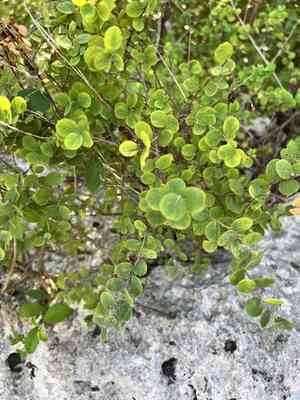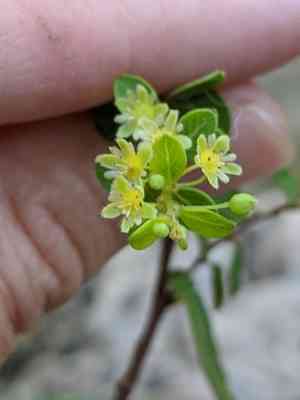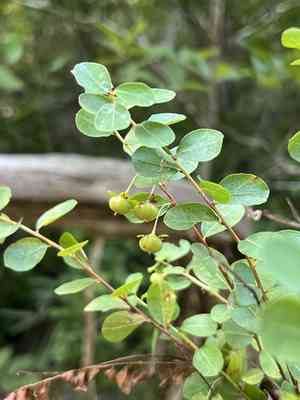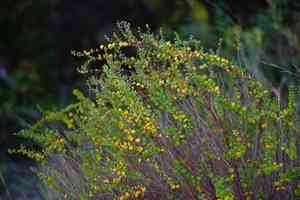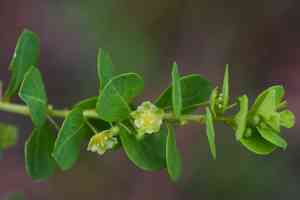
Missouri maidenbush(Phyllanthopsis phyllanthoides)

Missouri maidenbush (Phyllanthopsis phyllanthoides)

Also known as: None

Phyllanthopsis phyllanthoides, commonly known as buckbrush or maidenbush, is a shrub native to the south-central United States. It typically grows to a height of three to four feet.

**Key Characteristics:**
- **Leaves:** Small and simple, arranged alternately along the stems.
- **Flowers:** Tiny and greenish, with male and female flowers on the same plant.
- **Fruit:** Produces small red berries, about the size of a BB shot, which are mildly toxic.

**Habitat:**
- **Location:** Frequently found along old roadsides, fence rows, and in sandy soils.
- **Preferred Environment:** Thrives in sunny to partly shaded areas, often in pine or oak woodlands and scrublands.

This hardy shrub is well-adapted to well-drained soils and can often be seen in disturbed areas.

Attributes of Missouri maidenbush

Lifespan
Perennial
Plant Type
Shrub
Plant Height
Approximately 0.3 to 1 meter
Spread
Not applicable as the plant does not form a crown
Leaf Color
Green
Flower Size
Small, less than 1 cm
Flower Color
Greenish

ForwardPlant - Identify plants with a snap

Identify and diagnose plants, get toxicity alerts, and explore safety guides for all types of fungi.

Try for Free

Images of Missouri maidenbush

Missouri maidenbush(Phyllanthopsis phyllanthoides)

Quickly Identify Missouri maidenbush

1
This plant can be identified by its jointed stems, small greenish flowers, and alternately placed leaves. The leaves are lanceolate to ovate in shape.

Scientific Classification of Missouri maidenbush

Phylum
Vascular plants
Class
Dicotyledons
Order
Malpighiales
Family
Leaf-flower
Genus
Phyllanthopsis
Species
Missouri maidenbush

Planting and Growing of Missouri maidenbush

Care Difficulty
Easy
Watering Schedule
Every 2 days
Sunlight Requirements
Partial sun
Sunshine Duration
6-10 hours
Ideal Temperature
65-75℉
Soil Type
Potting Mix, Peat Mix
Soil pH
6.5-7.5
Fertilizer Type
Balanced
Pruning Season
Spring, Summer
Pruning Area
Branches, Leaves
Pruning Frequency
2 times a year
Repotting Season
Spring
Pot Type
Plastic, Ceramic

water icon How to Water Missouri maidenbush?

For Phyllanthopsis phyllanthoides, aim to water adequately but avoid saturation. Ensure the soil is evenly moist and prevent puddling. Use approximately 250ml per session, allowing the excess to drain to prevent root rot.
What are the symptoms of an underwatered Missouri maidenbush?
What should I do if my Missouri maidenbush is not getting enough water?
What are the symptoms of an overwatered Missouri maidenbush?
How to save an overwatered Missouri maidenbush?

sunlight icon What Are the Sunlight Requirements for Missouri maidenbush?

Sunlight Requirements: Partial sun
Duration of light: 4 to 6 hours daily
This plant prefers partial sun conditions, benefiting from morning or late afternoon light that is filtered. This regime supports vigorous growth and maintains the vibrant color and health of its foliage.
How much sunlight does it need?
Solutions for ideal lighting?
Benefits of the right lighting?

temperature icon What Is the Ideal Temperature Range for Missouri maidenbush?

Ideal Temperature: 65 ~ 75℉
The ideal temperature range for cultivating Phyllanthopsis phyllanthoides is between 65°F and 75°F. This range provides the optimal environment for photosynthesis and growth, ensuring the plant remains healthy and vibrant. Maintaining a consistent temperature within this range can help in promoting robust growth and avoiding stress-related issues.

soil icon What Soil is Best for Missouri maidenbush?

Soil type: Loam, Sandy loam
Soil PH: 6.5 ~ 7.5
Phyllanthopsis phyllanthoides thrives in well-draining soils, ensuring that roots remain aerated and do not sit in water, which prevents root rot and supports healthy growth. Soil rich in organic matter provides essential nutrients needed for vigorous foliage and flower development, leading to lush growth and abundant blooms. This plant requires soil that retains moisture without being waterlogged, balancing hydration with the prevention of root diseases, promoting stable plant health.

fertilize icon How to Fertilize Missouri maidenbush?

Fertilizer type: Balanced
For Phyllanthopsis phyllanthoides, it's crucial to maintain balanced nutrient levels. Use a liquid fertilizer that has equal parts nitrogen, phosphorus, and potassium, such as 10-10-10. For each application, dilute the fertilizer to half the recommended strength on the packaging to prevent excess buildup.

prune icon How to Prune Missouri maidenbush?

Pruning Time: Spring, Summer
Start by removing any dead or diseased branches to maintain the plant's health. Follow this by trimming back any overgrown or leggy growth to encourage a fuller shape. Make your cuts just above a node or bud to stimulate new branches. Always use clean, sharp shears to ensure clean cuts that minimize stress to the plant. When shaping Phyllanthopsis phyllanthoides, consider the natural growth pattern and aim to enhance it. Trim selectively, removing branches that cross each other or grow inward. This technique not only enhances appearance but also improves air circulation within the plant, reducing the risk of disease. More About Pruning Techniques

propagate icon How to Propagate Missouri maidenbush plant?

Propagate Time: Spring, Early spring, Late spring
1
Choose stems that are healthy and free of any pests or disease. The selected stems should be semi-hardwood for the best chance of rooting.
2
Cut the stems at an angle and remove any lower leaves to reduce water loss, leaving only a few leaves at the top.
3
Dip the cut end of the stem in rooting hormone, then plant it in a well-draining potting mix. Firm the soil gently around the cutting.
More About Propagating Techniques

repot icon How to Repot Missouri maidenbush plant?

Repotting frequency: Every 2-3 years
1
Repotting Phyllanthopsis phyllanthoides is crucial when you notice roots growing out of the drainage holes or if the plant's growth has significantly slowed down. The ideal time is during the spring or autumn, as this is when the plant is actively growing and can recover more quickly from the shock of repotting.
2
Select a pot that is one to two sizes larger than the current one, with ample drainage holes. A slightly bigger pot ensures room for the roots to spread, promoting healthy growth. A pot with good drainage helps prevent waterlogging, which can cause root rot.
3
Choose a well-draining potting mix that is rich in organic matter. This type of soil allows excess water to escape, preventing root rot while also providing the necessary nutrients to thrive. The aerated soil structure supports root health and growth.

ForwardPlant - Identify plants with a snap

Find the best spots for them to optimize their health, simply using your phone.

Try for Free