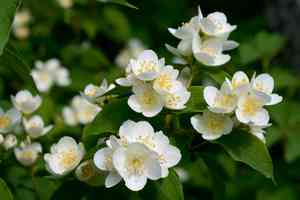
Hoary mock orange(Philadelphus pubescens)

Hoary mock orange (Philadelphus pubescens)

Also known as: Broad-leaved mock-orange

The Hoary mock orange (Philadelphus pubescens) is a deciduous shrub celebrated for its aromatic white blooms that appear from late spring to early summer. It generally grows to a height of 6-10 feet and has a robust, upright form. The leaves are oval, dark green, and have a subtly hairy texture underneath.

**Key Characteristics:**
1. **Fragrant Blooms**: Produces clusters of sweet-smelling, white flowers.
2. **Leaf Texture**: Oval leaves with a slightly hairy underside.
3. **Growth Form**: Upright branches with a bushy habit.

**Ideal Growing Conditions:**
1. **Light**: Prefers full sun to partial shade.
2. **Soil**: Performs best in well-drained, fertile soil but is quite adaptable.
3. **Water Needs**: Requires moderate watering; soil should remain moist but not soggy.
4. **Hardiness**: Suitable for USDA zones 4-8.

Pruning after the flowering season can help maintain its shape and promote healthy growth.

Attributes of Hoary mock orange

Lifespan
Perennial
Plant Type
Shrub
Plant Height
1.2 m to 3 m
Spread
4-8 feet
Leaf Color
Green
Flower Size
1-2 inches
Flower Color
White

ForwardPlant - Identify plants with a snap

Identify and diagnose plants, get toxicity alerts, and explore safety guides for all types of fungi.

Try for Free

Images of Hoary mock orange

Hoary mock orange(Philadelphus pubescens)

Quickly Identify Hoary mock orange

1
To identify Philadelphus pubescens, look for its arching branches, oval to lance-shaped leaves with fine hairs on the underside, and clusters of four-petaled, white fragrant flowers.

Scientific Classification of Hoary mock orange

Phylum
Vascular plants
Class
Dicotyledons
Order
Cornales
Family
Hydrangea
Genus
Mock oranges
Species
Hoary mock orange

Planting and Growing of Hoary mock orange

Care Difficulty
Easy
Watering Schedule
Every 2 days
Sunlight Requirements
Partial sun
Sunshine Duration
6-10 hours
Ideal Temperature
60-75℉
Soil Type
Potting Mix
Soil pH
6.5-7.5
Fertilizer Type
Balanced
Pruning Season
Spring, Summer
Pruning Area
Branches, Leaves
Pruning Frequency
2 times a year
Repotting Season
Spring
Pot Type
Plastic, Ceramic

water icon How to Water Hoary mock orange?

Philadelphus pubescens thrives when its soil is kept moderately moist. Aim for about 500ml of water per session, ensuring that it penetrates deeply into the soil. Water until the topsoil feels moist but not waterlogged, allowing any excess water to drain away.
What are the symptoms of an underwatered Hoary mock orange?
What should I do if my Hoary mock orange is not getting enough water?
What are the symptoms of an overwatered Hoary mock orange?
How to save an overwatered Hoary mock orange?

sunlight icon What Are the Sunlight Requirements for Hoary mock orange?

Sunlight Requirements: Partial sun
Duration of light: 4-6 hours daily
Philadelphus pubescens thrives in partial sun, requiring moderate sunlight exposure to maintain health and support prolific flowering.
What is the ideal light condition for Philadelphus pubescens?
How can I achieve these lighting conditions?
What are the benefits of ideal light conditions for this plant?

temperature icon What Is the Ideal Temperature Range for Hoary mock orange?

Ideal Temperature: 60 ~ 75℉
The ideal temperature range for Philadelphus pubescens, between 60°F and 75°F, ensures proper growth and flowering. This temperature range allows for optimal metabolic activity and cellular function, crucial for the plant's health.

soil icon What Soil is Best for Hoary mock orange?

Soil type: Loam, Sandy loam
Soil PH: 6.5 ~ 7.5
Philadelphus pubescens thrives in well-drained soil to prevent root rot and ensure healthy growth. A well-drained soil allows excess water to escape, which is crucial for maintaining the balance of moisture and nutrients. While drainage is crucial, the soil should retain some moisture to prevent the plant from drying out. Adequate moisture helps in sustaining the plant's lush, green foliage and supports its flowering phase. Philadelphus pubescens prefers a fertile loamy texture that is enriched with organic matter. This ensures robust growth by providing the plant with essential nutrients and creating a hospitable environment for root expansion.

fertilize icon How to Fertilize Hoary mock orange?

Fertilizer type: Balanced
For Philadelphus pubescens, a balanced fertilizer with equal parts nitrogen, phosphorus, and potassium (e.g., 10-10-10) is ideal. When using liquid fertilizer, dilute it to half the recommended strength and apply about 250-500 ml per plant. Solid fertilizers should be applied as per the package instructions, typically around 50 grams per application for a mature bush.

prune icon How to Prune Hoary mock orange?

Pruning Time: Spring, Summer
Be aware that most flowering occurs on growth from the previous year, so take care not to over-prune and remove potential blooms. Keep the natural shape of the shrub in mind, avoiding excessive cutting that might make it look unbalanced or sparse. Always wear gloves and goggles when pruning to protect yourself from sharp branches and falling debris. Consider fertilizing after pruning to help the plant recover and stimulate robust new growth.

propagate icon How to Propagate Hoary mock orange plant?

Propagate Time: Spring,Early spring,Late spring
1
To propagate by seed, first collect seeds from the Philadelphus pubescens fruit after it ripens in autumn. Clean and dry them before planting to ensure better germination rates.
2
Select healthy, mature stems from the plant in early spring or late spring. Trim the cutting to about 4-6 inches and remove any leaves from the lower half to prepare it for rooting.
3
For layering, choose a low-lying branch and slightly wound it. Bury a part of the branch into the soil while keeping the endpoint above ground, which encourages root development over several months.

repot icon How to Repot Hoary mock orange plant?

Repotting frequency: Every 2-3 years
1
Philadelphus pubescens typically needs repotting when you see roots poking out of the bottom drainage holes, or when the plant's growth has noticeably slowed down despite optimal conditions. These are sure signs that the plant is becoming pot-bound, or the soil has become compacted and less effective at providing necessary nutrients.
2
Select a pot that is one size larger than the current one with good drainage holes. A slightly larger pot will prevent water from sitting around the roots and causing rot, while still allowing enough space for the roots to grow freely. Opt for pots made of breathable materials like terracotta to aid in moisture control.
3
Use a well-draining, fertile soil mix. This is vital as Philadelphus pubescens thrives in soils that allow water to percolate but retain enough moisture and nutrients for growth. A well-chosen soil mix provides good structure for root development while ensuring air and water movement, preventing soggy conditions.

ForwardPlant - Identify plants with a snap

Find the best spots for them to optimize their health, simply using your phone.

Try for Free

