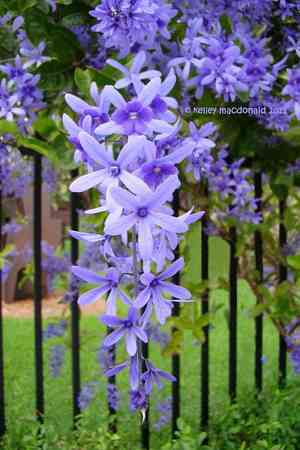
Queen's wreath (Petrea volubilis)
Also known as: Nilmani
Queen's wreath (Petrea volubilis) is a perennial vine indigenous to Central America and the Caribbean. Valued for its decorative appeal, it thrives in gardens globally. The plant blooms with distinctive star-shaped purple flowers during late spring and early summer. The genus name "Petrea" commemorates Lord Robert James Petre, a notable British horticulturist from the 17th century.
In This Article
Attributes of Queen's wreath
Lifespan
Perennial
Plant Type
Vine, Shrub
Plant Height
5 m
Spread
1.8 m to 3 m
Leaf Color
Green
Flower Size
2.5 cm to 5 cm
Flower Color
Purple Lavender
Images of Queen's wreath
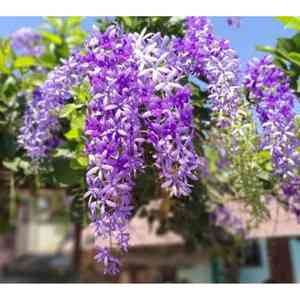
Quickly Identify Queen's wreath
1
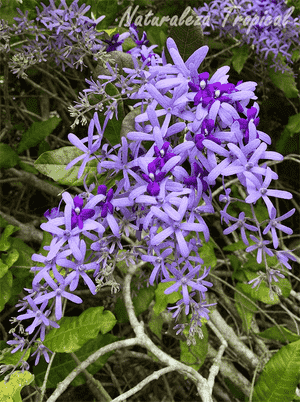
Elliptical dark green leaves up to 8 inches (20 cm) long.
2
Cascading racemes of tubular blue flowers, roughly 1 foot (30 cm) long.
3
Coarse textured leaves similar to sandpaper.
4
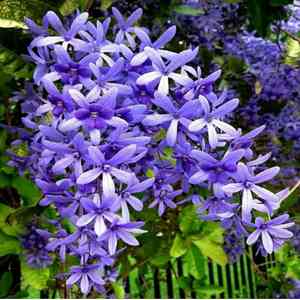
Purple star-shaped flowers with lighter purple calyx persisting after petals fall.
5
Prominent vein pattern running parallel to leaf margins.
Scientific Classification of Queen's wreath
Phylum
Vascular plants
Class
Dicotyledons
Order
Lamiales
Family
Verbena
Genus
Petrea
Species
Queen's wreath
Planting and Growing of Queen's wreath
Care Difficulty
Easy
Watering Schedule
Every 4 days
Sunlight Requirements
Full sun
Sunshine Duration
6-12 hours
Ideal Temperature
65-85℉
Soil Type
Potting Mix, Peat Mix
Soil pH
6.5-7.5
Fertilizer Type
Balanced
Pruning Season
Spring, Summer
Pruning Area
Branches, Leaves
Pruning Frequency
Once a year
Repotting Season
Spring
Pot Type
Plastic, Ceramic
 How to Water Queen's wreath?
Petrea volubilis, also known as the Queen's Wreath, enjoys thorough watering. In general, provide around 500 milliliters of water each session, ensuring the soil is moist but not waterlogged. Water until you notice it beginning to drain from the bottom of the pot.
What are the symptoms of an underwatered Queen's wreath?
›
What should I do if my Queen's wreath is not getting enough water?
›
What are the symptoms of an overwatered Queen's wreath?
›
How to save an overwatered Queen's wreath?
›
 What Are the Sunlight Requirements for Queen's wreath?
Petrea volubilis prefers a full sun to partial sun range. Ideal conditions involve placing the plant in an environment where it receives ample sunlight for robust blooming and foliage health.
More About Sunlight Requirements Techniques→
What are the ideal lighting conditions?
›
How can I ensure ideal light exposure?
›
What benefits does proper lighting provide?
›
 What Is the Ideal Temperature Range for Queen's wreath?
For optimal growth, Petrea volubilis thrives best when kept in temperatures ranging from 65°F to 85°F. This range simulates the warm, tropical environments that the plant is native to. Maintaining a consistent temperature within this range ensures robust growth and prolific blooming. Slight deviations can be tolerated, but keeping conditions stable will result in the healthiest plants.
 What Soil is Best for Queen's wreath?
Petrea volubilis thrives in well-draining soil. This is crucial as it prevents waterlogging, which could lead to root rot. A well-draining soil ensures the roots get enough oxygen and allows excess water to flow away, keeping the plant healthy. This plant flourishes best in a nutrient-rich medium. Such soil provides essential nutrients that support vigorous growth and prolific flowering. Ensuring that the soil is rich in organic matter can boost the overall health and aesthetic appeal of the Petrea volubilis. Keeping the soil pH between 6.5 and 7.5 is ideal for Petrea volubilis. Such a pH range ensures optimal nutrient uptake and prevents nutrient lockout. It helps maintain balance, allowing the plant to access the full spectrum of nutrients required for its development.
 How to Fertilize Queen's wreath?
For Petrea volubilis, it is essential to apply the right amount of fertilizer to ensure healthy growth. For liquid fertilizer, use a balanced mix diluted to half strength; typically, 1 tablespoon per gallon of water is sufficient. Be careful not to over-fertilize, as this can harm the plant.
 How to Prune Queen's wreath?
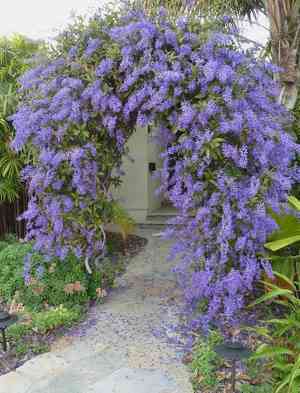
Begin by removing any dead, damaged, or diseased branches. This not only keeps the plant healthy but also prevents the spread of disease. Use sterilized pruning shears for clean cuts. Prune back new growth by up to one-third to promote a denser and more compact form. This helps the plant to conserve energy and focus on developing stronger branches and more vibrant blooms. If you want your Petrea volubilis to follow a particular shape, such as a trellis or arch, regular pruning will help guide its growth. Be mindful of the plant's natural growing tendencies to ensure a harmonious shape.
More About Pruning Techniques→
 How to Propagate Queen's wreath plant?
1
Select healthy, non-flowering stems that are about 4-6 inches long. Make sure to cut just below a node to optimize growth potential.
2
Dip the cut end of the stem in rooting hormone to encourage root development. Shake off excess hormone to prevent clumping.
3
Insert the hormone-treated stem into a pot filled with a moist potting mix. Ensure it is planted deep enough to stand upright securely.
 How to Repot Queen's wreath plant?
1
Petrea volubilis should be repotted when you notice roots protruding from the drainage holes, growth slowdown, or when the soil seems compacted and waterlogged. These signs indicate that the plant needs more space and a refreshed growing medium to thrive.
2
Select a pot that is at least one size larger than the current one, ensuring it has drainage holes. Terracotta pots are excellent as they allow for aeration and help to prevent overwatering by letting moisture evaporate. The right pot should promote healthy root growth and prevent root rot.
3
Use a well-draining potting mix with added perlite or sand to ensure good aeration. This soil choice prevents waterlogging and provides the necessary support and nutrients the plant requires, allowing the roots to spread and anchor firmly.
Learn More About Queen's wreath Diseases
Anthracnose
Bacterial Leaf Spot
Bacterial Soft Rot
Bacterial Wilt
Black Spot
Chemical Injury
Crown Gall
Damping-off
Downy Mildew
Drought Stress
Fusarium Wilt
Gray Mold
Leaf Spot
Mosaic
Nutrient Deficiency
Nutrient Toxicity
Powdery Mildew
Root Rot
Root-knot Nematode
Rusts
Sooty Mold
Spider Mites
Temperature Stress
Thrips Damage
White Mold



