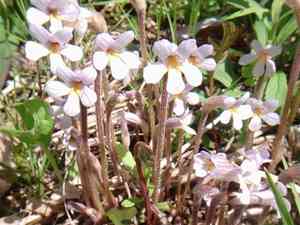
Whorled lousewort (Pedicularis verticillata)
Also known as: Whorled lousewort
Whorled lousewort is a semi-parasitic plant that derives nutrients from the roots of nearby plants. While it may resemble dead-nettle species in terms of flower appearance, it can be distinguished by its leaf structure. Whorled lousewort's leaves are lobed and often appear as if they are composed of several smaller leaves.
In This Article
Attributes of Whorled lousewort
Lifespan
Perennial
Plant Type
Herb
Plant Height
15 cm to 35 cm
Spread
The plant does not form a crown; leaf whorls span approximately 10-20 cm in diameter.
Leaf Color
Green
Flower Size
4 mm to 7 mm
Flower Color
Pink Purple
Images of Whorled lousewort
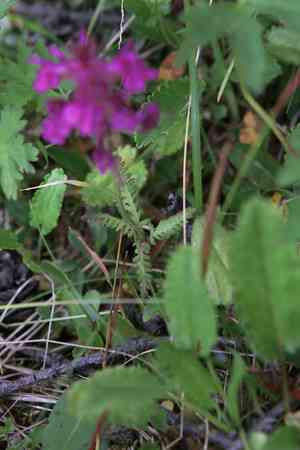
Quickly Identify Whorled lousewort
1
To identify Pedicularis verticillata, look for its whorled leaves that are arranged in circles around the stem, and its tubular, bilabiate flowers which are usually pink, purple, or occasionally white. The plant typically grows in moist, alpine or subalpine meadows.
Scientific Classification of Whorled lousewort
Phylum
Vascular plants
Class
Dicotyledons
Order
Lamiales
Family
Broomrape
Genus
Pedicularis
Species
Whorled lousewort
Planting and Growing of Whorled lousewort
Care Difficulty
Hard
Watering Schedule
Every 6 days
Sunlight Requirements
Partial sun
Sunshine Duration
6-10 hours
Ideal Temperature
60-70℉
Soil Type
Potting Mix, Peat Mix
Soil pH
5.5-7
Fertilizer Type
Balanced
Pruning Season
Spring, Summer
Pruning Area
Branches, Leaves
Pruning Frequency
2 times a year
Repotting Season
Spring
Pot Type
Plastic, Ceramic
 How to Water Whorled lousewort?
For Pedicularis verticillata, it's crucial to maintain soil moisture without creating waterlogged conditions. Watering should be thorough enough to keep the soil evenly moist but not soggy. Aim for around 250 ml per watering session, ensuring the water reaches the root zone but does not sit in a stagnant pool.
What are the symptoms of an underwatered Whorled lousewort?
›
What should I do if my Whorled lousewort is not getting enough water?
›
What are the symptoms of an overwatered Whorled lousewort?
›
How to save an overwatered Whorled lousewort?
›
 What Are the Sunlight Requirements for Whorled lousewort?
Partial sun exposure, involving a mix of sun and shade, is perfect. It helps Pedicularis verticillata maintain its vibrant colors and encourages robust flowering by balancing energy needs and protecting from harsh rays.
More About Sunlight Requirements Techniques→
How much light does Pedicularis verticillata need?
›
What are the optimal conditions for light exposure?
›
What are the benefits of ideal lighting?
›
 What Is the Ideal Temperature Range for Whorled lousewort?
For optimal growth, Pedicularis verticillata prefers a temperature range of 60°F to 70°F. This range ensures that the plant's physiological processes, including photosynthesis and respiration, are operating efficiently. Maintaining this temperature range can lead to robust plant health and vibrant flowering.
 What Soil is Best for Whorled lousewort?
Pedicularis verticillata thrives in well-draining loam or sandy loam soils that prevent waterlogging. These soil types ensure optimal root oxygenation and prevent root diseases, promoting healthy plant growth. Rich in nutrients, loam and lightly acidic soils provide the necessary minerals for the vibrant growth of Pedicularis verticillata. This nutrient-rich environment supports sustained blooming and robust plant development. A balanced moisture retention capability, as seen in loamy soils, ensures that Pedicularis verticillata receives adequate hydration without oversaturation. This balance supports steady growth and prevents stress due to fluctuating moisture levels.
 How to Fertilize Whorled lousewort?
For Pedicularis verticillata, a balanced approach to fertilization is crucial. Liquid fertilizers should be applied at half-strength to avoid any stress on the plant, using approximately 1 teaspoon per gallon of water. When using slow-release fertilizers, apply 1 tablespoon around the base of the plant to ensure a steady release of nutrients over time.
 How to Prune Whorled lousewort?
Start by identifying any dead or damaged stems in the plant. Dead stems can be recognized by their brittle texture and lack of green hue. Cut these back to the nearest healthy node to encourage new, robust growth. After removing dead or damaged stems, begin shaping the plant. Trim back any wayward or excessively long stems to maintain a harmonious shape. This not only enhances its appearance but also ensures that sunlight reaches all parts of the plant evenly.
More About Pruning Techniques→
 How to Propagate Whorled lousewort plant?
1
Fill your seed trays with a fine seed-starting mix, ensuring it’s well-moistened but not waterlogged. Lightly press the surface flat. This step provides a strong foundation for seed germination.
2
Scatter the seeds thinly across the surface of the mix, covering them lightly with a thin layer of additional mix. Label each tray with the plant's name and the sowing date to track growth progress.
3
Select healthy stems, cut about 4-6 inches long. Remove leaves from the lower half. Dip the end into rooting hormone powder to encourage root development before planting in a sterile medium.
 How to Repot Whorled lousewort plant?
1
The best time to repot Pedicularis verticillata is when you notice that the roots are growing out of the drainage holes or when the plant appears to be growing slower than usual. These signs indicate that the plant has outgrown its current pot and needs more space to thrive.
2
Select a pot that is about one to two inches larger in diameter than the current one. This size allows ample space for root growth without overwhelming the plant. Opting for a pot with drainage holes can prevent root rot by allowing excess water to escape.
3
Use a well-draining sandy soil mix to ensure that water does not pool at the roots, which could lead to root rot. Sandy soil mimics the natural habitat of Pedicularis verticillata, providing a supportive environment that enhances nutrient uptake.
Learn More About Whorled lousewort Diseases
Anthracnose
Bacterial Leaf Spot
Bacterial Soft Rot
Bacterial Wilt
Chemical Injury
Cyst Nematode
Damping-off
Downy Mildew
Drought Stress
Fusarium Wilt
Gray Mold
Leaf Spot
Mosaic
Nutrient Deficiency
Nutrient Toxicity
Powdery Mildew
Root Rot
Root-knot Nematode
Rusts
Sooty Mold
Spider Mites
Temperature Stress
Thrips Damage
White Mold



