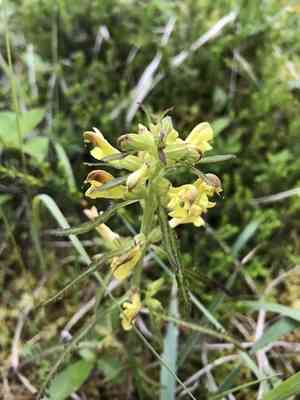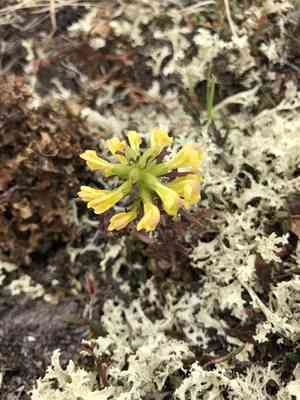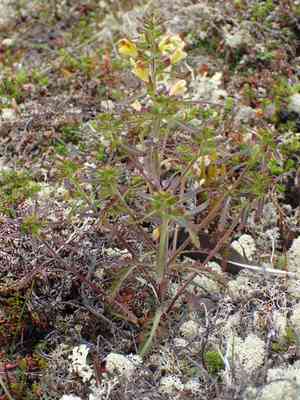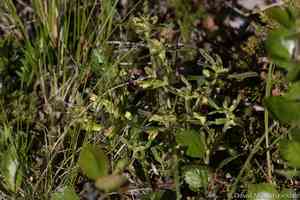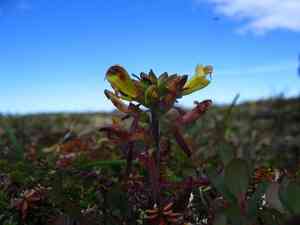
Labrador lousewort(Pedicularis labradorica)

Labrador lousewort (Pedicularis labradorica)

Also known as: Labrador lousewort

The Labrador lousewort (Pedicularis labradorica) is a resilient perennial herb well-suited for the moist, alpine regions it inhabits. Its survival is bolstered by several key traits:

1. **Robust Perennial Nature**: This allows it to endure year-round harsh conditions and make the most of the short growing season.
2. **Distinctive Floral Structure**: It produces striking yellow flowers with a slipper-like shape and a hooded back, which bloom from mid to late summer and attract pollinators.
3. **Leaf Adaptations**: The plant has lance-shaped leaves with serrated edges, which likely play a role in efficient water use and protection against herbivory.
4. **Growth Habit**: It maintains a low and compact form, reducing exposure to strong alpine winds and conserving heat.
5. **Hemiparasitic Abilities**: By parasitizing the roots of neighboring plants, it gains additional nutrients essential for survival in nutrient-poor soils.

These adaptations collectively enable the Labrador lousewort to thrive in the challenging conditions of its alpine habitat.

Attributes of Labrador lousewort

Lifespan
Perennial
Plant Type
Herb
Plant Height
10-40 cm
Spread
Not applicable, as it does not form a canopy
Leaf Color
Green
Flower Size
0.5-1 cm
Flower Color
Purple, Pink

ForwardPlant - Identify plants with a snap

Identify and diagnose plants, get toxicity alerts, and explore safety guides for all types of fungi.

Try for Free

Images of Labrador lousewort

Labrador lousewort(Pedicularis labradorica)

Quickly Identify Labrador lousewort

1
This plant can be identified by its distinctive tubular flowers that range in color from purple to pink, and its finely divided, fern-like leaves. It typically grows in tundra regions and moist, rocky slopes.

Scientific Classification of Labrador lousewort

Phylum
Vascular plants
Class
Dicotyledons
Order
Lamiales
Family
Broomrape
Genus
Pedicularis
Species
Labrador lousewort

Planting and Growing of Labrador lousewort

Care Difficulty
Moderate
Watering Schedule
Every 2 days
Sunlight Requirements
Partial sun
Sunshine Duration
6-10 hours
Ideal Temperature
50-65℉
Soil Type
Potting Mix, Peat Mix
Soil pH
5.5-6.5
Fertilizer Type
Balanced
Pruning Season
Spring, Summer
Pruning Area
Branches, Leaves
Pruning Frequency
2 times a year
Repotting Season
Spring
Pot Type
Plastic, Ceramic

water icon How to Water Labrador lousewort?

For Pedicularis labradorica, it's crucial to mimic its natural habitat by ensuring soil moisture without waterlogging. Ideally, water it with about 250 ml of water, ensuring the soil is moist but not soggy, allowing excess water to drain completely.
What are the symptoms of an underwatered Labrador lousewort? ›
What should I do if my Labrador lousewort is not getting enough water? ›
What are the symptoms of an overwatered Labrador lousewort? ›
How to save an overwatered Labrador lousewort? ›

sunlight icon What Are the Sunlight Requirements for Labrador lousewort?

Sunlight Requirements: Partial sun
Duration of light: 4-6 hours
Partial sun exposure for Pedicularis labradorica fosters optimal health, mimicking natural woodland light conditions. This balance prevents stress and supports vibrant growth and blooming cycles.
What is the recommended lighting for Pedicularis labradorica? ›
How can I ensure my Pedicularis labradorica gets ideal sunlight? ›
What are the benefits of ideal lighting for Pedicularis labradorica? ›

temperature icon What Is the Ideal Temperature Range for Labrador lousewort?

Ideal Temperature: 50 ~ 65℉
The ideal temperature range for Pedicularis labradorica spans from 50°F to 65°F. This range is optimal for the plant's metabolic processes and growth. Within this temperature bracket, the plant can effectively carry out photosynthesis, nutrient uptake, and cellular functions. Maintaining temperatures within this range ensures robust growth and healthy development, mimicking the plant's native environmental conditions.

soil icon What Soil is Best for Labrador lousewort?

Soil type: Loam, Acidic soil, Peat soil
Soil PH: 5.5 ~ 6.5
Pedicularis labradorica prefers moist but well-drained soil, which helps to prevent root rot while maintaining necessary hydration levels. This balance allows for optimal root health and nutrient absorption. Soil rich in organic matter or nutrients supports the lush growth of Pedicularis labradorica. Enriched soils provide essential minerals needed for vibrant foliage and successful flowering. Proper soil aeration is crucial for Pedicularis labradorica, assisting in the exchange of gases and enhancing root respiration. This facilitates strong root systems and better plant vitality.

fertilize icon How to Fertilize Labrador lousewort?

Fertilizer type: Balanced
For Pedicularis labradorica, the fertilizer amount should be moderate. Utilize a balanced 10-10-10 liquid fertilizer, diluted to half strength, ensuring the nitrogen, phosphorus, and potassium are evenly distributed. This supports foliage, root development, and flowering without overwhelming the plant.

prune icon How to Prune Labrador lousewort?

Pruning Time: Spring, Summer
Begin by inspecting your Pedicularis labradorica for any dead or diseased stems. Use clean, sharp pruning shears to cut these stems back to a healthy part of the plant to promote recovery. Next, remove any stems that are crossing or rubbing against each other to improve airflow and prevent future damage. Trim back overgrown areas to maintain the plant’s natural shape, but take care not to remove more than one-third of the plant's growth at any one time to avoid stress. More About Pruning Techniques→

propagate icon How to Propagate Labrador lousewort plant?

Propagate Time: Late spring,Early summer
1
Fill the seed tray with a well-draining potting mix, ensuring it is uniform and free of clumps. Lightly water the mix so it's damp but not waterlogged. This step ensures the medium is ready to support seed germination.
2
Distribute the seeds evenly across the surface of the potting mix. Lightly cover them with a thin layer of additional potting mix or vermiculite to protect the seeds while allowing light penetration, which some seeds might require for germination.
3
Place the seed tray in a location with consistent temperatures around 20°C (68°F) and indirect light. Moisture should be maintained by regular misting or using a humidity dome to prevent the soil from drying out, promoting successful seed germination.
More About Propagating Techniques→

repot icon How to Repot Labrador lousewort plant?

Repotting frequency: Every 1-2 years
1
Pedicularis labradorica signals the need for repotting through root-bound symptoms and stunted growth. The optimal time is during the growing seasons of spring and autumn when the plant can easily recover from the stress. Look for roots showing at the bottom of the pot or emerging above the soil surface as these are clear signs it's time for a new home.
2
Choose a pot that is one size larger, with adequate drainage holes to prevent waterlogging. Terracotta pots can be a good choice due to their porous nature, allowing airflow around the roots. The right pot facilitates healthier root growth and prevents the common issue of root rot, keeping your plant thriving.
3
Opt for a well-draining, loamy soil mix to provide the necessary nutrients and good drainage. Adding perlite or sand can enhance drainage and aeration. This type of soil ensures the roots get enough air and do not sit in water, which helps in keeping the plant healthy and vigorous.

ForwardPlant - Identify plants with a snap

Find the best spots for them to optimize their health, simply using your phone.

Try for Free