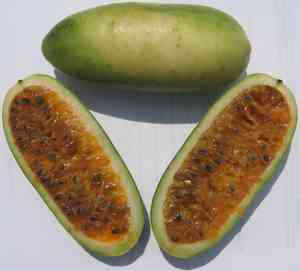
Banana passionflower (Passiflora mollissima)
Also known as: Banana poka, Tasco
The plant you’re describing is the "Banana Passionfruit" (Passiflora mollissima). This Andean native features striking pink flowers that are highly attractive to hummingbirds. It yields edible fruits that resemble small bananas and have a tangy, sweet taste. Besides its culinary uses in jams and desserts, the plant also holds medicinal value.
In This Article
Attributes of Banana passionflower
Lifespan
Perennial
Plant Type
Fern
Plant Height
8 m
Spread
3 m
Leaf Color
Green
Flower Size
10 cm to 13 cm
Flower Color
Pink White
Images of Banana passionflower
Quickly Identify Banana passionflower
1
Identify Passiflora mollissima by its vigorous climbing habit, trilobed leaves, deep pink tubular flowers, and elongated, yellow to orange fruits resembling small bananas.
Scientific Classification of Banana passionflower
Phylum
Vascular plants
Class
Dicotyledons
Order
Malpighiales
Family
Passionflowers
Genus
Passion flowers
Species
Banana passionflower
Planting and Growing of Banana passionflower
Care Difficulty
Easy
Watering Schedule
Every 4 days
Sunlight Requirements
Partial sun
Sunshine Duration
4-8 hours
Ideal Temperature
60-75℉
Soil Type
Potting Mix, Peat Mix
Soil pH
5.5-6.5
Fertilizer Type
Balanced
Pruning Season
Spring, Summer
Pruning Area
Branches, Leaves
Pruning Frequency
2 times a year
Repotting Season
Spring
Pot Type
Plastic, Ceramic
 How to Water Banana passionflower?
Passiflora mollissima prefers a consistently moist soil. Watering should be done until the water begins to drain from the bottom of the pot, ensuring that the entire root system is well hydrated without any waterlogging, allowing for proper aeration.
What are the symptoms of an underwatered Banana passionflower?
›
What should I do if my Banana passionflower is not getting enough water?
›
What are the symptoms of an overwatered Banana passionflower?
›
How to save an overwatered Banana passionflower?
›
 What Are the Sunlight Requirements for Banana passionflower?
Passiflora mollissima ideally enjoys partial to full sun conditions, favoring around 4 to 6 hours of sunlight per day. Adequate light enhances its growth potential and flowering capacity, promoting vibrant foliage and robust health.
More About Sunlight Requirements Techniques→
What is the best lighting condition for Passiflora mollissima?
›
How can one provide the ideal lighting for this plant?
›
Why is ideal lighting crucial for this plant's health?
›
 What Is the Ideal Temperature Range for Banana passionflower?
For Passiflora mollissima, maintaining an ideal temperature range between 60°F and 75°F provides optimal growing conditions. During this temperature range, the plant can perform crucial physiological functions such as photosynthesis and nutrient uptake efficiently, promoting vigorous growth and healthy flowering. Any fluctuations outside this range can stress the plant and hamper its development.
 What Soil is Best for Banana passionflower?
Passiflora mollissima thrives in well-drained soil that prevents waterlogging. This condition facilitates proper root aeration, vital for its health and growth, allowing essential nutrients to be effectively absorbed by the plant. Moderately fertile soil with organic matter supports robust growth for Passiflora mollissima. Nutrient-rich substrates ensure the plant receives ample nutrition for flowering and fruiting, resulting in healthier and more vigorous vines. Soil that retains moisture without becoming waterlogged is ideal for Passiflora mollissima. Maintaining adequate moisture is crucial to support the plant's constant need for hydration, promoting sustained growth and vitality.
 How to Fertilize Banana passionflower?
When fertilizing Passiflora mollissima, aim for a balanced approach using a 10-10-10 NPK formulation. For liquid fertilizer, use 1/2 teaspoon per gallon of water. Apply this mixture evenly across the soil to ensure optimal nutrient absorption.
 How to Prune Banana passionflower?
Start by identifying dead or diseased stems and remove them using clean, sharp pruning shears. Next, trim back any overgrown or tangled vines to improve air circulation and sunlight penetration. Ensure each cut is clean and just above a node to encourage new shoots. Passiflora mollissima, also known as the banana passionfruit, can be quite vigorous. To manage its growth, focus on cutting back the older vines significantly. This will rejuvenate the plant, keeping it both manageable and productive in its growth habit.
More About Pruning Techniques→
 How to Propagate Banana passionflower plant?
1
To propagate Passiflora mollissima from seeds, start by soaking the seeds in warm water for 24 hours to break dormancy. This helps to speed up germination by softening the seed coat.
2
For cutting propagation, select healthy and non-flowering stems. Cut a segment about 4-6 inches long, ensuring it includes several nodes. Remove leaves from the lower half to reduce water loss.
3
Dip the cut end of the cutting in rooting hormone to promote faster root development. Plant it in a well-draining potting mix, and maintain consistent moisture by covering with a plastic bag.
 How to Repot Banana passionflower plant?
1
For Passiflora mollissima, repotting is best done when you observe roots growing out of the pot's drainage holes or when the plant becomes too large and starts to lose vigor. This typically indicates the current pot is too small and it's time for more space.
2
Select a pot that is about 2 inches bigger in diameter than the current one, ensuring it has ample drainage holes. This choice will provide the plant with enough room to grow, support healthy root development, and prevent waterlogging.
3
Opt for a rich, well-draining soil mix that can retain moisture yet still offer good aeration. A mix with added perlite or sand is ideal, as it keeps the roots healthy by preventing soil compaction and improving drainage.
Toxicity
Ingestion
WARNING
The judgment on toxicity and danger is for reference only. We DO NOT GUARANTEE any accuracy of such judgment. Therefore, you SHALL NOT rely on such judgment. It is IMPORTANT TO SEEK PROFESSIONAL ADVICE in advance when necessary.
Learn More About Banana passionflower Diseases
Anthracnose
Bacterial Leaf Spot
Bacterial Soft Rot
Bacterial Wilt
Chemical Injury
Crown Gall
Damping-off
Downy Mildew
Drought Stress
Fusarium Wilt
Gray Mold
Leaf Curl
Leaf Spot
Mosaic
Nutrient Deficiency
Nutrient Toxicity
Powdery Mildew
Root Rot
Root-knot Nematode
Rusts
Sooty Mold
Spider Mites
Temperature Stress
Thrips Damage
White Mold



